
Artificial intelligence is transforming how modern businesses manage their supply chains, and ChatGPT is becoming one of the most practical AI tools available today. From demand forecasting and inventory planning to supplier communication and logistics management, ChatGPT helps organizations streamline operations, improve efficiency, and make faster decisions. In this article, we’ll explore the most valuable supply chain management use cases of ChatGPT, along with its benefits, challenges, and future potential in supply chain optimization.
How ChatGPT Is Transforming Supply Chain Management
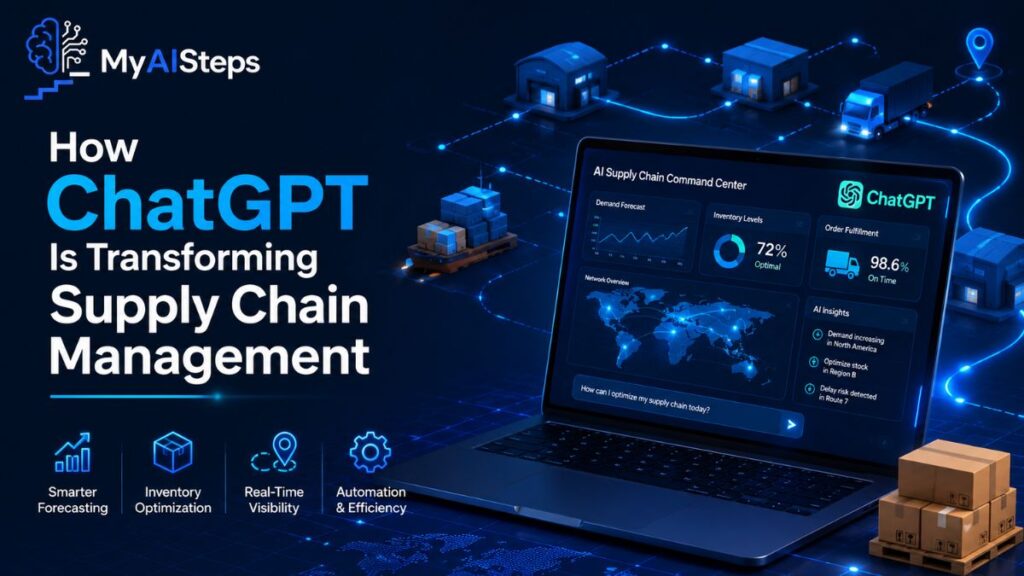
The modern supply chain relies heavily on data. Every purchase order, shipment update, supplier interaction, and inventory transaction creates valuable information that organizations must analyze and act upon. However, turning that data into meaningful insights often requires significant time and effort.
This is where ChatGPT is making a noticeable impact.
Unlike traditional software systems that require complex queries or technical expertise, ChatGPT allows users to interact with data using natural language. Supply chain professionals can ask questions, request summaries, generate reports, and receive actionable explanations without needing advanced technical skills.
For example, a logistics manager might ask:
“What were the primary causes of shipping delays last month?”
Instead of manually reviewing spreadsheets and reports, ChatGPT can summarize available information and present key findings in a clear and understandable format.
Key Ways ChatGPT Supports Supply Chain Operations
- Simplifies complex supply chain data
- Automates repetitive administrative tasks
- Improves communication across teams
- Supports operational decision-making
- Assists with reporting and documentation
- Enhances visibility into supply chain performance
- Reduces manual workload for planners and analysts
As organizations continue investing in supply chain automation and AI-powered workflows, ChatGPT serves as a bridge between raw operational data and practical business decisions.
Why This Matters
Today’s supply chains are interconnected ecosystems involving suppliers, manufacturers, warehouses, transportation providers, distributors, and customers. Delays or disruptions in one area can quickly affect the entire network.
By helping teams process information faster and communicate more effectively, ChatGPT contributes to greater agility, improved collaboration, and faster problem-solving across the supply chain.
Demand Forecasting and Inventory Planning with ChatGPT
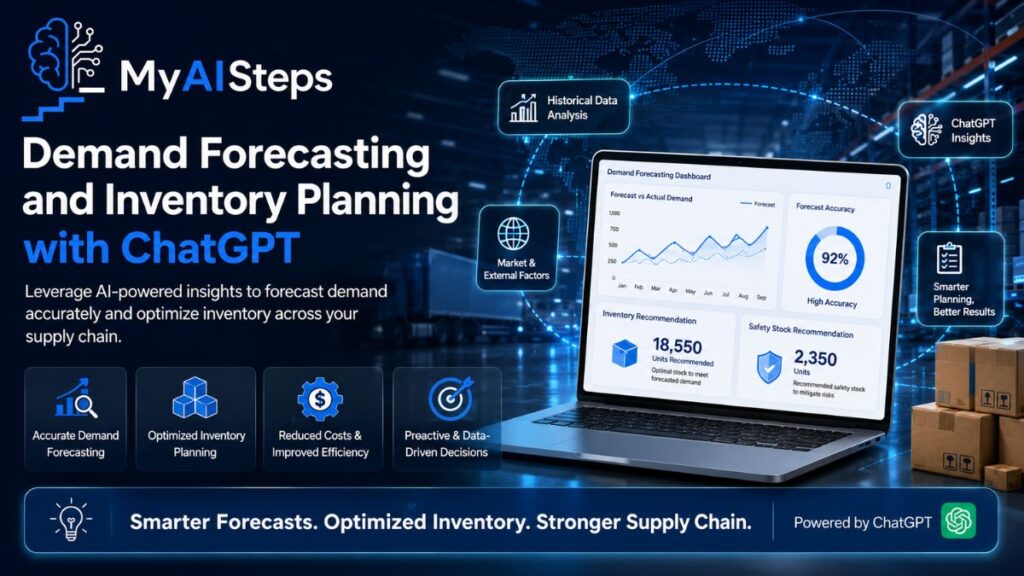
Demand forecasting remains one of the most important functions in supply chain management. Accurate forecasts help businesses maintain optimal inventory levels, reduce carrying costs, and meet customer demand without overstocking products.
However, forecasting is rarely straightforward.
Market trends change quickly. Consumer preferences evolve. Seasonal demand fluctuates. Unexpected disruptions can affect purchasing patterns overnight.
While ChatGPT is not a dedicated forecasting engine, it plays an important supporting role in the forecasting process.
How ChatGPT Helps Demand Planners
Supply chain planners often spend significant time reviewing reports, interpreting forecast results, and communicating findings to stakeholders.
ChatGPT can assist by:
- Summarizing historical sales trends
- Explaining forecasting outputs
- Identifying unusual demand patterns
- Generating forecasting reports
- Supporting scenario analysis
- Translating technical insights into business-friendly language
For instance, if a planner provides sales summaries from multiple quarters, ChatGPT can identify recurring trends and highlight possible factors influencing demand fluctuations.
Scenario Planning and Risk Assessment
One of ChatGPT’s strongest capabilities is helping organizations evaluate potential scenarios.
Examples include:
- What happens if supplier lead times increase by 20%?
- How would inventory levels be affected during peak season?
- What risks could emerge from sudden demand growth?
By generating detailed scenario analyses, ChatGPT helps businesses prepare for uncertainty and improve supply chain resilience.
Supporting Inventory Management
Effective inventory management requires balancing product availability with operational costs.
ChatGPT can support inventory optimization by helping teams:
- Review stock level reports
- Analyze slow-moving inventory
- Identify stockout risks
- Generate replenishment recommendations
- Create inventory performance summaries
Organizations that combine ChatGPT with inventory management software gain additional visibility into stock performance and demand patterns, enabling more informed decisions.
Business Benefits
Using ChatGPT during demand planning can help organizations:
- Improve forecasting communication
- Reduce planning time
- Enhance inventory visibility
- Support data-driven decisions
- Strengthen supply chain agility
Although dedicated forecasting systems remain essential, ChatGPT adds significant value by improving interpretation, collaboration, and reporting.
Using ChatGPT for Supplier Communication and Management
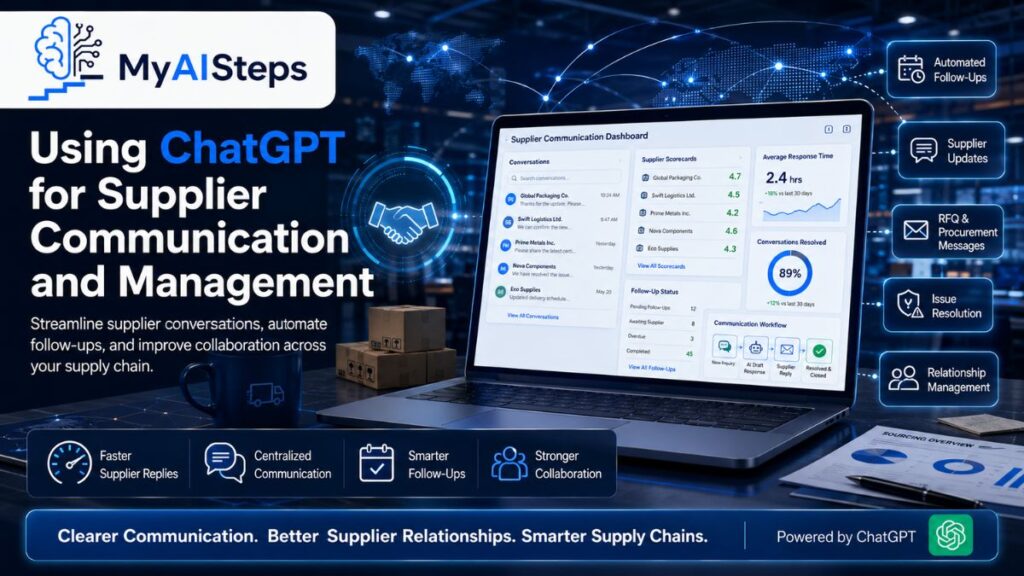
Strong supplier relationships are critical to supply chain success. Whether sourcing raw materials, negotiating contracts, or managing delivery schedules, businesses depend on effective communication with suppliers.
Unfortunately, supplier communication can be time-consuming.
Procurement teams often spend hours drafting emails, reviewing agreements, preparing meeting notes, and coordinating with multiple vendors across different regions.
ChatGPT helps streamline many of these activities.
Automating Supplier Communications
One of the most practical applications of ChatGPT is generating professional supplier correspondence.
Examples include:
- Supplier onboarding emails
- Request for quotation (RFQ) templates
- Vendor follow-up messages
- Performance review communications
- Contract renewal discussions
- Delivery status inquiries
Instead of creating each message from scratch, procurement professionals can provide context and receive a polished draft within seconds.
Supporting Supplier Relationship Management
Supplier relationship management involves much more than communication alone.
ChatGPT can assist teams by:
- Summarizing supplier performance reports
- Creating supplier scorecards
- Preparing meeting agendas
- Organizing contract information
- Generating negotiation talking points
This reduces administrative work and allows procurement professionals to focus on strategic supplier partnerships.
Improving Global Collaboration
Many supply chains involve international suppliers operating in different languages and time zones.
ChatGPT can help improve collaboration by:
- Simplifying technical language
- Supporting multilingual communication
- Creating consistent messaging
- Reducing misunderstandings
As global supply networks continue expanding, these capabilities become increasingly valuable.
Reducing Procurement Workload
Administrative tasks often consume a large portion of a procurement team’s day.
By automating routine communication and documentation, ChatGPT allows procurement professionals to spend more time on:
- Supplier evaluations
- Risk management
- Cost reduction initiatives
- Strategic sourcing
- Contract negotiations
This shift improves productivity while strengthening overall supplier management processes.
ChatGPT for Real-Time Supply Chain Data Analysis
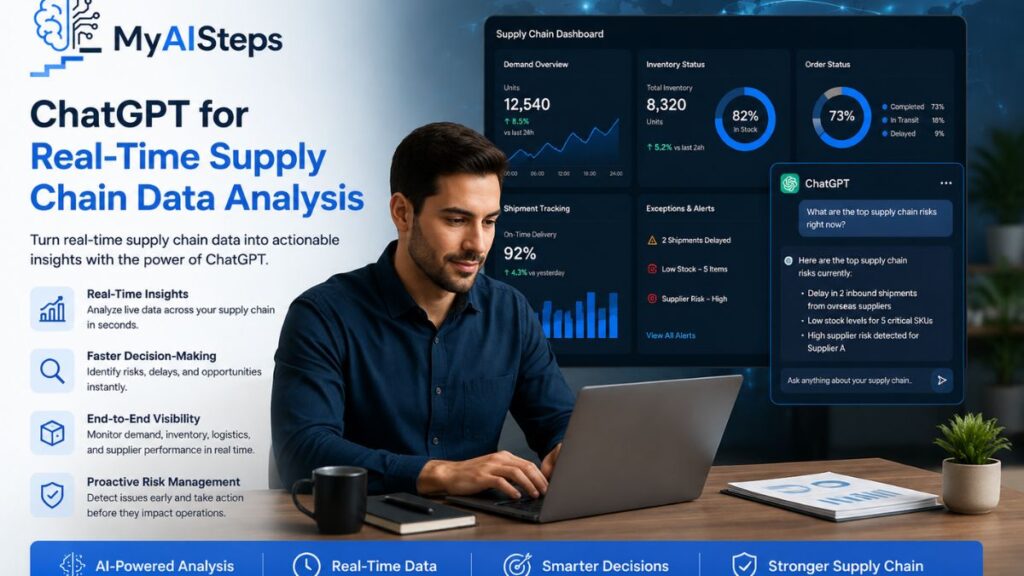
Supply chains generate enormous amounts of operational data every day.
Information flows from:
- Enterprise Resource Planning (ERP) systems
- Transportation Management Systems (TMS)
- Warehouse Management Systems (WMS)
- Supplier portals
- Customer service platforms
- Inventory databases
The challenge isn’t collecting data—it’s interpreting it quickly enough to support business decisions.
ChatGPT helps solve this problem by transforming raw data into actionable insights.
Making Data More Accessible
Many business leaders struggle to extract value from complex reports and spreadsheets.
ChatGPT can analyze structured information and generate clear summaries that answer questions such as:
- Which suppliers experienced the most delays?
- Which warehouse showed the lowest productivity?
- What inventory categories are underperforming?
- Which transportation routes face the highest disruption risk?
This allows teams to focus on decision-making rather than data interpretation.
Improving Supply Chain Analytics
Supply chain analytics plays a major role in operational improvement.
ChatGPT supports analytics initiatives by:
- Summarizing performance metrics
- Identifying recurring operational issues
- Highlighting trends and anomalies
- Generating executive-level reports
- Explaining key performance indicators (KPIs)
As a result, organizations can gain faster visibility into operational performance and respond more effectively to emerging challenges.
Supporting Decision-Making
One of the greatest benefits of conversational AI is its ability to make complex information easier to understand.
Instead of reviewing hundreds of data points, managers can ask direct questions and receive concise answers supported by available information.
This improves:
- Operational visibility
- Decision speed
- Strategic planning
- Cross-functional collaboration
- Risk management
As AI-driven supply chain analytics continues to evolve, tools like ChatGPT are becoming valuable assets for organizations seeking greater efficiency and insight.
Streamlining Procurement Processes with ChatGPT
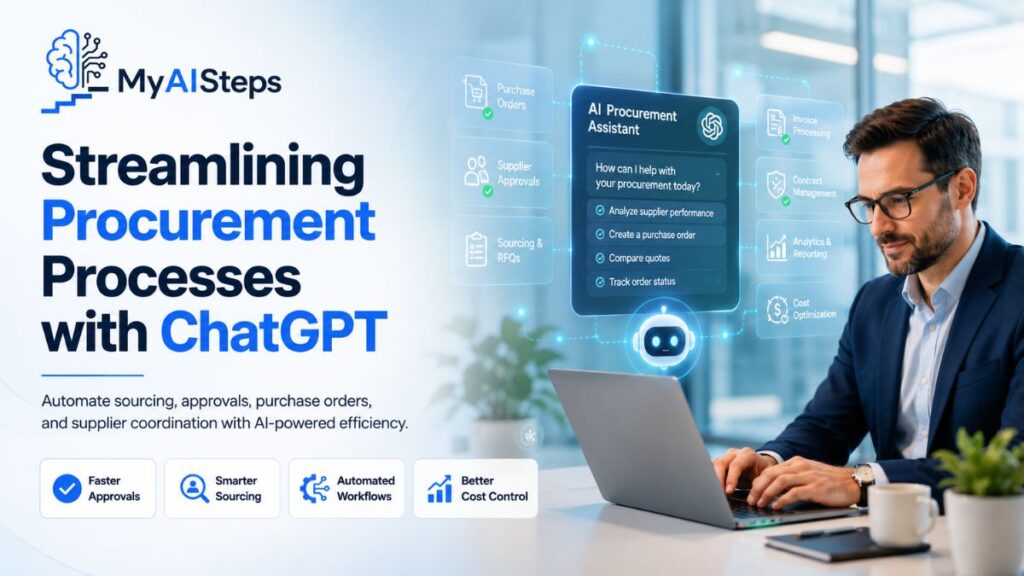
Procurement is one of the most critical functions within supply chain management. Every purchasing decision affects costs, supplier relationships, inventory availability, and overall operational performance. However, procurement teams often spend a significant amount of time on repetitive administrative tasks that slow down productivity.
This is where ChatGPT can provide substantial value.
By automating documentation, simplifying vendor comparisons, and supporting procurement workflows, ChatGPT helps organizations improve efficiency while maintaining greater consistency across purchasing operations.
How ChatGPT Supports Procurement Teams
Procurement professionals can use ChatGPT to:
- Create Request for Proposal (RFP) documents
- Draft Request for Quotation (RFQ) templates
- Summarize supplier contracts
- Compare vendor proposals
- Generate procurement reports
- Organize purchasing requirements
- Support supplier evaluation processes
Instead of manually reviewing multiple supplier submissions, teams can use ChatGPT to create structured comparisons that highlight pricing, lead times, service levels, and potential risks.
Improving Procurement Decision-Making
Modern procurement strategies rely heavily on data-driven decision-making. ChatGPT can help teams interpret purchasing information more effectively by identifying key differences between suppliers and summarizing procurement insights in a clear format.
This enables organizations to:
- Reduce procurement cycle times
- Improve sourcing efficiency
- Enhance supplier selection
- Support cost optimization initiatives
- Increase procurement transparency
As businesses continue pursuing procurement optimization and supply chain automation, conversational AI is becoming a valuable support tool throughout the purchasing process.
Improving Warehouse Operations Through AI Assistance
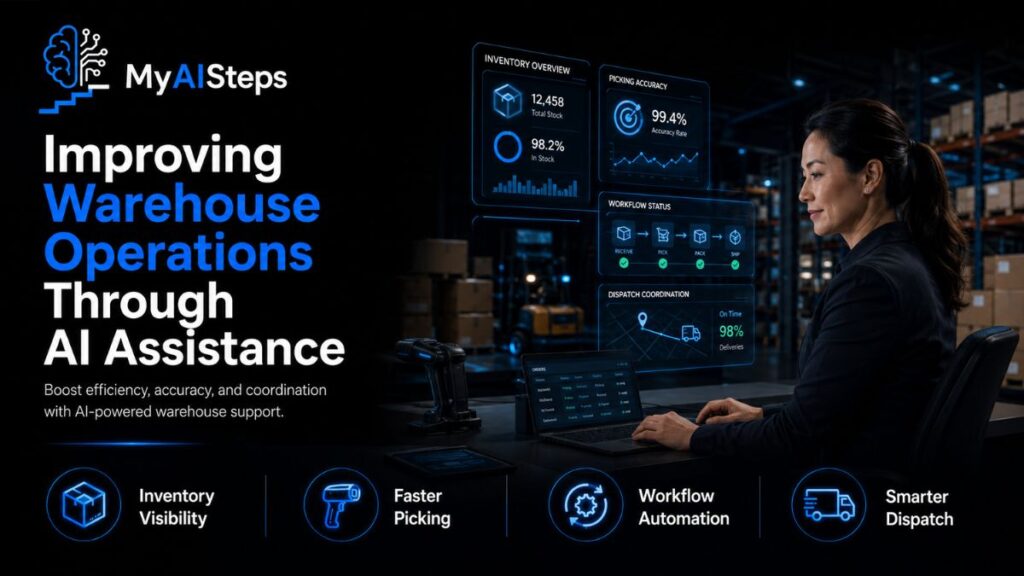
Warehouse management plays a central role in supply chain performance. Efficient warehouse operations directly impact inventory accuracy, order fulfillment speed, customer satisfaction, and transportation efficiency.
While warehouse environments are often associated with physical operations, a significant portion of warehouse management involves communication, documentation, planning, and process improvement.
ChatGPT can support these activities in several practical ways.
Enhancing Warehouse Documentation
Maintaining accurate documentation is essential for operational consistency and compliance.
Warehouse managers can use ChatGPT to create:
- Standard Operating Procedures (SOPs)
- Employee training materials
- Safety guidelines
- Equipment usage instructions
- Shift handover reports
- Incident summaries
This reduces the administrative burden placed on supervisors while improving documentation quality.
Supporting Workforce Training
Warehouse teams often experience frequent staff turnover and ongoing training requirements.
ChatGPT can help create:
- Onboarding guides
- Training manuals
- Safety awareness content
- Process walkthroughs
- Frequently asked questions for employees
By simplifying complex operational procedures, organizations can improve workforce productivity and reduce training time.
Improving Warehouse Performance Analysis
When integrated with warehouse management systems (WMS), ChatGPT can help teams better understand operational metrics such as:
- Picking accuracy
- Storage utilization
- Order fulfillment rates
- Inventory turnover
- Labor productivity
These insights support continuous improvement efforts and help managers identify opportunities for greater warehouse efficiency.
ChatGPT Use Cases in Logistics and Transportation Management
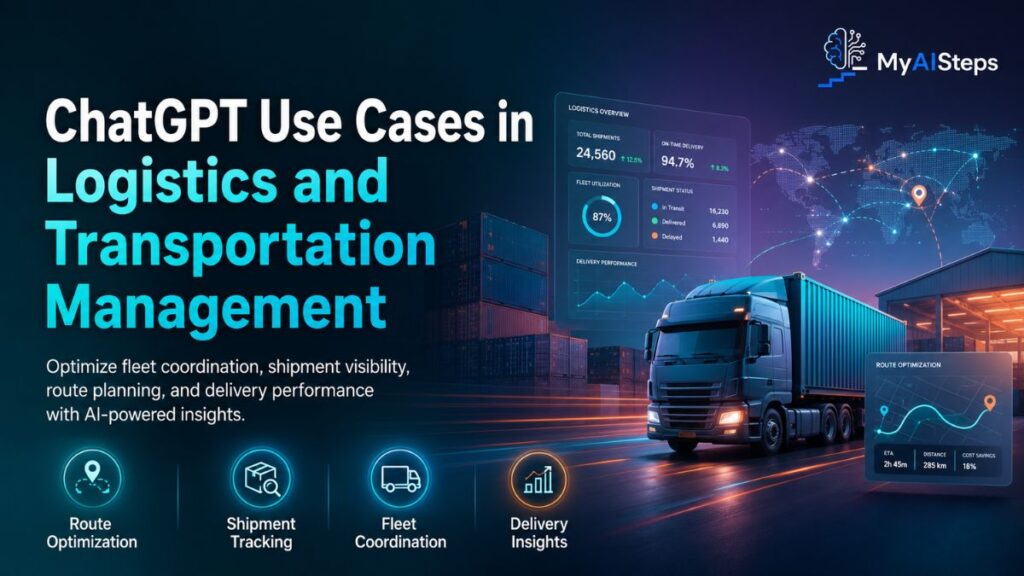
Transportation and logistics management involve coordinating shipments, managing carriers, monitoring delivery performance, and responding to disruptions.
Because logistics operations generate large amounts of information every day, many organizations struggle to process data quickly enough to make timely decisions.
ChatGPT helps bridge this gap.
Supporting Logistics Planning
Logistics professionals can use ChatGPT to assist with:
- Shipment documentation
- Carrier communication
- Route planning discussions
- Delivery performance analysis
- Transportation reporting
- Freight management summaries
This reduces manual workload and improves operational visibility.
Improving Transportation Management
Transportation management requires balancing multiple factors simultaneously, including:
- Delivery speed
- Transportation costs
- Route efficiency
- Carrier reliability
- Customer expectations
ChatGPT can help transportation managers evaluate these variables by summarizing available information and presenting key insights in an easy-to-understand format.
Managing Supply Chain Disruptions
Unexpected disruptions remain one of the biggest challenges in logistics.
Common examples include:
- Weather events
- Port congestion
- Labor shortages
- Transportation delays
- Customs issues
- Supplier disruptions
ChatGPT can assist by helping teams communicate delays, analyze disruption impacts, and generate response plans more efficiently.
This capability contributes to stronger supply chain resilience and improved risk management.
Supporting Digital Logistics Transformation
As logistics organizations continue adopting AI-powered technologies, ChatGPT serves as an intelligent layer that enhances communication, reporting, and operational analysis.
Rather than replacing transportation management systems, ChatGPT complements existing technology investments and improves overall decision-making capabilities.
Enhancing Customer Service in Supply Chain Operations
Customer service has become a major competitive differentiator across industries. Customers expect accurate information, fast responses, and transparent communication regarding orders and deliveries.
Supply chain disruptions often become customer service issues, making effective communication essential.
ChatGPT helps organizations deliver better customer experiences by improving responsiveness and consistency.
Customer Communication Support
Customer service teams can use ChatGPT to:
- Draft personalized responses
- Explain shipping delays
- Provide order status updates
- Handle return inquiries
- Create customer service templates
- Generate support documentation
This enables businesses to respond more quickly while maintaining professional communication standards.
AI-Powered Customer Support
Many organizations now use AI-powered chatbots supported by technologies similar to ChatGPT.
These systems can provide:
- 24/7 customer assistance
- Instant responses
- Order tracking information
- Self-service support options
- Frequently asked questions
As a result, organizations can improve customer satisfaction while reducing support costs.
Strengthening Customer Trust
Supply chain issues cannot always be avoided. However, how organizations communicate during disruptions often determines customer perception.
ChatGPT helps businesses maintain transparency by delivering clear, accurate, and consistent messaging during periods of uncertainty.
This contributes to stronger customer relationships and improved brand reputation.
Benefits and Challenges of Using ChatGPT in Supply Chains
Like any emerging technology, ChatGPT offers both opportunities and limitations.
Understanding these factors helps organizations implement AI responsibly and maximize long-term value.
Key Benefits
Improved Efficiency
Many administrative tasks can be completed significantly faster through automation.
Examples include:
- Report creation
- Email drafting
- Documentation preparation
- Data summarization
- Information retrieval
Better Decision Support
ChatGPT helps teams understand complex operational data and generate actionable insights more quickly.
Enhanced Communication
Consistent communication improves collaboration among suppliers, employees, customers, and business stakeholders.
Increased Productivity
By reducing repetitive work, employees can focus on higher-value strategic activities.
Improved Accessibility
Non-technical users can interact with supply chain information using natural language rather than complicated software interfaces.
Common Challenges
Data Accuracy
The quality of ChatGPT’s output depends heavily on the quality of the data provided.
Human Oversight Requirements
Critical decisions involving contracts, compliance, finances, or strategic planning should always include human review.
Data Privacy Considerations
Organizations must ensure sensitive information is handled according to internal security policies and regulatory requirements.
System Integration Limitations
Without integration into ERP, WMS, or TMS platforms, ChatGPT cannot automatically access real-time operational data.
Achieving the Best Results
Organizations that treat ChatGPT as a decision-support tool rather than a fully autonomous solution typically achieve the most sustainable results.
Combining AI capabilities with human expertise creates a balanced approach that improves both efficiency and accuracy.
Future of ChatGPT in Supply Chain Management
The future of AI in supply chain management looks increasingly promising.
As organizations accelerate digital transformation initiatives, ChatGPT and similar technologies are expected to become more deeply integrated into everyday operations.
Greater System Integration
Future implementations will likely involve stronger connections between ChatGPT and:
- Enterprise Resource Planning (ERP) systems
- Warehouse Management Systems (WMS)
- Transportation Management Systems (TMS)
- Supplier management platforms
- Inventory management software
This integration will enable more accurate and timely decision support.
Advanced Predictive Capabilities
AI technologies continue evolving beyond basic automation.
Future supply chain AI solutions may provide:
- Predictive risk identification
- Advanced demand forecasting support
- Automated workflow recommendations
- Proactive disruption alerts
- Intelligent inventory optimization
These capabilities could significantly improve supply chain agility and responsiveness.
Expansion of AI-Powered Supply Chains
As AI tools become more affordable and accessible, adoption will extend beyond large enterprises.
Small and medium-sized businesses are expected to increasingly leverage AI for:
- Procurement management
- Inventory planning
- Supplier collaboration
- Logistics optimization
- Customer service enhancement
This trend will contribute to broader digital supply chain transformation across industries.
The Continued Importance of Human Expertise
Despite rapid advances in artificial intelligence, human judgment remains essential.
Successful supply chains require:
- Strategic thinking
- Relationship management
- Ethical decision-making
- Leadership
- Risk assessment
The future is unlikely to involve AI replacing supply chain professionals. Instead, AI will empower professionals to work more efficiently and make better-informed decisions.
Conclusion
The growing adoption of ChatGPT in supply chain management reflects a broader shift toward intelligent, data-driven operations. From procurement optimization and warehouse management to logistics coordination and customer service, ChatGPT offers practical solutions that help organizations improve efficiency, communication, and decision-making.
While ChatGPT is not a replacement for specialized supply chain software, it serves as a powerful support tool that bridges the gap between complex operational data and actionable business insights. Organizations that combine AI-powered assistance with human expertise can unlock significant advantages in productivity, agility, and supply chain performance.
As digital transformation continues accelerating across industries, businesses that strategically integrate AI into their supply chain processes will be better positioned to adapt to market changes, manage disruptions, and deliver greater value to customers.
Frequently Asked Questions (FAQs)
What are the primary supply chain management use cases of ChatGPT?
ChatGPT can support demand forecasting, inventory planning, supplier communication, procurement management, warehouse operations, transportation management, logistics analysis, and customer service activities.
Can ChatGPT improve supply chain efficiency?
Yes. By automating repetitive administrative tasks, simplifying data analysis, and enhancing communication, ChatGPT can help organizations improve operational efficiency and productivity.
Is ChatGPT suitable for logistics management?
ChatGPT can support logistics professionals by assisting with reporting, documentation, carrier communication, shipment analysis, and disruption management. However, it works best alongside dedicated logistics systems.
How does ChatGPT help procurement teams?
Procurement teams can use ChatGPT to generate RFQs, compare supplier proposals, summarize contracts, create procurement reports, and streamline sourcing workflows.
Can ChatGPT replace ERP systems?
No. ChatGPT is not a replacement for ERP, WMS, or TMS platforms. Instead, it complements these systems by helping users interpret information and automate communication-related tasks.
What are the risks of using ChatGPT in supply chain management?
Potential challenges include data accuracy concerns, privacy considerations, integration limitations, and overreliance on AI-generated outputs without proper human oversight.