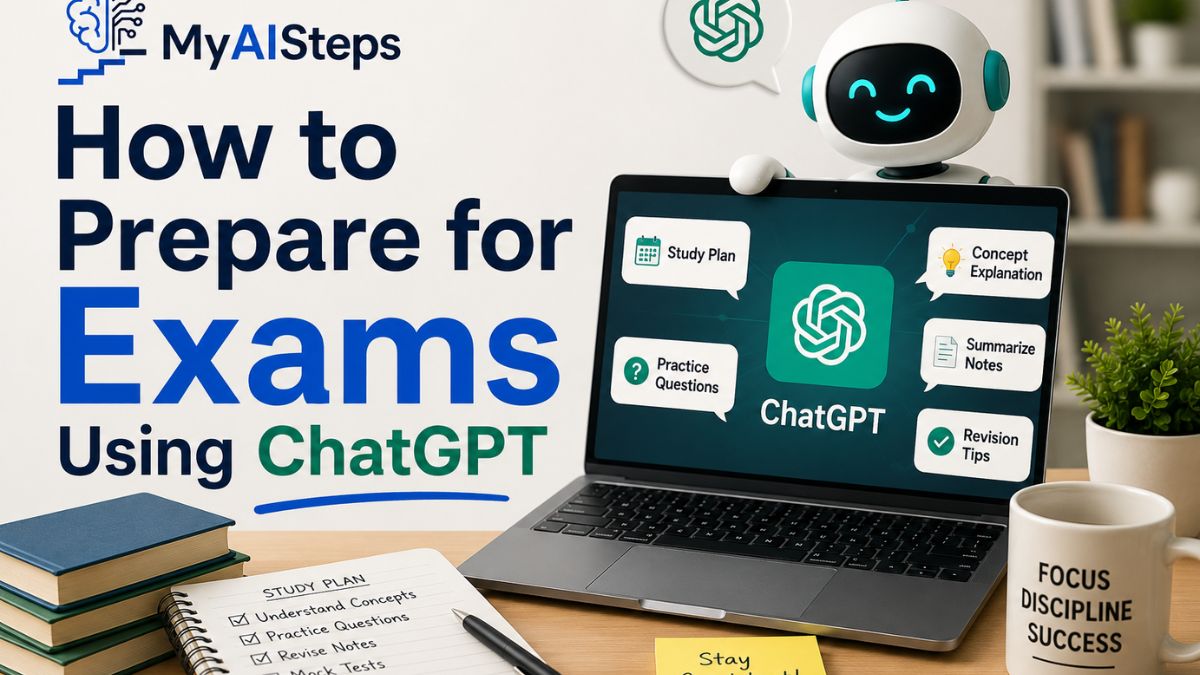
In today’s competitive academic environment, students need smarter and more efficient ways to prepare for exams. Traditional study methods like rote memorization and passive reading are no longer enough on their own. This is where artificial intelligence tools like ChatGPT become extremely useful. When used correctly, ChatGPT can act as a personal study assistant that helps you understand concepts, organize your study schedule, and improve your overall performance in exams.
Instead of replacing your learning process, ChatGPT enhances it by making studying more structured, interactive, and personalized. From creating study plans to generating practice questions and summarizing complex topics, it supports almost every stage of exam preparation. In this guide, we will explore how students can use ChatGPT effectively to study smarter, not harder.
How to Create a Personalized Study Plan Using ChatGPT
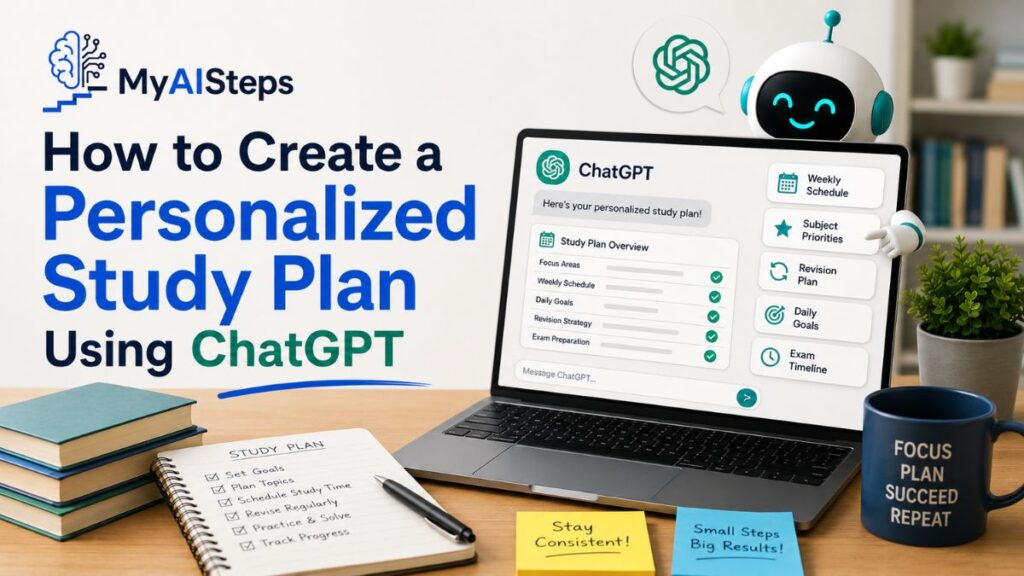
One of the most powerful uses of ChatGPT is building a structured study plan based on your exam schedule. Many students fail not because they don’t study, but because they don’t organize their time properly.
You can simply provide ChatGPT with your exam details, such as subjects, dates, and available study hours. For example:
“I have exams in Physics, Chemistry, and English within 10 days. I can study 5 hours daily. Create a balanced study plan.”
ChatGPT will generate a structured timetable that includes:
- Daily study targets
- Subject prioritization
- Revision days
- Break intervals
This helps eliminate confusion and gives you a clear direction every day.
A strong study plan ensures:
- Better time management
- Reduced stress
- Balanced subject coverage
- Consistent revision cycles
Instead of guessing what to study, you always know your next step.
Using ChatGPT to Summarize Complex Topics and Chapters
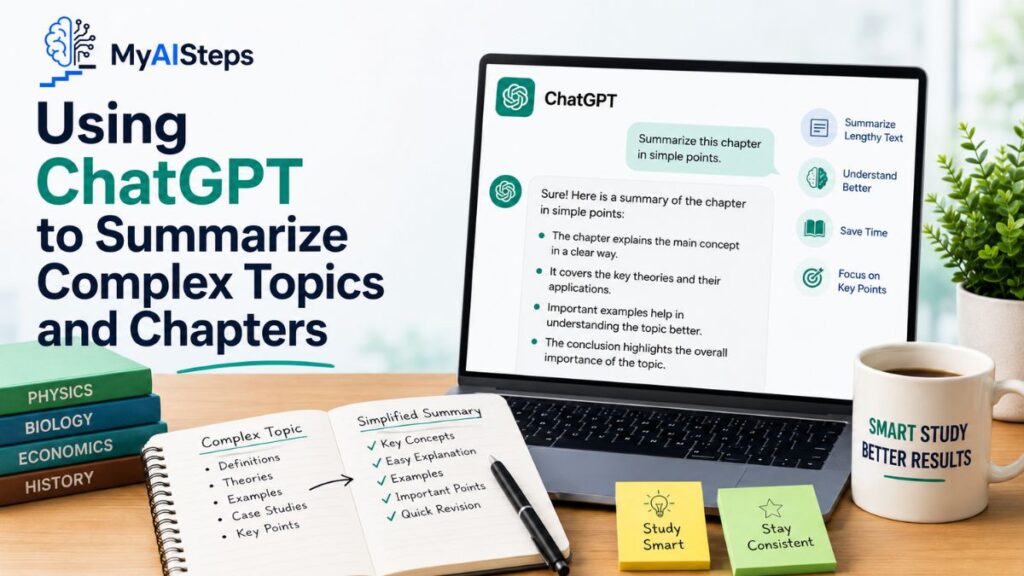
Long textbook chapters often overwhelm students because they contain too much information. ChatGPT helps simplify this by converting complex topics into clear, digestible summaries.
For example, you can ask:
“Summarize the chapter on Photosynthesis in simple terms with key points for exams.”
ChatGPT can provide:
- Short summaries
- Bullet-point notes
- Key definitions
- Important exam-focused points
This improves understanding and saves revision time.
You can also request different formats:
- Concept maps (text-based)
- Comparison tables
- Step-by-step explanations
This flexibility helps students understand topics in multiple ways, improving memory retention.
How ChatGPT Can Generate Practice Questions and Mock Tests
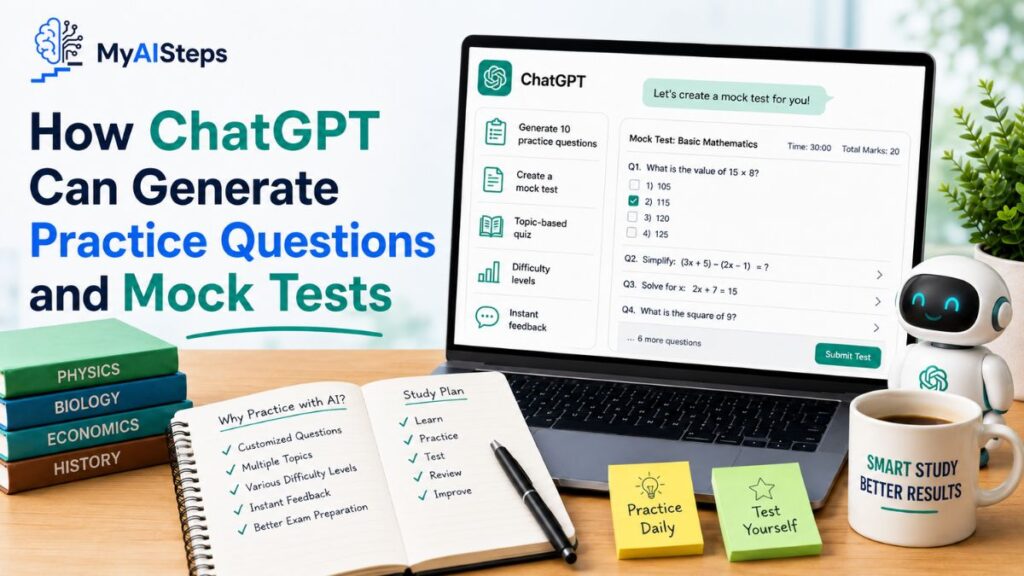
Practicing questions is one of the most effective ways to prepare for exams. ChatGPT can generate unlimited practice questions based on your syllabus.
You can ask:
“Create 10 multiple-choice questions from the topic Cell Biology with answers.”
It can generate:
- Multiple-choice questions
- Short-answer questions
- Essay-style questions
- True/false questions
Even better, you can request explanations for each answer:
“Explain why each answer is correct or incorrect.”
This improves conceptual understanding instead of just memorization.
You can also simulate full exams:
- Timed mock tests
- Subject-specific exams
- Mixed-topic papers
Mock exams help you:
- Build exam confidence
- Improve time management
- Reduce exam anxiety
- Understand question patterns
Using ChatGPT for Summaries, Revision & Concept Clarity (Advanced Tip)
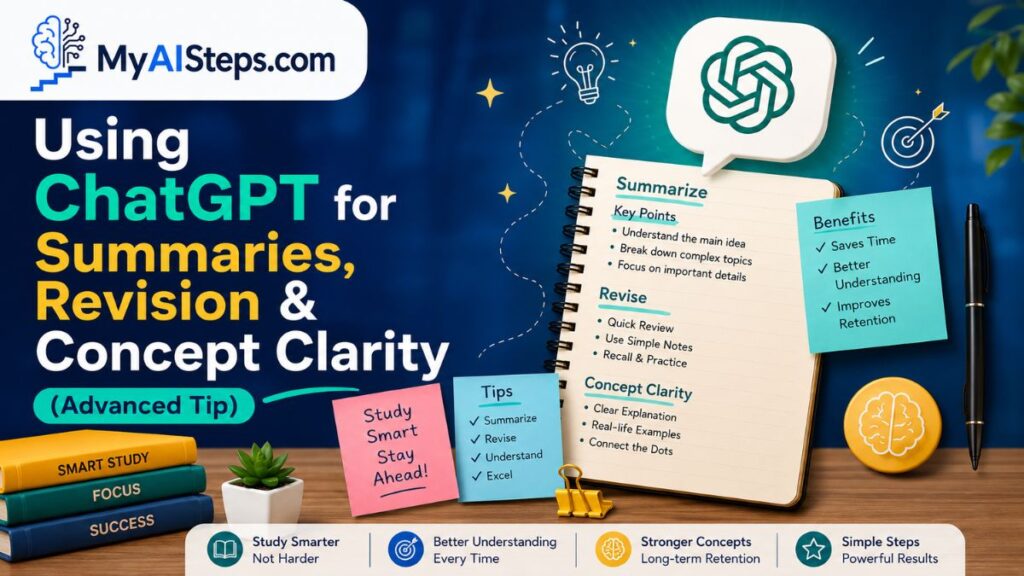
Another advanced use is combining summaries with revision cycles. Instead of reading everything repeatedly, you can ask ChatGPT to:
- Summarize a topic
- Then create revision notes
- Then generate 5 quick questions
This creates a full learning loop:
Understand → Revise → Test
This method is far more effective than passive reading.
Creating Flashcards with ChatGPT for Better Memory Retention
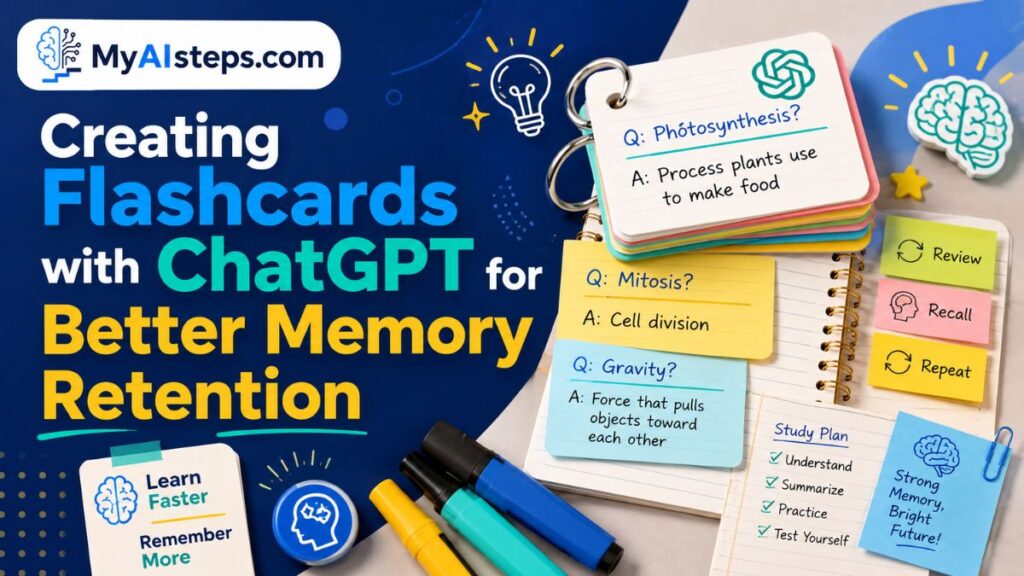
Flashcards are a proven method for memorization, and ChatGPT makes them extremely easy to create.
You can use prompts like:
“Create 15 flashcards on Human Digestive System with question and answer format.”
ChatGPT will generate structured flashcards that you can use for:
- Quick revision
- Daily practice
- Last-minute review
Flashcards help improve:
- Memory recall
- Fast revision
- Concept clarity
You can also increase difficulty:
- Basic definitions
- Application-based questions
- Exam-level tricky questions
Using ChatGPT for Active Recall and Spaced Repetition
Active recall is one of the most powerful learning techniques. Instead of reading notes repeatedly, you test yourself.
You can ask ChatGPT:
“Quiz me on the Nervous System one question at a time.”
This creates an interactive learning session where ChatGPT:
- Asks questions
- Waits for your answer
- Gives feedback
This method improves long-term memory.
Spaced repetition is another powerful technique. You can ask:
“Create a 7-day revision schedule for Chemistry topics using spaced repetition.”
ChatGPT will structure revision like:
- Day 1: Learn
- Day 3: Revise
- Day 5: Test
- Day 7: Final review
This ensures information stays in long-term memory.
How to Improve Time Management During Exam Preparation
Time management is often the biggest challenge for students.
You can use ChatGPT to:
- Build daily study schedules
- Balance multiple subjects
- Prioritize difficult topics
For example:
“I have 4 exams in 2 weeks. Create a daily study plan with 4 hours per day.”
ChatGPT will:
- Break time into sessions
- Add breaks
- Balance subjects
It can also analyze your routine:
“Is my study method effective if I only re-read notes?”
It will suggest improvements like:
- Active learning
- Practice testing
- Reduced passive reading
Good time management leads to:
- Less stress
- Better preparation
- Higher performance
Best ChatGPT Prompts for Different Subjects
Different subjects require different strategies.
Mathematics
“Solve this step-by-step and give similar practice problems.”
Science
“Explain this concept with real-life examples.”
History
“Summarize causes and effects with exam questions.”
Literature
“Analyze this theme in simple exam-friendly language.”
Languages
“Correct my writing and explain mistakes.”
This makes learning highly personalized.
Common Mistakes Students Make When Using ChatGPT
Many students misuse ChatGPT, which reduces its effectiveness.
Common mistakes include:
- Copy-pasting answers without understanding
- Using vague prompts
- Relying on it without textbooks
- Not practicing active recall
- Treating it as shortcut instead of tool
To get the best results, always combine ChatGPT with real study materials.
Benefits and Limitations of ChatGPT in Exam Preparation
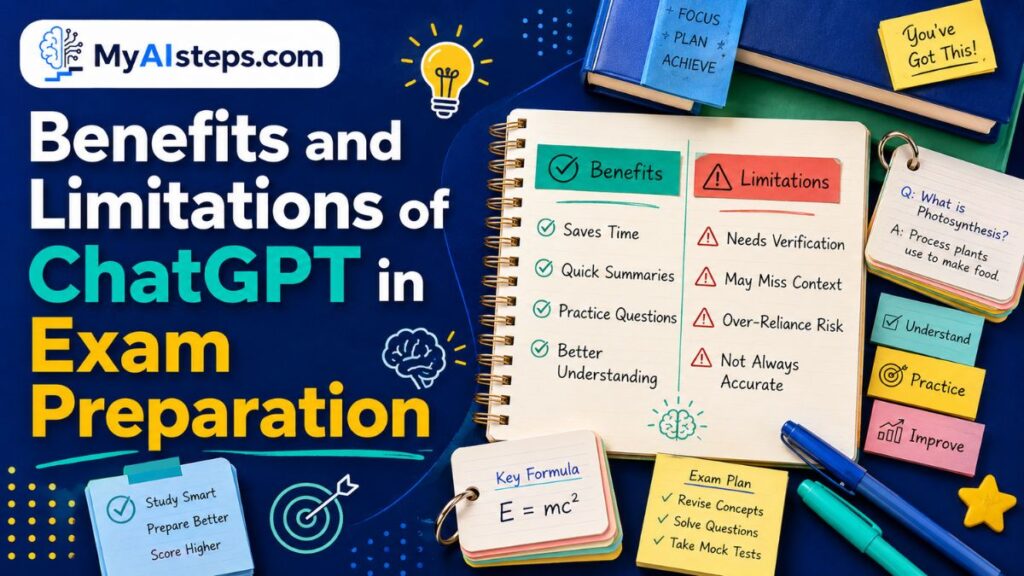
Benefits:
- Instant explanations anytime
- Personalized learning support
- Practice questions generation
- Study planning assistance
- Better revision structure
Limitations:
- Can sometimes be inaccurate
- Not a replacement for teachers
- May oversimplify complex topics
- Requires fact-checking
When used correctly, it becomes a powerful study assistant.
Conclusion
ChatGPT is a powerful learning tool that can completely transform how students prepare for exams. It helps in planning studies, simplifying complex topics, generating practice questions, and improving revision techniques.
However, its true value depends on how it is used. Students who combine ChatGPT with traditional study methods, active recall, and consistent practice achieve the best results.
Instead of relying on memorization alone, using AI as a guided learning assistant allows students to study smarter, stay organized, and perform better in exams.
Frequently Asked Questions
Can ChatGPT help in exam preparation?
Yes, it helps with study plans, summaries, practice questions, and revision strategies.
Is ChatGPT accurate for studying?
It is mostly accurate but should always be verified with textbooks.
Can ChatGPT replace studying?
No, it supports studying but cannot replace deep learning.
Is ChatGPT good for making notes?
Yes, it can create structured and simplified notes.
Can ChatGPT generate exam papers?
Yes, it can create full mock exams with answers.