
If you’ve spent any time with ChatGPT, you’ve probably realized that how you ask a question matters just as much as what you’re asking. Trending prompts—those clever ways of structuring questions that get better answers—are spreading across communities faster than ever. In 2026, knowing which prompts work and where to find them can save you hours of trial and error. This guide shows you what trending prompts actually are, why some go viral, and exactly where to discover the ones that work for your specific needs.
What Are ChatGPT Trending Prompts?

ChatGPT trending prompts are proven question templates and phrasing techniques that generate higher-quality, more useful responses from the AI. They’re not magic formulas—they’re structured ways of asking that help the model understand what you really want. A trending prompt might ask ChatGPT to adopt a role (“You’re a professional copywriter”), provide specific formats (“Give me a numbered list with explanations”), or include context (“I’m writing for beginners, not experts”).
These prompts gain traction when people discover they consistently produce better results. Someone shares a prompt that actually works, others test it, refine it, and share their versions. Before long, thousands of people are using variations of the same technique. The difference between a generic question and a trending prompt often comes down to clarity, context, and structure.
What makes a prompt “trend” is practical results. If a prompt consistently solves a real problem—whether that’s writing better emails, brainstorming faster, or explaining complex topics—people keep using it and recommending it. They work because they align with how language models actually process information, cutting through vagueness and giving the AI clear direction.
Why Are Some ChatGPT Prompts Becoming Viral in 2026?

The explosion of trending prompts in 2026 comes down to competitive advantage and convenience. As more people use ChatGPT for work and learning, everyone’s looking for ways to get better outputs faster. When someone discovers a prompt that produces genuinely useful results, they share it. Social platforms, Discord communities, Reddit threads, and LinkedIn posts become distribution channels for prompts that actually work.
Businesses are also driving the trend. Marketing teams, content creators, and developers realize that spending 30 seconds on a better prompt saves hours of editing and revision. This creates pressure to find and share the best techniques. Simultaneously, AI literacy is becoming a genuine skill—employers now expect people to know how to get quality results from AI tools, making prompt-finding a legitimate job requirement.
The viral nature of trending prompts also comes from their democratization. Early on, prompt engineering felt like a specialized technical skill. Now, anyone who stumbles onto a good prompt can understand and share it. Communities build around different niches: educators share student-focused prompts, marketers swap sales and copywriting templates, and developers trade code-writing techniques. This specialization makes prompts more targeted and useful for specific audiences.
How to Find the Latest ChatGPT Trending Prompts
The best sources for trending ChatGPT prompts are specialized prompt libraries, AI communities, and social platforms where users actively test and share what works. PromptBase and OpenAI’s own resource sections maintain curated collections organized by use case. These aren’t just random prompts—they’re tested and ranked by user feedback, so you’re seeing what actually performs.
Reddit’s AI subreddits (r/ChatGPT, r/OpenAI, r/PromptEngineering) are goldmines for discovering what’s trending in real time. Users post prompts they’ve tested, discuss what works and what doesn’t, and evolve techniques together. The sorting system means the most useful prompts float to the top. LinkedIn is another underrated source—professionals share prompts they’ve used successfully in business contexts, often with before-and-after examples.
Social media platforms like Twitter and TikTok have become surprising hotspots for prompt discovery. Creators post short clips showing off a prompt’s results, sometimes with the actual text. Discord communities focused on AI tools have dedicated channels for sharing and testing new prompts. The advantage of these spaces is speed—trends emerge and spread within hours.
Search Google for “ChatGPT prompts [your specific need]” and you’ll find blogs and communities discussing what’s working. Pay attention to publication dates and user comments—newer posts reflect current trends, and comments reveal whether people are still getting results. YouTube creators also test and rank trending prompts, often showing you exactly how to use them with real examples.
Best ChatGPT Trending Prompts for Everyday Use
Everyday prompts are designed to handle common tasks that most people face regularly—answering questions, explaining concepts, brainstorming ideas, and solving problems quickly. One of the simplest trending templates asks ChatGPT to “explain this like I’m a beginner,” which consistently produces clear, jargon-free explanations. Another popular prompt structure is: “I need [specific output format]. Please provide [the task] and format it as [structure they want].” This direct approach eliminates ambiguity about what you’re asking for.
The “role-based” prompt is trending because it works across almost any task. Start with “You are an expert [profession or role]” and then ask your question. When you tell ChatGPT to think like a professional in a specific field, the responses improve noticeably. Another tested approach is the “before-and-after” request: “Here’s what I have [your current output]. Make it better by [specific improvement].” This works because ChatGPT understands exactly what you’re trying to improve rather than starting from scratch.
For quick information gathering, the “comparison” prompt trends because it saves time: “Compare [thing A] and [thing B] across these dimensions: [list them].” Specificity makes the difference. Rather than just asking for a comparison, you’re directing which angles matter to you. The “step-by-step breakdown” prompt is equally popular: “Walk me through how to [task] as if I’ve never done this before.” This naturally produces organized, actionable responses that readers actually follow.
Top ChatGPT Prompts for Students and Learning

Student-focused prompts have become one of the fastest-growing categories because they address real learning challenges—breaking down complex topics, preparing for tests, and understanding material in different ways. The “explain then test” prompt trending among students works like this: “Explain [concept] in simple terms, then give me five practice questions to test my understanding.” This mimics good tutoring by combining explanation with retrieval practice, which improves memory retention.
Another high-performing student prompt uses the “teach-back” method: “Explain this concept as if you’re teaching it to someone who knows nothing about it. Then ask me to explain it back to you.” This forces active learning rather than passive reading. For essay help, students trend toward: “Help me outline an essay about [topic]. I have these points: [list them]. Organize them logically and suggest areas I’m missing.” This approach provides structure without writing the essay, keeping the work authentic.
Test preparation prompts are trending because they handle a specific pain point. “I’m preparing for a test on [subject]. Ask me questions about [topic] and grade my answers. If I’m wrong, explain the correct answer and why.” This creates an interactive study session. For difficult concepts, the “metaphor-based” approach works well: “Explain [complex topic] using an analogy or metaphor. Then apply it to [real-world situation].” Analogies stick in memory better than technical definitions, which is why this format trends among learners.
Popular ChatGPT Prompts for Content Creators
Content creators trend toward prompts that accelerate production without compromising quality, focusing on research assistance, outline generation, and optimization rather than full content writing. One trending template is: “Research [topic] and provide me with [number] surprising insights that most people don’t know about. Include credible sources or reasoning for each insight.” This gives creators fresh angles and hooks for their content before they write a single word.
The “outline and structure” prompt is popular because it solves the hardest part of creation: “Create a detailed outline for [content type] about [topic]. Each section should have [X] key points. Make it engaging for [audience description].” Creators then write from this structured blueprint, which is faster and more organized than starting blank. For repurposing content, the trending approach is: “I wrote [original content]. Generate [number] alternative versions optimized for: social media post, email newsletter, video script, blog section. Keep the main message but adapt tone and format.”
Video and podcast creators trend toward: “Generate [number] hook ideas for a video/podcast about [topic] that would make [target audience] click or listen within the first five seconds.” This addresses the biggest challenge in digital content—getting attention. For SEO optimization, creators use: “Rewrite this content for better search engine ranking while keeping it engaging to read. Focus on [primary keyword] and naturally include related terms like [related keywords].” This addresses the tension between AI optimization and human readability that all modern creators face.
Best ChatGPT Prompts for Business and Marketing
Business professionals trend toward prompts that handle time-intensive tasks—email drafting, customer communication, strategic planning, and campaign ideation—where quality matters and speed saves money. The “email template” prompt trending in corporate environments looks like: “Draft a professional email for [situation]. The tone should be [tone]. I want to accomplish [goal]. Make it concise but thorough.” Different variations cover prospecting, follow-ups, negotiations, and crisis communication, each tailored by context.
For marketing strategy, a high-performing prompt is: “I sell [product/service] to [target audience]. Generate [number] content ideas for [content format] that address their pain points: [list them]. Each idea should solve a specific problem.” This produces targeted content calendars rather than generic suggestions. The “competitor analysis” prompt trends because it synthesizes information efficiently: “What are the main strengths and weaknesses of [competitors]? How can my [product/service] differentiate based on these gaps?” This gives businesses positioning without expensive research.
Sales and customer service teams trend toward: “Write a [communication type] to handle this customer situation: [describe it]. The outcome I want is [goal]. Use [tone], and address their concerns without admitting fault.” Customer-specific scenarios produce better results than generic templates. For campaign planning, the trending structure is: “Create a marketing campaign plan for [product]. Our budget is [amount]. Target audience: [description]. Success metric: [what we’re measuring]. Generate timeline, channel recommendations, and messaging themes.” This covers strategic thinking while leaving tactical execution to the team.
How to Write Your Own Trending ChatGPT Prompts
The best trending prompts come from people who understand their own needs well enough to communicate them clearly. You don’t need technical skills to build prompts that work—you need specificity. Start by identifying exactly what you want ChatGPT to produce. Instead of “write me something,” think: “write me a professional email that asks for a favor without being pushy.” The second version guides the AI toward your actual outcome.
Build your prompts using three core elements: context, task, and format. Context tells ChatGPT who you are and what situation you’re in. Task is the action you want performed. Format is how you want the output structured. A tested template looks like: “You are [role]. I need you to [task]. Format your response as [structure].” This three-part approach consistently produces better results than rambling requests.
Test your prompts multiple times before deciding they work. Try minor variations—change the tone, add constraints, adjust the detail level—and see what improves the output. Keep notes on what worked. The prompts that trend are often refined versions of simpler ideas, improved through iteration. Share your best prompts in communities relevant to your field. When others test them and get results, you’re seeing real confirmation that your prompt structure works.
Common Mistakes to Avoid When Using ChatGPT Prompts
Most prompt failures happen because people don’t give ChatGPT enough information to understand what they actually want. Vagueness is the biggest mistake—asking “write about productivity” produces generic output, while “write a productivity article for software developers struggling to focus during remote work” produces something useful. The difference is specificity. ChatGPT can’t read your mind; it can only work with what you tell it.
Another common error is changing too many variables at once. If your prompt produces mediocre output, adjust one element—the tone, the format, or the level of detail—not everything. This makes it impossible to know what actually improved things. People also forget to provide examples of what they want. Showing ChatGPT one example of the style, tone, or format you’re after improves results dramatically more than just describing it.
Testing your prompts only once is a setup for disappointment. A prompt that works perfectly for one task might fail on a slightly different variation. The most reliable prompts work consistently across multiple tests. Many users also fail to iterate based on feedback. If ChatGPT’s first answer is 80% there, don’t accept it—ask it to refine specific parts. The follow-up prompt “fix the opening paragraph to be more engaging” often produces better results than starting over with a new prompt.
Real Examples of ChatGPT Trending Prompts in 2026
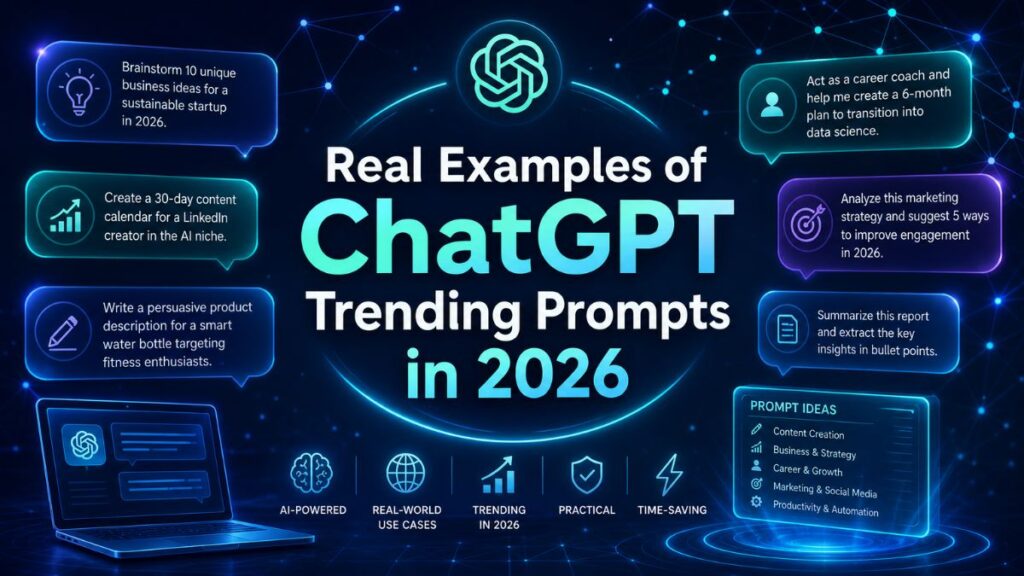
Concrete examples help you understand how structure translates into better results. Here’s a trending prompt for research: “I’m researching [topic] for [purpose]. Find me three surprising insights that contradict common assumptions, and explain the reasoning or evidence behind each one.” This works because it asks for specificity (surprising, contradictory) and reasoning (why each insight matters), not just a list.
For creative writing, a high-performing prompt is: “Write a [content type] about [topic] for [audience]. The tone should be [tone]. Include a compelling hook in the first sentence that makes readers want to continue. After the first draft, suggest where I could add more vivid detail.” This prompt accomplishes three things: it sets parameters, it identifies a specific improvement to focus on, and it asks for suggestions rather than expecting perfection on the first try.
For problem-solving, this trending template works across contexts: “I’m trying to [goal], but I’m stuck because [specific obstacle]. I’ve already tried [what you’ve tried]. What am I missing? Give me three unconventional approaches I probably haven’t considered.” This works because it shows you’ve already tried basic solutions and you’re looking for deeper thinking. For productivity and planning: “Create a realistic action plan for [project/goal]. I have [timeframe] and can dedicate [amount of time] per week. Break it into phases with specific milestones. Be honest about what’s achievable given these constraints.” Honesty about constraints produces plans you’ll actually follow.
Conclusion
Trending ChatGPT prompts aren’t mysteries—they’re communication tools refined through real use. The patterns are consistent: successful prompts are specific, structured, and tested. You’ve learned what makes prompts trend, where to find them, and how to build your own. The real advantage comes from understanding that prompt quality directly impacts your results, whether you’re a student studying for exams, a creator working on content, or a professional managing a business.
Your next step is simple: test three prompts this week that match your actual work. Pay attention to what works and what doesn’t. Start a notes file with prompts that produce results worth saving. As you build your personal library of working prompts, you’ll notice patterns in what helps ChatGPT produce better output for your specific needs. That awareness is what separates people who get generic results from people who get genuinely useful answers.
Frequently Asked Questions
What makes a ChatGPT prompt “trending” versus just effective?
A trending prompt has been tested and shared by enough people that it becomes recognized across communities as producing consistently good results.
Can I use trending prompts without modifying them?
Yes, trending prompts often work well directly because they’ve been refined by many users.
How long should my ChatGPT prompt be?
The length doesn’t matter as much as clarity and completeness. A simple prompt works fine if it’s specific: “Explain quantum computing as if I’m a beginner.
Why do some prompts work for me but fail for others?
ChatGPT’s responses vary based on how you phrase requests, what information you provide, and sometimes timing or the model version being used.
Where should I start if I’m brand new to ChatGPT prompts?
Start with simple, role-based prompts: “You are a [profession]. Help me with [task].” These work reliably across most situations.
Can AI trending prompts help with academic work?
Yes, but ethically and effectively. Use prompts to understand concepts, outline essays, practice explaining ideas, or generate study questions
Do trending prompts change frequently, or do they stay useful?
The most effective prompts—role-based, specific, structured requests—remain useful long-term because they align with how language models work. While new trends emerge as communities discover novel approaches, fundamental prompt structures that worked in 2024 still work effectively in 2026.