
ChatGPT has moved well beyond its early days as a public demo. It’s now one of the highest-traffic AI products in the world, and the financial story behind it has become just as interesting as the technology itself. People searching for the ChatGPT net worth in 2026 are usually trying to pin down a real number — not a vague estimate — and understand how a chatbot turned into a multi-billion-dollar business engine.
The short answer is that ChatGPT doesn’t have its own net worth as a standalone entity. It’s a product built and owned by OpenAI, so its financial value lives inside OpenAI’s overall business picture. That’s what this article unpacks — the revenue streams, the company valuation, and what those numbers actually mean.
What is ChatGPT Net Worth in 2026?
When people ask about the ChatGPT net worth, they’re really asking about OpenAI’s worth — because that’s where the number lives. ChatGPT is a product, not a company, so it doesn’t carry its own balance sheet or shareholder equity.
That said, ChatGPT is unquestionably OpenAI’s most valuable asset. OpenAI’s valuation crossed $300 billion in early 2025 after a major funding round anchored by SoftBank. By 2026, that figure reflects continued growth in enterprise adoption, expanded API usage, and a steadily growing subscriber base. The product alone reportedly contributes the majority of OpenAI’s annual revenue — a number that analysts estimated at over $3.4 billion for 2024 and has likely grown since.
So the honest framing is this: ChatGPT’s “worth” is inseparable from OpenAI’s market value. If OpenAI were to spin ChatGPT out tomorrow and sell it independently, the price tag would sit in the hundreds of billions — not because of what it earns today, but because of what it controls: user behavior, developer ecosystems, enterprise contracts, and a brand that’s become synonymous with AI for a huge chunk of the global market.
How ChatGPT Generates Revenue in Today’s AI Market
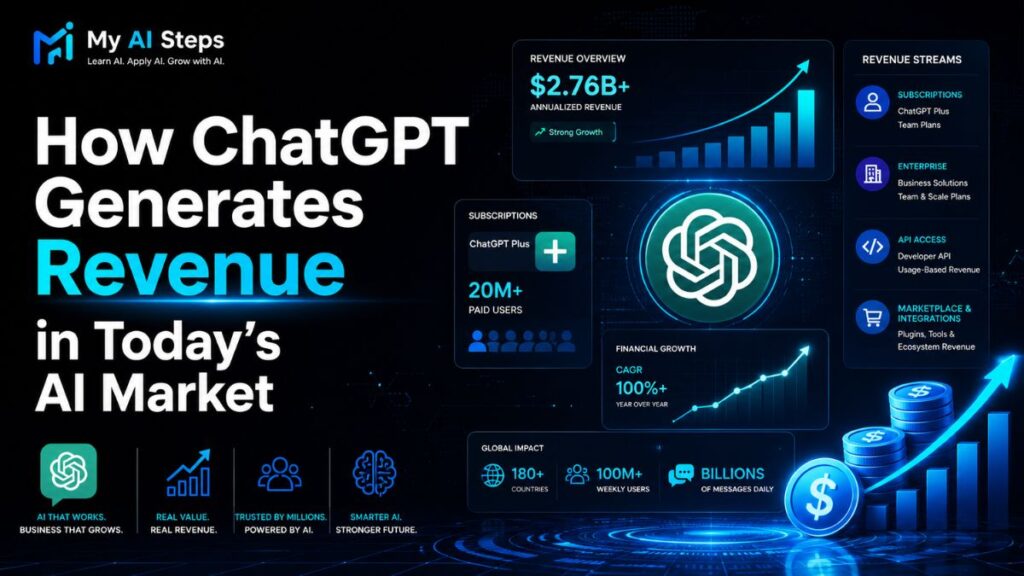
ChatGPT runs on multiple revenue streams, and it’s worth understanding each one because they serve very different customer segments.
The most visible is the consumer subscription model. ChatGPT Plus costs $20 per month and gives users access to advanced models like GPT-4o. ChatGPT Pro, priced at $200 per month, is aimed at power users and professionals who need higher usage limits and early access to newer features. Multiplied across millions of paying users globally, these subscriptions generate significant recurring revenue each month.
ChatGPT Enterprise is where the bigger contracts sit. Companies pay substantially more for dedicated infrastructure, data privacy controls, admin dashboards, and team-level access. These aren’t publicly priced — enterprise SaaS contracts rarely are — but deal sizes for larger organizations are reported to run well into five and six figures annually.
Then there’s the API layer. Developers and companies building their own AI-powered tools pay OpenAI per token to access the same underlying models that power ChatGPT. This has quietly become one of the most scalable parts of the business. A company might never use ChatGPT directly but spend tens of thousands of dollars a year on API calls to build a customer support tool or a writing assistant.
Microsoft’s partnership also plays a role. As both a major investor and a distribution partner through Azure OpenAI Service, Microsoft channels enterprise demand toward OpenAI’s models at a scale that’s difficult to replicate through direct sales alone.
OpenAI Valuation Behind ChatGPT and Its Real Worth
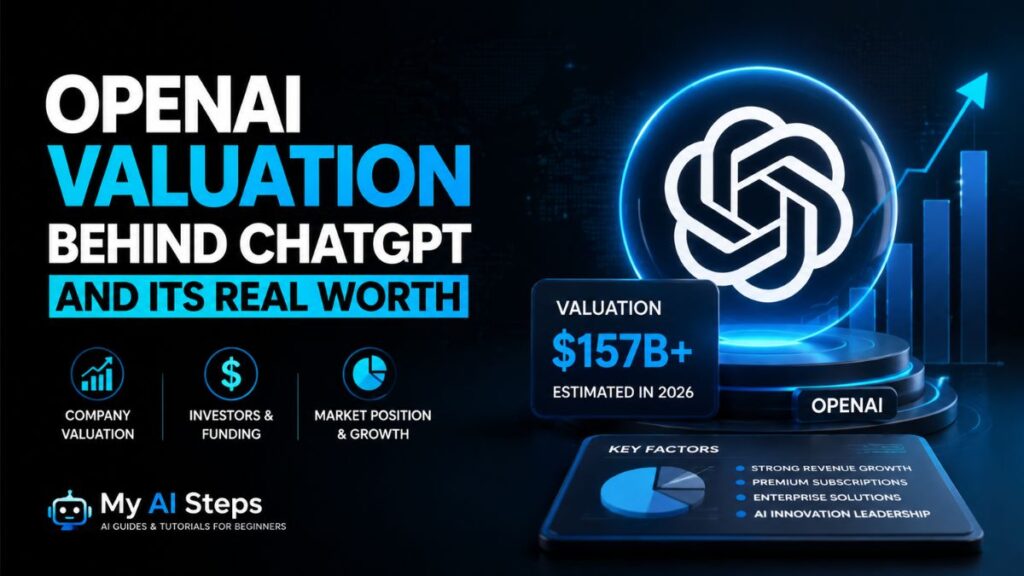
OpenAI’s valuation trajectory tells the clearest financial story. The company was valued at around $80 billion in early 2024. By late 2024, that climbed to $157 billion. Then in early 2025, a $40 billion funding round pushed the figure to $300 billion — one of the largest private fundraising rounds in tech history.
That kind of growth isn’t about a single product launch or a viral moment. It reflects a market repricing of what large-scale AI infrastructure is actually worth once commercial use cases become proven and sticky.
One thing that makes the 2026 picture different from earlier years is OpenAI’s ongoing structural shift. The company has been moving away from its original nonprofit governance model toward a more conventional capped-profit structure. This matters for valuation because it directly affects how future investors calculate returns, how equity is distributed, and whether an IPO becomes realistic in the next few years.
ChatGPT sits at the center of all of it. It drives the consumer brand, anchors the enterprise pitch, and generates the usage data that helps OpenAI improve its models faster than almost anyone else in the space. The relationship between OpenAI’s valuation and ChatGPT’s commercial performance isn’t indirect — it’s almost one-to-one.
ChatGPT User Growth and Global Market Expansion
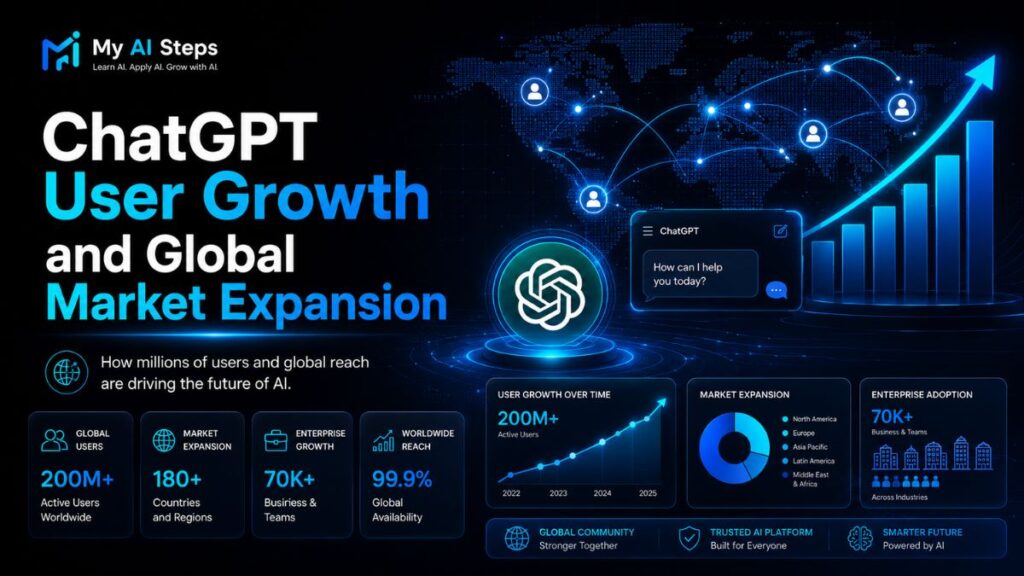
ChatGPT hit 100 million users in just two months after its late 2022 launch — faster than any consumer app before it. By late 2024, OpenAI reported over 200 million weekly active users, and that growth wasn’t concentrated in one part of the world.
Markets across Southeast Asia, Latin America, India, and parts of Europe have seen strong adoption as OpenAI expanded language support and localized its mobile apps. That geographic spread matters for two reasons. It widens the total addressable market for paid subscriptions, and it builds the kind of embedded daily use that’s genuinely difficult for competitors to displace quickly.
Developer adoption tells a parallel story. The number of businesses building products on top of OpenAI’s API grew sharply through 2023 and 2024. Many tools that users interact with daily — AI writing assistants, customer support bots, internal productivity apps — are running on the same underlying models that power ChatGPT. That embedded presence across third-party products adds platform value that doesn’t show up directly in the weekly user count but matters a lot for long-term business stability.
ChatGPT Subscription Plans and Their Revenue Impact
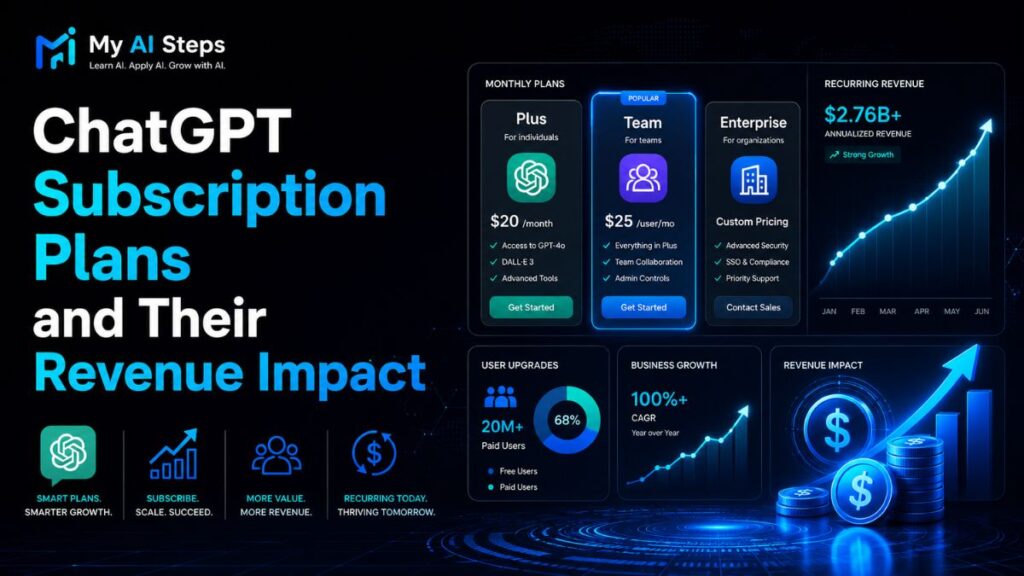
OpenAI built its pricing around a clear funnel. The free tier brings users in. Usage limits push motivated ones toward paid plans. It’s a simple model and it’s working at scale.
ChatGPT Plus at $20/month is the most widely adopted paid tier. ChatGPT Team, aimed at small and mid-sized businesses, runs between $25 and $30 per user per month and adds workspace features, shared admin controls, and higher usage limits for the whole team. ChatGPT Pro at $200/month serves a different segment entirely — researchers, developers, and power users who run the tool for hours a day and need the highest-performance models without throttling.
The revenue math is worth working through. If just 5% of 200 million weekly active users are on the Plus plan, that’s 10 million paying subscribers generating roughly $2 billion annually from that tier alone — before factoring in Team plans, Pro subscriptions, or enterprise contracts. Even at a more conservative estimate, subscription revenue adds up fast at this user scale.
OpenAI hasn’t published a public breakdown of subscription revenue by tier. But analyst estimates consistently point to subscriptions as the largest individual revenue category in its business, ahead of API income in terms of total dollars.
Comparison of ChatGPT With Other AI Tools in Terms of Market Value
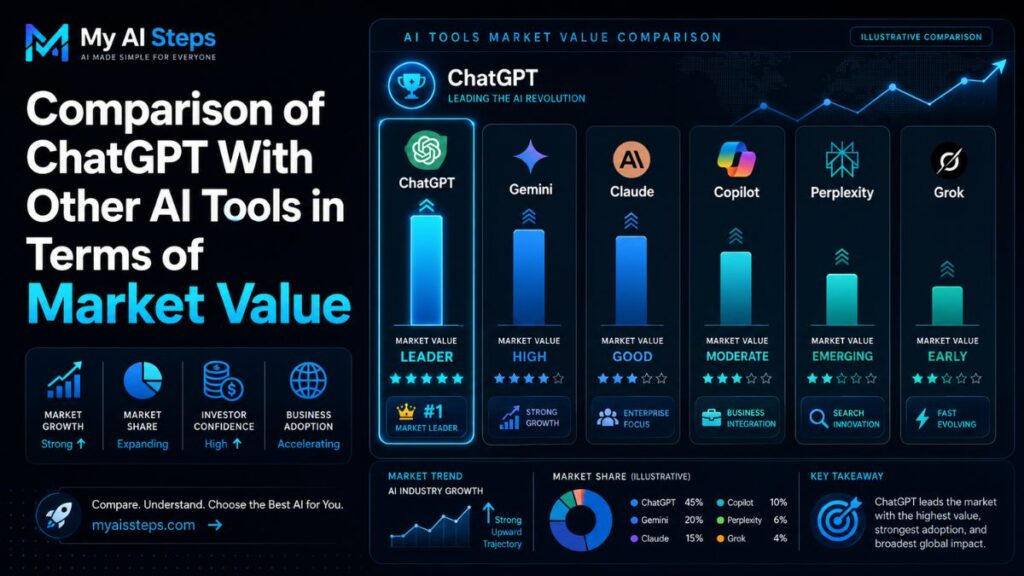
Direct comparisons here need careful framing. Most of ChatGPT’s biggest rivals aren’t independent businesses — they’re features inside trillion-dollar companies. Google Gemini lives inside Alphabet. Meta AI is a product within Meta. Microsoft Copilot is embedded across Microsoft’s enterprise software suite. Comparing their standalone “market value” to ChatGPT’s isn’t really an apples-to-apples exercise.
The cleaner comparisons are with independent AI companies. Anthropic, which builds Claude, has grown rapidly and attracted major investment — but its reported valuation sits well below where OpenAI is priced. Perplexity AI, which positions itself as an AI-powered alternative to traditional search, operates at an earlier stage and a considerably smaller scale despite strong press coverage.
What gives ChatGPT a structural edge in market value discussions is brand ubiquity. In a lot of everyday conversations, “ChatGPT” is simply what people call AI — regardless of which tool they’re actually using. That kind of cultural shorthand is hard to build and nearly impossible to buy. It also creates a default behavior: when someone needs to try an AI tool, ChatGPT is usually the first place they go. That starting-point advantage compresses over time as competitors improve, but it still carries real weight in how investors price the platform today.
Key Factors That Influence ChatGPT’s Overall Valuation
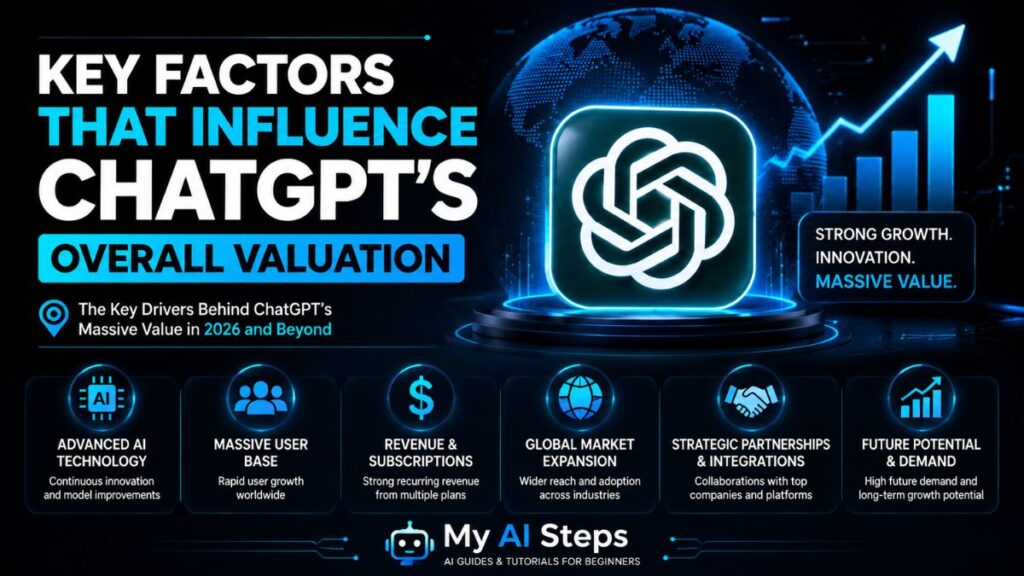
A few specific things move the needle on OpenAI’s valuation, and understanding them puts the headline numbers in better context.
Revenue growth rate carries the most weight at this stage. Investors aren’t primarily evaluating current profitability — they’re evaluating trajectory. If annual revenue doubles consistently, valuation multiples hold even without a profit on the books. That’s the logic behind most high-growth tech companies, and OpenAI is no exception.
Model quality has a direct commercial effect. When OpenAI ships a meaningfully better model, enterprise clients have a concrete reason to stay and expand their contracts. It also creates pricing leverage — users are much more willing to pay more when the output is visibly and practically better than what they were getting before.
Regulatory risk is the hardest factor to quantify. AI-specific legislation in the EU, data handling rules across different markets, and evolving US policy discussions all carry real financial exposure. Rules that restrict how AI companies train models or store user data could affect both operating costs and market access in ways that are difficult to price in advance.
Competition dynamics remain the most discussed long-term pressure point. Google has a distribution advantage through Search, Android, and Chrome that no other company can replicate. If Gemini closes the performance gap and gets pushed as the default AI assistant to billions of existing Google users, the growth assumptions built into OpenAI’s valuation face a genuine challenge — one that matters more than any single funding round.
Future Growth Potential of ChatGPT in the AI Industry
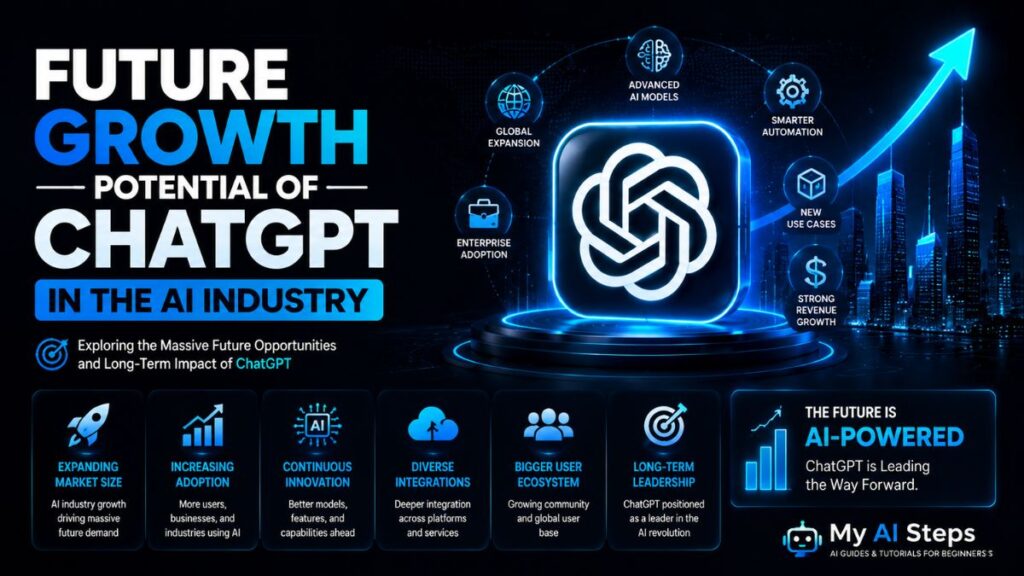
The version of ChatGPT available in 2026 is materially different from what launched in late 2022. It handles voice conversations, analyzes documents and images, executes code, and in its more recent iterations can take autonomous actions — browsing websites, managing files, completing multi-step tasks without someone guiding each move. That shift toward agentic behavior is where a lot of the next wave of growth sits.
Enterprise automation is the clearest near-term opportunity. Businesses that use AI agents to handle internal workflows — drafting reports, processing data, scheduling, customer communication — tend to deepen their reliance on those tools over time. That’s a favorable pattern for sustained revenue growth, and OpenAI has been building toward it with custom GPT features and expanded developer tools.
On the consumer side, voice and mobile interfaces bring ChatGPT to users who don’t think of themselves as AI-savvy. As the product becomes more conversational, the potential user base stretches well beyond the early adopter crowd that drove the initial growth.
Is ChatGPT Profitable or Still in the Growth Phase?
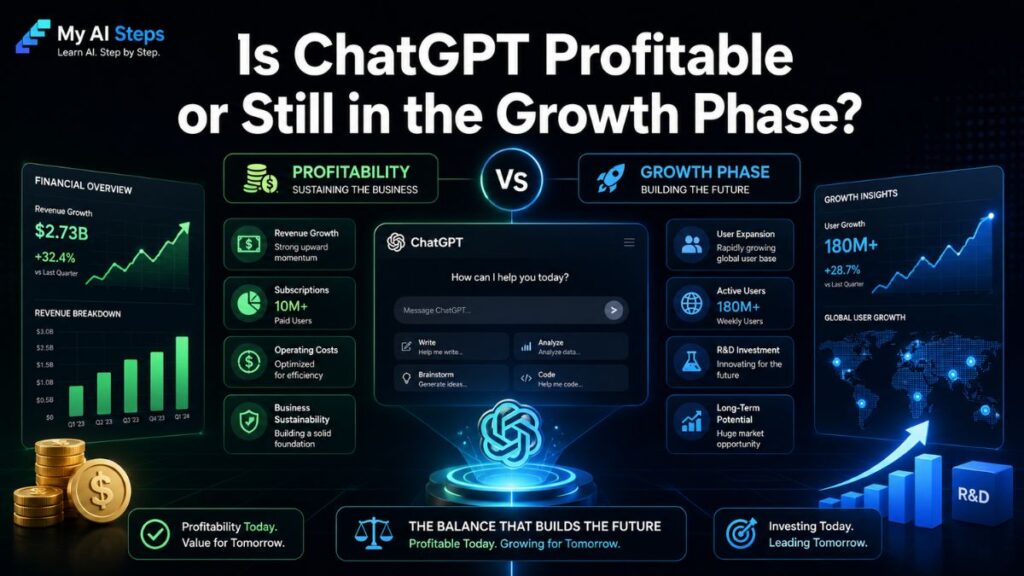
OpenAI is not profitable yet, and it hasn’t suggested otherwise. Reports from 2024 estimated the company spent somewhere between $8 and $9 billion while bringing in roughly $3.4 to $4 billion in revenue. The largest expense is compute — training large models requires enormous processing power, and serving those models to millions of users every day adds up fast.
That gap is real, but context matters. Most major tech platforms ran losses for years before their unit economics stabilized. The relevant question isn’t whether OpenAI is in the black today — it’s whether the trajectory is moving the right way. Revenue has grown faster than most analysts forecasted. The cost per model inference has declined as infrastructure has matured. And enterprise contracts, once embedded into a company’s workflow, tend to renew.
Profitability likely isn’t arriving in 2026. But the gap between what the company earns and what it spends has been getting smaller, not larger.
Final Insights on ChatGPT Net Worth and Long-Term Value Outlook
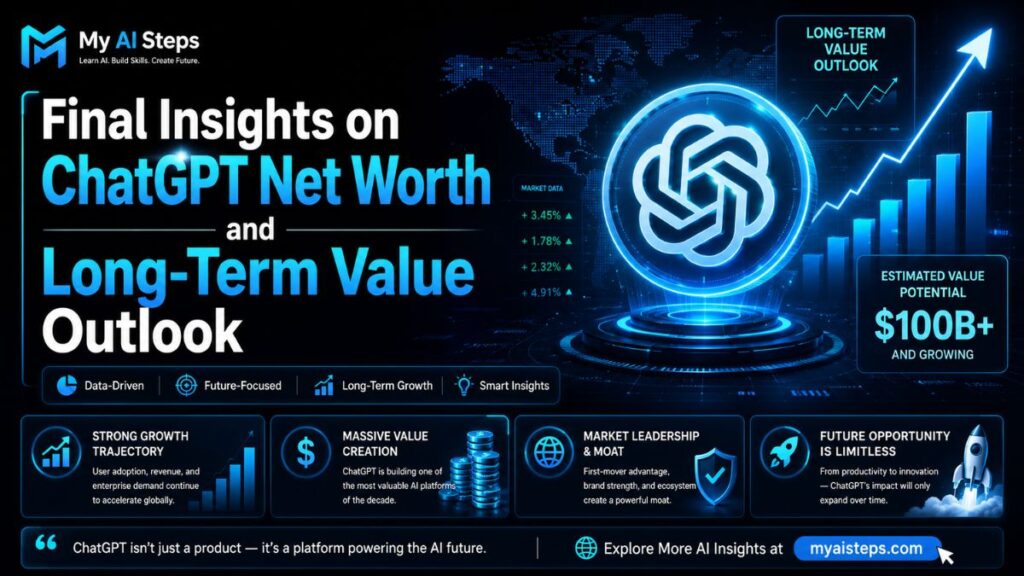
Assigning a precise number to ChatGPT’s worth is harder than it looks. A large portion of OpenAI’s valuation is forward-looking — built on expectations about AI adoption, product retention, and the ability to convert a dominant market position into a durable business.
What’s less speculative is the commercial footprint: hundreds of millions of users, an enterprise customer base that keeps expanding, a developer ecosystem built around the API, and a brand that still functions as the category default for most people entering the AI space for the first time. Those aren’t projections. They’re measurable assets.
The longer-term picture depends on how well ChatGPT holds that position as AI capabilities become standard features inside most software rather than standalone products. That transition is already underway, and it’s the real test of long-term value.
The financial story around ChatGPT is more layered than any headline figure captures. OpenAI’s valuation reflects platform position, subscription growth, enterprise traction, and brand recognition that competitors have found genuinely difficult to replicate. The product doesn’t need to be profitable right now to carry significant value — it needs to hold its ground long enough for the revenue model to mature, and right now the indicators are pointing in the right direction.
If there’s one honest takeaway here, it’s that the question isn’t just what ChatGPT is worth today — it’s whether that worth holds over the next few years as the AI landscape keeps shifting. Based on where things stand in 2026, the answer looks reasonably solid, though not without real risk.
Conclusion
The financial story around ChatGPT is more layered than any headline figure captures. OpenAI’s valuation reflects platform position, subscription growth, enterprise traction, and brand recognition that competitors have found genuinely difficult to replicate. The product doesn’t need to be profitable right now to carry significant value — it needs to hold its ground long enough for the revenue model to mature, and right now the indicators are pointing in the right direction.
If there’s one honest takeaway here, it’s that the question isn’t just what ChatGPT is worth today — it’s whether that worth holds over the next few years as the AI landscape keeps shifting. Based on where things stand in 2026, the answer looks reasonably solid, though not without real risk.
Frequently Asked Questions
What is ChatGPT’s net worth in 2026?
ChatGPT doesn’t carry its own net worth — its financial value sits within OpenAI, which is currently valued at around $300 billion.
Is OpenAI a publicly traded company?
No, OpenAI is still privately held as of 2026 and has not completed a public listing.
How does ChatGPT make money?
Through consumer subscriptions (Plus, Pro, Team), enterprise contracts, and API access paid by developers and businesses.
Is ChatGPT profitable right now?
No — OpenAI’s expenses still outpace revenue, though the gap has been narrowing as revenue grows faster than costs.
Who are ChatGPT’s biggest competitors?
Google Gemini, Anthropic’s Claude, Microsoft Copilot, and Meta AI are its main rivals in the AI assistant market.