
The ChatGPT affiliate program gives content creators, bloggers, and online marketers a concrete way to earn money by promoting one of the most widely used AI tools available right now. You refer someone to ChatGPT Plus, they subscribe, and you receive a commission. That’s the core idea. But like most affiliate programs, the details matter — and understanding how it actually works saves you a lot of wasted effort up front.
This article walks through everything from eligibility and sign-up to how referrals are tracked and commissions are paid out. Whether you’re new to affiliate marketing or just adding another income stream to what you already have, what follows is practical and direct.
What Is the ChatGPT Affiliate Program and How Does It Work?
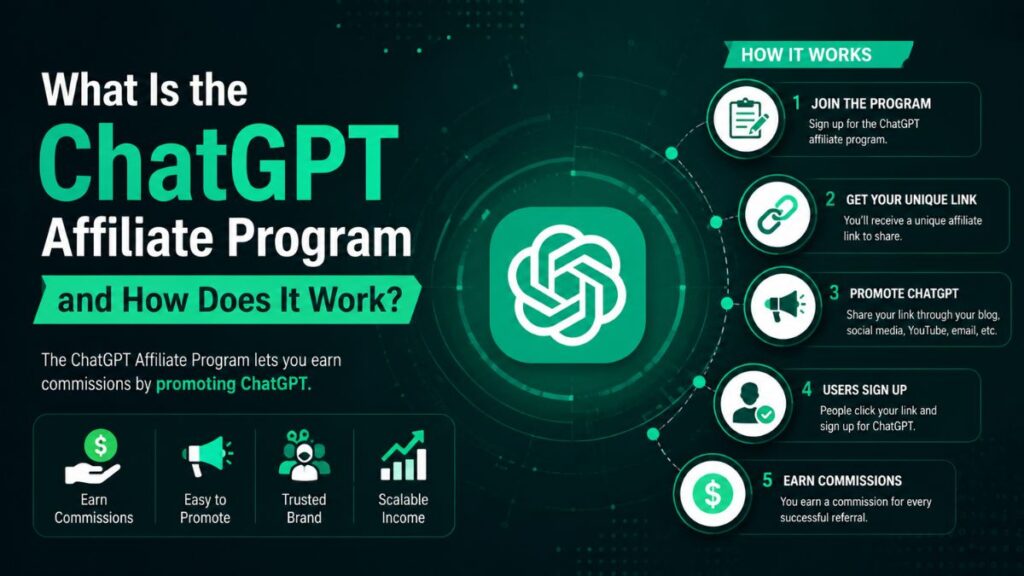
OpenAI runs an affiliate program that lets approved partners earn a commission for referring new paying subscribers to ChatGPT Plus. The subscription is priced at $20 per month, and affiliates earn a percentage of that when someone signs up through their unique referral link.
The program operates through Impact, a well-known affiliate tracking platform that many SaaS and technology companies use. Once you’re accepted, you get access to an affiliate dashboard inside Impact where you can retrieve your tracking links, watch clicks and conversions, and check your earnings in real time.
Here’s how the mechanics work in practice. When someone clicks your affiliate link, a tracking cookie gets placed in their browser. If they sign up for ChatGPT Plus within that cookie window, the sale gets credited to your account. The commission then sits in your Impact balance and gets paid out according to the standard payout schedule.
One thing that trips up a lot of beginners: the program pays on ChatGPT Plus conversions only, not free signups. If someone clicks your link and creates a free account, that doesn’t earn you anything. The referral has to result in a paid subscription for a commission to count. Understanding this early helps you shape your content toward people who already see value in an AI assistant and are close to making a purchase decision — not just casual browsers.
Who Can Join the ChatGPT Affiliate Program?
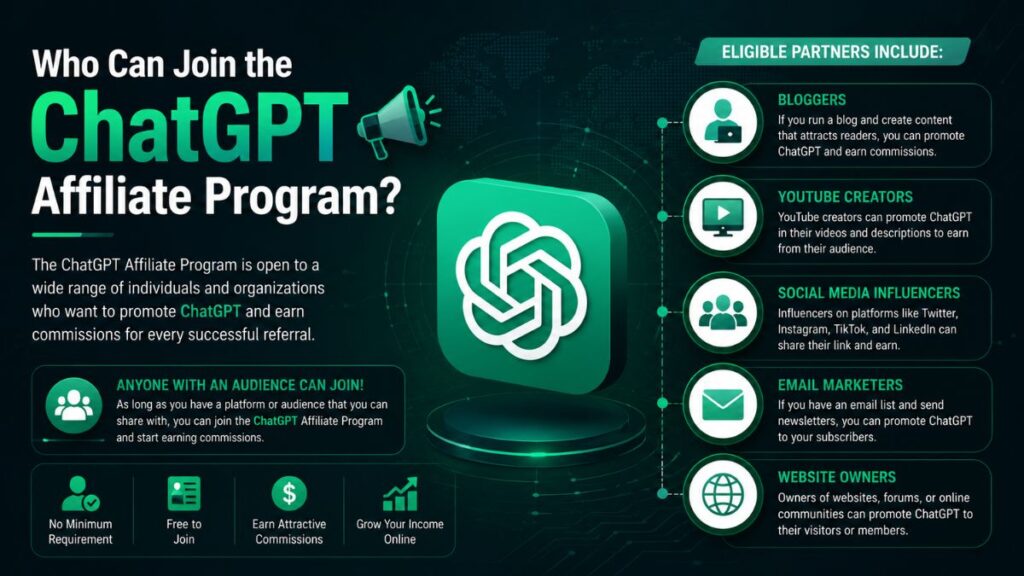
This isn’t an open-door program where anyone can sign up instantly. OpenAI reviews each application, and they tend to favor affiliates who already have an active audience or a content platform that’s genuinely connected to AI tools, productivity, software, or technology.
Bloggers writing in the AI or tech space tend to get approved with fewer issues. So do YouTubers who review software tools, educators with AI-focused audiences, and newsletter writers with engaged subscribers in a relevant niche. The common factor isn’t fame or massive follower counts — it’s fit. Your audience should have a real reason to care about an AI writing, research, or productivity subscription.
If you’re just starting out and have no traffic yet, it’s better to build some before applying. That doesn’t mean you need a huge platform. A focused blog with steady traffic in the right niche can be enough. What reviewers pay attention to is relevance. A site with 5,000 monthly readers in the AI space is a stronger candidate than a general lifestyle blog with ten times the traffic.
There are also compliance requirements involved. You’ll need to agree to OpenAI’s affiliate terms, follow their promotional guidelines, and properly disclose your affiliate relationship to your audience. The FTC’s disclosure rules apply here, and most established publishers follow them as a matter of habit. A simple line like “This article contains affiliate links, meaning I may earn a commission if you subscribe through my link” is usually sufficient. It builds trust with your readers and keeps you on the right side of both the advertiser and regulators.
Geographic availability may also be a factor. Not all regions are currently included in the program, so checking current eligibility before applying is worth a few minutes of your time.
How to Sign Up for the ChatGPT Affiliate Program Step by Step
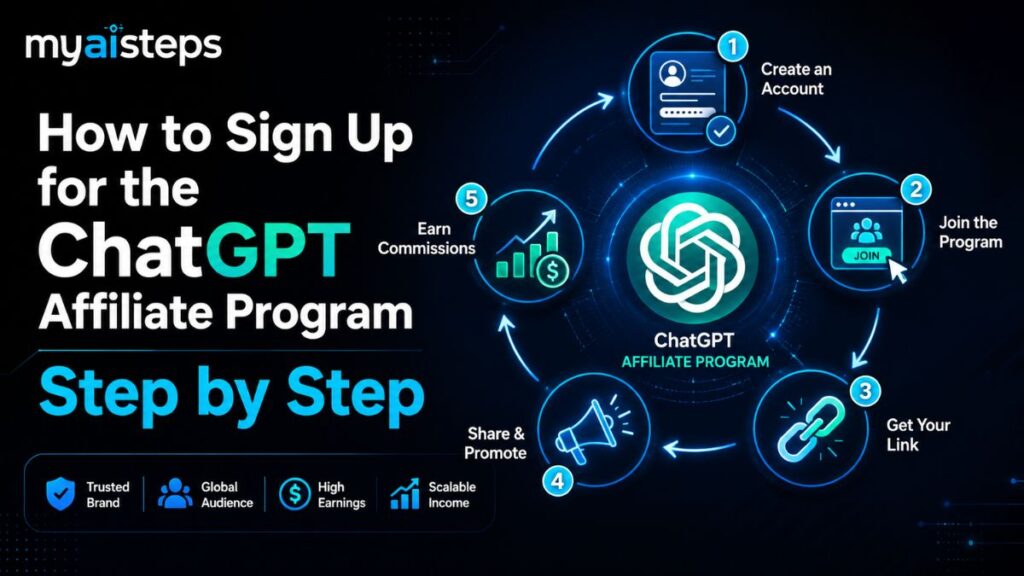
The application process starts on OpenAI’s website and routes you through Impact to complete your profile. Here’s how it typically goes.
Start by visiting OpenAI’s official site and navigating to their affiliate or partnership section. The page there will direct you to apply through Impact. If you don’t have an existing Impact account, you’ll create one during the process — it takes only a few minutes and doesn’t require technical knowledge.
Inside the Impact application form, you’ll be asked for your website or platform URL, a description of your audience, your main promotional channels, and your payment information. This is where a lot of applicants undersell themselves. Vague answers weaken your application. Instead of writing something generic like “I promote on social media,” be specific. Mention that you run a weekly AI newsletter, publish tutorials on YouTube, or operate a blog that covers AI productivity tools for small business owners. Give them a clear picture of who you reach and how.
Once submitted, OpenAI reviews the application manually. Approval typically takes a few business days, though it can vary. If accepted, you’ll have immediate access to your affiliate links, any available promotional materials, and the full reporting dashboard inside Impact.
Rejection on the first attempt is common and not a dead end. Build more content, grow your audience a bit further, and reapply once your platform looks more established. A lot of successful affiliates in this space didn’t get in on the first try.
What Are the Commission Rates in the ChatGPT Affiliate Program?
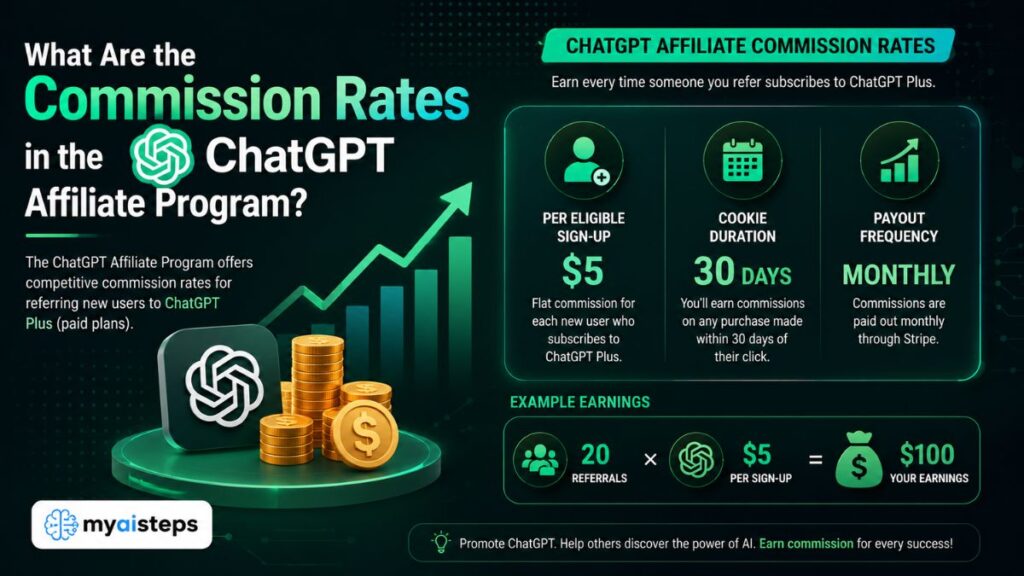
OpenAI’s affiliate program offers a percentage-based commission on ChatGPT Plus subscriptions that come through your referral link. The exact rate and any recurring payout structure are outlined in your affiliate agreement inside Impact, and these details can change over time, so verifying your current terms directly in the dashboard is always the right move before building projections around expected earnings.
What matters more than the number itself is understanding whether the commission is one-time or recurring. Some affiliate programs pay you once when a user subscribes. Others pay a percentage for every month that subscriber stays active. Recurring commissions tend to compound over time, which changes the earning potential significantly if you’re bringing in consistent referrals.
At a subscription price of $20 per month, even a modest commission rate adds up when you’re generating steady referrals rather than sporadic ones. A creator who sends five new subscribers per month and earns a recurring percentage will consistently outperform one who gets twenty referrals in a single week and then nothing. That’s just how the math works with subscription-based affiliate income.
One more thing worth knowing: commission tracking begins only after a successful paid conversion. Trials, free accounts, and cancelled subscriptions before billing completes don’t count toward your earnings. Keep this in mind when reviewing your Impact dashboard — the difference between clicks, signups, and confirmed commissions will almost always have a gap.
How Does ChatGPT Track Affiliate Referrals and Sales?
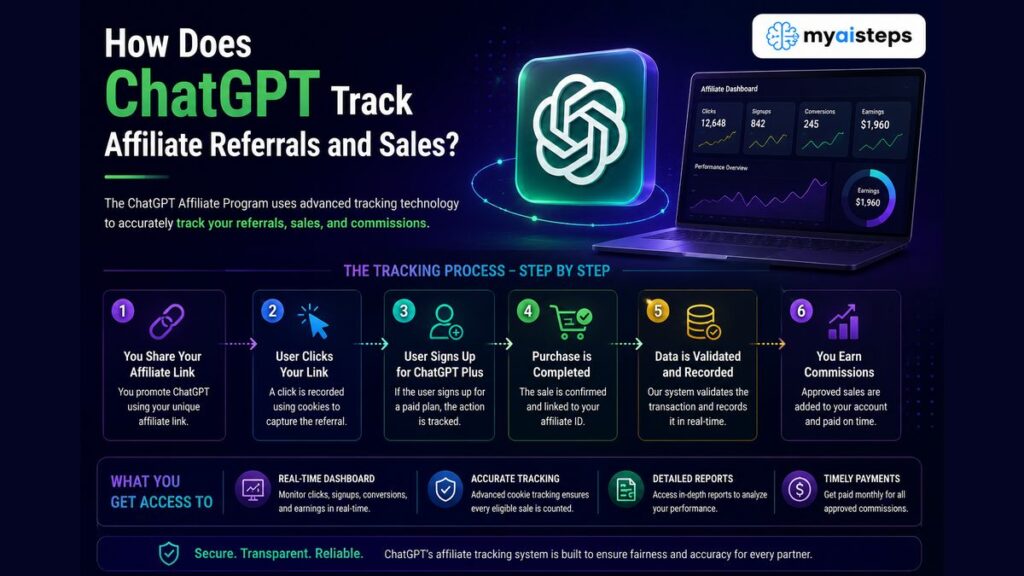
Tracking runs entirely through the Impact platform using cookie-based attribution. When someone clicks your affiliate link, a cookie gets placed in their browser that ties their activity to your account. If they complete a paid ChatGPT Plus subscription before the cookie expires, the conversion gets recorded under your affiliate profile.
The attribution window — meaning how long the cookie stays active after a click — is specified in your program terms. This matters more than people realize. If someone clicks your link, gets distracted, and comes back a week later to subscribe, that referral may or may not get credited depending on where their timing falls within the cookie window. A longer window obviously works in your favor.
Impact’s dashboard gives you a breakdown of your link clicks, conversion events, pending commissions, and approved payouts. It’s fairly straightforward to use. You can see which links are generating traffic and which ones aren’t converting, which helps you adjust your promotional strategy based on real data rather than guessing.
One thing that sometimes confuses newer affiliates: commissions often go through a “pending” or “locked” period before they’re approved and paid out. This is normal. It exists to account for refunds and chargebacks. A conversion might show up in your account right away but sit in pending status for 30 to 45 days before it clears. That pending period varies by program and can shift, so checking your current payout timeline inside Impact keeps you from thinking something went wrong when it hasn’t.
Using UTM parameters alongside your affiliate link is also worth doing if you’re running traffic from multiple sources. It helps you see inside your own analytics which article or video drove the click, separate from what Impact tells you about the conversion itself.
Best Ways to Promote ChatGPT Affiliate Links Successfully
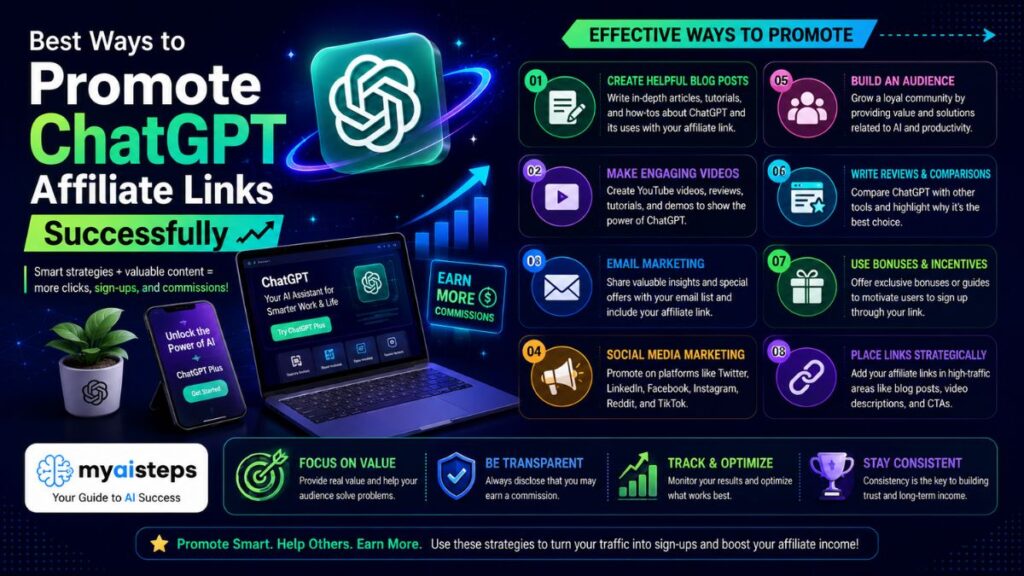
The most effective promotion doesn’t feel like promotion. Content that answers a real question and naturally includes your affiliate link will consistently outperform content that exists only to sell.
Tutorial-style blog posts work well because people searching for “how to use ChatGPT for X” are already interested in the product. A post that teaches someone how to use ChatGPT for freelance writing, lesson planning, or email drafting solves a problem first, and the affiliate link fits naturally when you mention the Plus subscription at the right moment.
Comparison content is another reliable format. Articles or videos comparing ChatGPT Plus to free alternatives, or to other AI writing tools, attract readers who are already in evaluation mode. These visitors have already decided they want something — they’re just figuring out which option fits them best. That’s a much warmer audience than general traffic.
YouTube tutorials tend to perform well over time because they rank in both YouTube search and Google. A video walking through a ChatGPT Plus feature, with your affiliate link in the description, can continue sending referrals months or even years after you publish it.
Email newsletters are underused for this purpose. If you have a list of subscribers interested in productivity, freelancing, AI tools, or online work, a well-written recommendation inside a weekly email often converts better than a blog post because the trust factor with your audience is already there.
What doesn’t work: generic posts like “ChatGPT Affiliate Program review” with no real information, or pushing the link repeatedly to people who’ve already seen it without adding new value.
Tips to Increase Earnings With the ChatGPT Affiliate Program
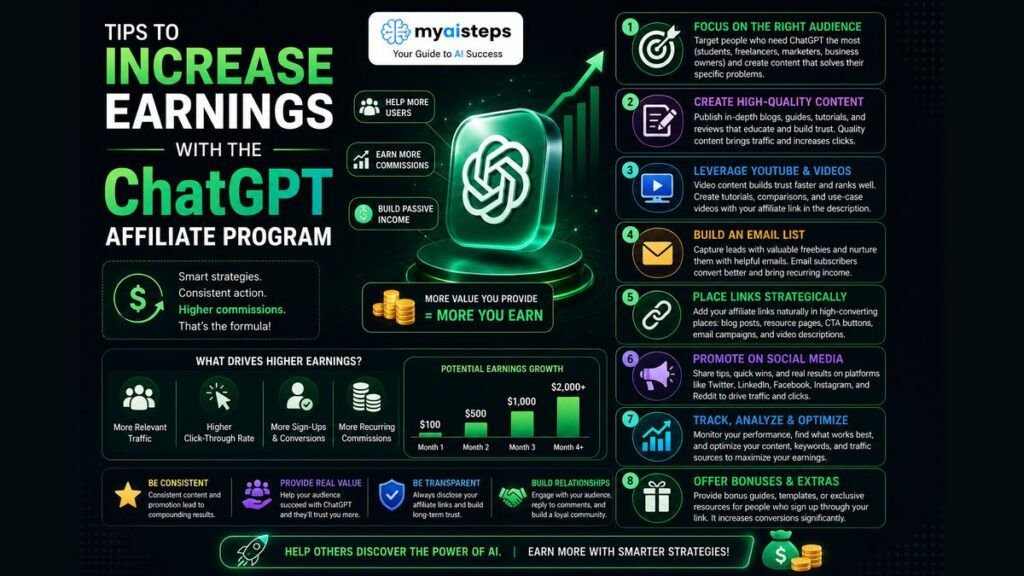
Targeting the right audience matters more than audience size. If your readers or viewers are already using free AI tools and want to know if Plus is worth the upgrade, that’s a much easier conversion than convincing someone who’s never touched AI to spend $20 a month.
Create content that addresses the upgrade question specifically. Posts like “Is ChatGPT Plus worth it?” or “What do you actually get with ChatGPT Plus?” pull in people right at the decision point. These searches come from users who are close to buying — they just need a clear, honest answer to push them forward.
Update your best-performing content regularly. If you have an article or video that’s already getting steady traffic, adding your affiliate link or refreshing the section that discusses pricing and subscription options can increase conversions without requiring you to build anything new.
Track what converts and what doesn’t. If one piece of content sends dozens of clicks with zero paid subscriptions, that audience might not be the right fit, or the placement might not be giving people enough reason to click through. Small adjustments — better link placement, a more direct call to action, a comparison table — can shift a non-converting page into one that earns consistently.
Patience matters here. Affiliate income from content compounds slowly at first and then more noticeably once you have multiple pieces ranking and generating traffic simultaneously. Most people quit too early because results don’t appear in the first 60 days.
Common Mistakes to Avoid as a ChatGPT Affiliate
One of the most frequent mistakes is writing content aimed at everyone. When you try to appeal to all types of readers, the content ends up too vague to be useful to anyone. People who convert are usually those with a specific problem they’re trying to solve — not casual visitors who clicked on a generic AI article.
Hiding the affiliate nature of your content is another issue. Some affiliates avoid disclosure because they worry it hurts conversions. In reality, transparent disclosure builds reader trust, and that trust is what drives clicks. Most readers understand how affiliate partnerships work and don’t mind as long as the content is genuinely helpful.
Promoting too hard is easy to fall into when you’re focused on earnings. If every paragraph is pushing someone toward a purchase, readers notice and bounce. The goal is to answer questions honestly, mention the product where it’s relevant, and let the link do its job naturally.
Relying only on one traffic source is a fragile strategy. Affiliates who build content on a single platform — one social account, one video channel, or one blog — are exposed to algorithm changes, policy updates, or traffic drops that can cut referrals overnight. Spreading content across two or three channels makes the income more stable over time.
Finally, not reading the affiliate program terms is a mistake that can cost you your account. OpenAI has rules about how affiliates can and can’t promote their products. Bidding on branded keywords in paid ads, for instance, may be restricted. Misrepresenting the product or making income claims you can’t support violates most affiliate agreements. Reading the terms once and revisiting them occasionally protects your account from preventable issues.
Is the ChatGPT Affiliate Program Worth Joining in 2026?
That depends on what kind of content you already create and who reads or watches it.
If you’re in a niche where AI tools are naturally relevant — writing, education, marketing, freelancing, software, business productivity — the program is a solid addition to your existing monetization. You don’t have to build a new audience or pivot your content strategy. You’re recommending something that already fits.
The $20 monthly subscription price is low enough that it’s not a difficult sell for people who are already curious about AI assistants. That low barrier is both an advantage and a limitation. It makes conversions easier, but it also means each referral’s commission is modest. Earning meaningfully from this program takes consistent content output, not a one-time push.
Compared to some higher-ticket software affiliate programs, ChatGPT Plus commissions won’t make anyone wealthy from a handful of referrals. But if you’re generating referrals regularly through solid content that stays relevant and keeps ranking, the income adds up predictably. For content creators with an AI-curious audience, it’s worth the effort. For someone whose platform has no overlap with AI tools, it’s probably not the right fit.
The program’s staying power is also worth considering. AI subscriptions aren’t going away, and OpenAI holds a well-recognized position in the market. That makes this a more durable partnership than some niche software programs that disappear after a year or two.
Alternatives to the ChatGPT Affiliate Program for Extra Income
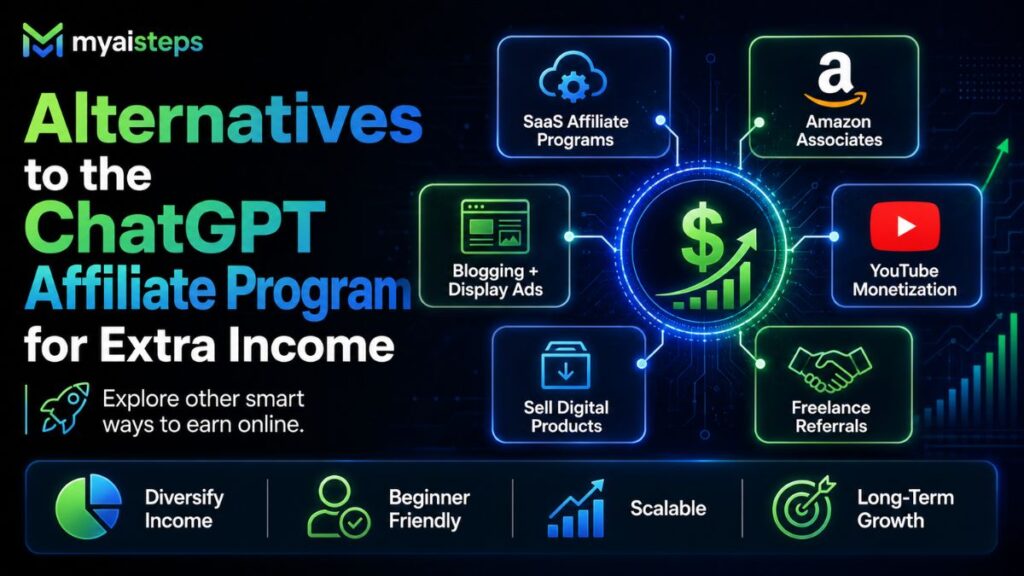
If you want to diversify your AI-related affiliate income, several other programs are worth exploring.
Jasper has an affiliate program that pays commissions on subscriptions to their AI writing platform. Since Jasper targets content teams and marketers, it suits audiences that skew toward professional content production rather than personal use. Commission rates and terms are available on their website.
Copy.ai and Writesonic both offer referral-based income for affiliates promoting AI writing and productivity tools. If your audience creates content for business or marketing purposes, these programs sit naturally alongside a ChatGPT recommendation rather than competing with it.
Notion AI has attracted a large user base among students, freelancers, and teams. Their affiliate or referral programs (availability varies by region) can work well if your audience overlaps with productivity and organization content.
Beyond AI-specific tools, platforms like ClickBank, ShareASale, and Impact host hundreds of software and SaaS programs. If you’re already using Impact for OpenAI’s program, discovering and applying to related programs is straightforward from the same dashboard.
The practical advice is to pick two or three programs that actually align with your content rather than signing up for dozens and spreading your effort thin. Depth of promotion on a few relevant products almost always outperforms shallow coverage of many.
Building affiliate income with any program takes longer than most people expect. The ChatGPT affiliate program works best when it fits naturally into content you’d be creating anyway — tutorials, comparisons, honest reviews, and practical guides that answer questions your audience is already asking. That kind of content ages well and keeps sending referrals without requiring constant attention.
Start with one or two solid pieces, track what performs, and build from there. There’s no shortcut to consistent affiliate income, but there is a straightforward path if you stay focused on being useful rather than just visible.
Conclusion
The ChatGPT affiliate program is a practical income option for content creators who already have an audience curious about AI tools, productivity, or digital work. It’s not a passive income setup that runs itself from day one — it takes consistent content, some patience with the approval process, and a genuine effort to recommend the product to people who’ll actually find it useful. When those pieces come together, the referrals tend to follow.
If you’re just getting started, focus on one or two well-researched pieces before worrying about scale. Understand your tracking, know your commission terms, and keep creating content that answers real questions. That’s the straightforward way to make affiliate income work over the long term.
Frequently Asked Questions
Does OpenAI have an affiliate program for ChatGPT?
Yes, OpenAI runs an affiliate program through the Impact platform where approved partners earn commissions on ChatGPT Plus referrals.
How much can you earn with the ChatGPT affiliate program?
Earnings depend on your referral volume and the current commission rate outlined in your Impact affiliate agreement.
Is the ChatGPT affiliate program free to join?
Yes, applying and participating as an affiliate is free — you only need an approved application and an Impact account.
How long does it take to get approved for the ChatGPT affiliate program?
Approval typically takes a few business days, though OpenAI reviews applications manually so timing can vary.
Can beginners apply for the ChatGPT affiliate program?
Yes, but having an active content platform with a relevant audience improves your chances of getting approved.