
If you’ve used ChatGPT to brainstorm ideas, polish a paragraph, or explain a tricky concept, you’ve probably asked yourself: do I actually need to cite this? You’re not alone. As AI tools become part of everyday student life, citing ChatGPT correctly has turned into one of the most searched academic writing questions of 2026.
The good news is that citing ChatGPT isn’t complicated once you understand the basic rules. Unlike a book or journal article, ChatGPT doesn’t have a human author, a fixed publication date, or a page number you can point to. That’s why APA, MLA, and Chicago style each treat it a little differently.
This guide walks you through exactly how to cite ChatGPT in APA 7th edition, MLA 9th edition, and Chicago style, with real examples you can copy and adapt. You’ll also learn when citation is actually required, which mistakes to avoid, and how university policies are handling AI-assisted work in 2026. Whether you’re writing a research paper, an essay, or a class assignment, this guide will help you use ChatGPT responsibly and stay on the right side of academic integrity.
What Does It Mean to Cite ChatGPT?
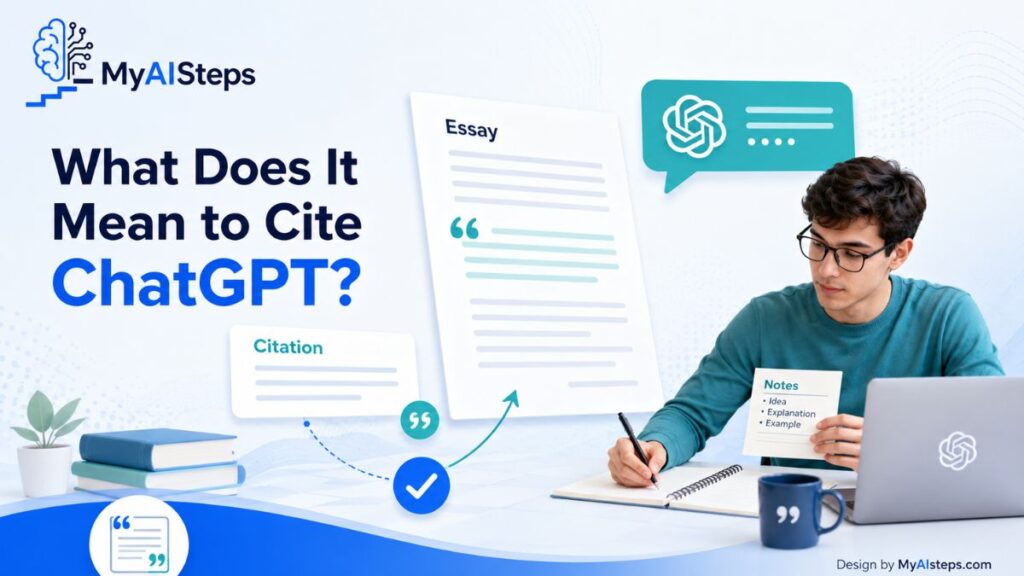
Citing ChatGPT means giving credit to the tool whenever its output shapes your written work. This applies whether you copy a sentence directly, paraphrase an explanation it gave you, or use it to generate an idea, an outline, or a data summary that ends up in your paper.
Here’s the tricky part: ChatGPT isn’t a traditional source. It doesn’t have a named human author, it can’t be cited as “personal communication” in the usual sense, and every conversation produces a unique response — even if two people type the exact same prompt. Because of this, style guides treat ChatGPT more like software than like a book or article.
In practice, citing ChatGPT usually involves two things:
- An in-text citation at the point where you use ChatGPT’s output (a paraphrase, a quote, or a generated idea).
- A reference list or works cited entry that identifies the tool, the company behind it (OpenAI), and the version you used.
Some instructors also ask for a short note describing how you used the tool — for example, “ChatGPT was used to draft an initial outline of this section, which was then revised and expanded” – especially if you used it for brainstorming rather than direct wording.
Why This Matters for Academic Integrity
Citing AI tools isn’t just a formatting formality. It’s about transparency. If a reader can’t tell which ideas are yours and which came from an AI model, that blurs the line between original work and borrowed content — even if nothing was technically “stolen” from a person. Treating ChatGPT like any other source you’d cite protects you from accusations of misrepresenting your own work.
When Should You Cite ChatGPT in Academic Writing?

Not every use of ChatGPT requires a citation, but many uses do. Here’s a simple way to think about it: if ChatGPT contributed content or ideas that appear in your paper, cite it. If you only used it as a tool to polish something you already wrote, a brief acknowledgment is usually enough.
You should cite ChatGPT when you:
- Directly quote text that ChatGPT generated.
- Paraphrase an explanation, argument, or summary it produced.
- Use data, an outline, or a list of ideas it created as part of your paper.
- Include an AI-generated image, chart, or code snippet in your work.
You should acknowledge (but may not need a formal citation for) functional uses, such as:
- Using ChatGPT to check grammar or improve sentence flow.
- Asking it to translate a phrase.
- Using it to reformat text you already wrote.
For these functional uses, a short note in your introduction or methods section — something like “This paper was edited for grammar and clarity using ChatGPT” — usually satisfies most instructors’ expectations.
Quick Tip
When in doubt, cite it anyway. Over-citing rarely causes problems, but under-citing can raise questions about originality. If you’re not sure what your professor expects, ask before you submit — policies vary a lot between departments, and even between individual instructors in the same department.
Common Beginner Mistake
A lot of students assume that because ChatGPT “isn’t a real source,” it doesn’t need citing at all. This is incorrect. If its output influenced your paper’s content, it needs the same transparency you’d give to a book, article, or website.
How to Cite ChatGPT in APA Style (7th Edition)
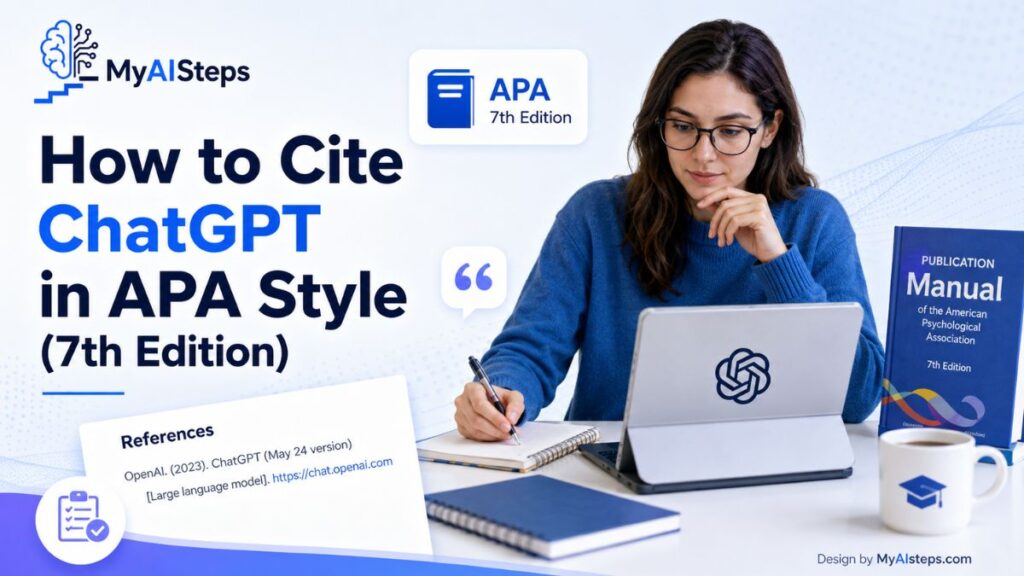
APA treats ChatGPT similarly to software, following the template used for algorithms and computer programs in the Publication Manual. Since ChatGPT has no individual human author, the company — OpenAI — is listed as the author.
In-Text Citation Format
Use a parenthetical citation with the company name and year:
(OpenAI, 2026)
Reference List Format
OpenAI. (2026). ChatGPT (Feb 2026 version) [Large language model]. https://chat.openai.com/chat
Break this down:
- Author: OpenAI (the company, not “ChatGPT”).
- Date: The year you used the tool.
- Title: ChatGPT, italicized, with the version noted in parentheses if known.
- Description: [Large language model], in square brackets.
- Source: The URL where the tool can be accessed.
Quoting ChatGPT’s Text
Because a specific chat session usually can’t be retrieved by your reader, APA recommends including the exact prompt you used directly in your text, followed by the AI-generated response in quotation marks:
When asked to explain confirmation bias in simple terms, ChatGPT responded that people “tend to search for and remember information that confirms what they already believe” (OpenAI, 2026).
If the response is long, APA suggests placing the full text in an appendix so readers can see exactly what was generated, since the same prompt can produce a different answer each time.
Where to Mention Your AI Use
APA recommends describing how you used ChatGPT in your Methods section, or in your introduction if you’re writing an essay or literature review rather than a research report.
Beginner Tip
If your version of ChatGPT provides a shareable chat link, some newer APA guidance (updated in 2025) allows including that link and a short chat title instead of the generic homepage URL — check your instructor’s preferred format, since practices are still evolving.
How to Cite ChatGPT in MLA Style (9th Edition)
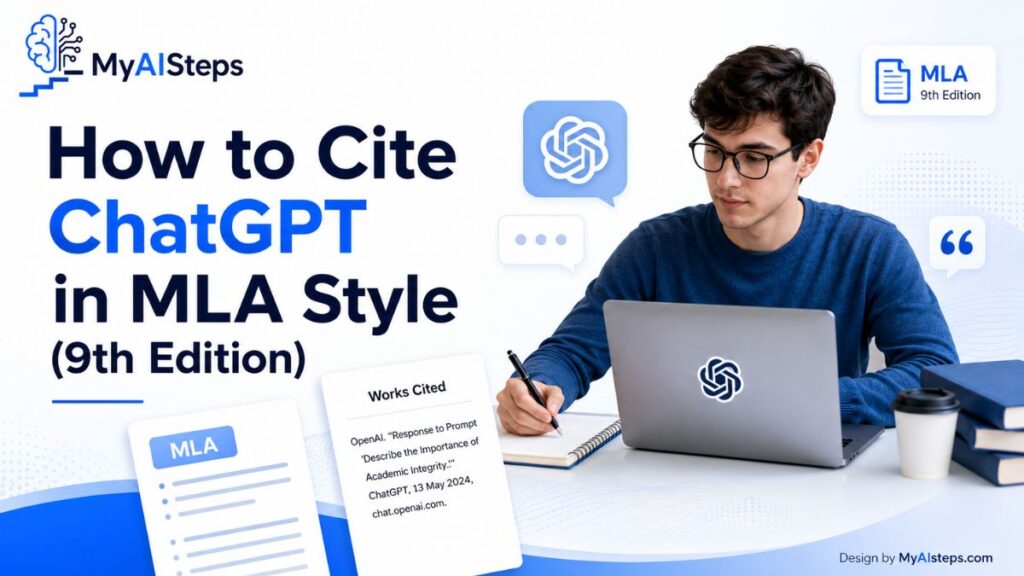
MLA uses its flexible “container” system, which is designed to handle new and unusual source types — including AI tools. Unlike APA, MLA does not treat ChatGPT as the author. Instead, the prompt becomes the title of the entry.
Works Cited Format
“Describe the causes of the French Revolution in simple terms” prompt. ChatGPT, 13 Jan. version, OpenAI, 3 Mar. 2026, chat.openai.com/chat.
Break this down:
- Title of source: Your prompt, in quotation marks, followed by the word “prompt.”
- Title of container: ChatGPT, italicized.
- Version: The version date, if shown.
- Publisher: OpenAI.
- Date: The date you generated the content.
- Location: The general URL for the tool.
In-Text Citation
MLA typically cites AI sources by the shortened title (the beginning of the prompt) since there’s no author name or page number to reference:
(“Describe the causes”)
Important MLA Rule
MLA explicitly advises against listing ChatGPT (or you, the user submitting the prompt) as the “author.” The author field is left out entirely — only the title, container, version, publisher, date, and location are used.
Citing Secondary Sources ChatGPT Mentions
If ChatGPT references other sources — book titles, articles, or statistics — always verify they’re real before citing them. AI tools sometimes generate citations for sources that don’t exist. If you use one of those secondary sources yourself, cite the original source directly, not just ChatGPT.
How to Cite ChatGPT in Chicago Style

Chicago style treats ChatGPT’s output as similar to a personal communication, cited in a footnote rather than in the bibliography, since chat sessions typically can’t be retrieved by another reader.
Footnote Format
If the prompt is already mentioned in your text:
- Text generated by ChatGPT, March 3, 2026, OpenAI, https://chat.openai.com/chat.
If the prompt is not mentioned in your text, include it in the footnote:
- ChatGPT, response to “Explain the difference between weather and climate,” March 3, 2026, https://chat.openai.com/chat.
Repeated Citations
If you cite ChatGPT again later in the same paper, Chicago allows a shortened note:
- ChatGPT.
Bibliography
Because Chicago treats AI chat output as a non-retrievable personal communication, it’s typically not included in the bibliography at all — only the footnote is required. Always confirm this with your instructor, since some departments prefer a bibliography entry regardless.
Editing Note
If you used ChatGPT to edit rather than generate text, mention this directly in the footnote:
- Text generated by ChatGPT, March 3, 2026, OpenAI, https://chat.openai.com/chat. Edited for style and clarity.
Examples of ChatGPT Citations for Essays and Research Papers
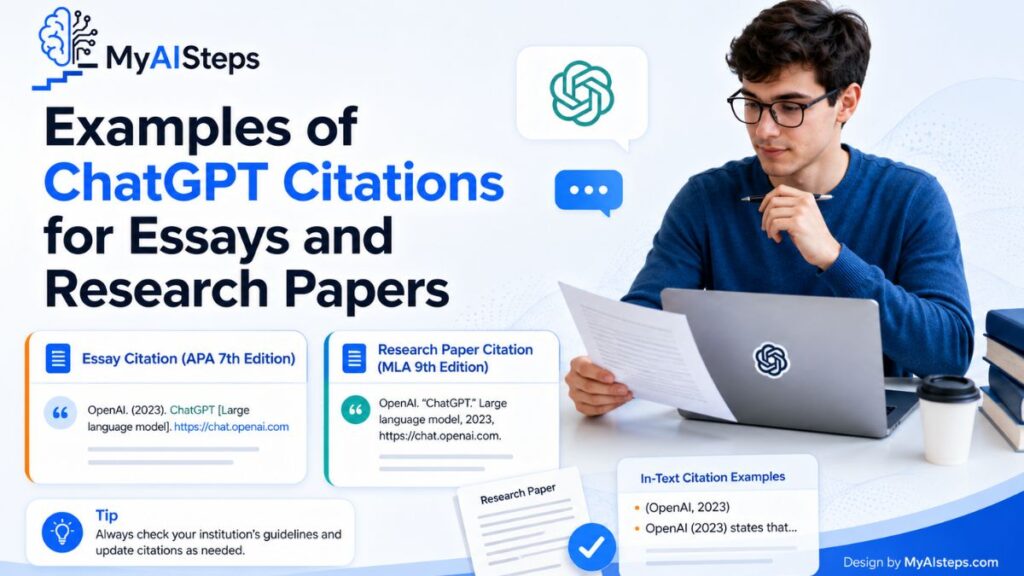
| Style | In-Text Citation | Reference/Works Cited Entry |
| APA 7th | (OpenAI, 2026) | OpenAI. (2026). ChatGPT (version) [Large language model]. https://chat.openai.com/chat |
| MLA 9th | (“Describe the causes”) | “Describe the causes of X” prompt. ChatGPT, version, OpenAI, date, chat.openai.com/chat. |
| Chicago | Footnote number | 1. ChatGPT, response to “prompt text,” date, https://chat.openai.com/chat. |
Example: Paraphrasing ChatGPT (APA)
ChatGPT’s explanation suggested that renewable energy adoption is often slowed by storage limitations rather than generation capacity (OpenAI, 2026).
Example: Quoting ChatGPT (MLA)
ChatGPT described photosynthesis as a process where “plants convert light energy into chemical energy stored in glucose” (“Explain photosynthesis”).
Example: Functional Use Acknowledgment (any style)
This essay was proofread for grammar and clarity using ChatGPT (OpenAI, 2026).
Common Mistakes to Avoid When Citing ChatGPT
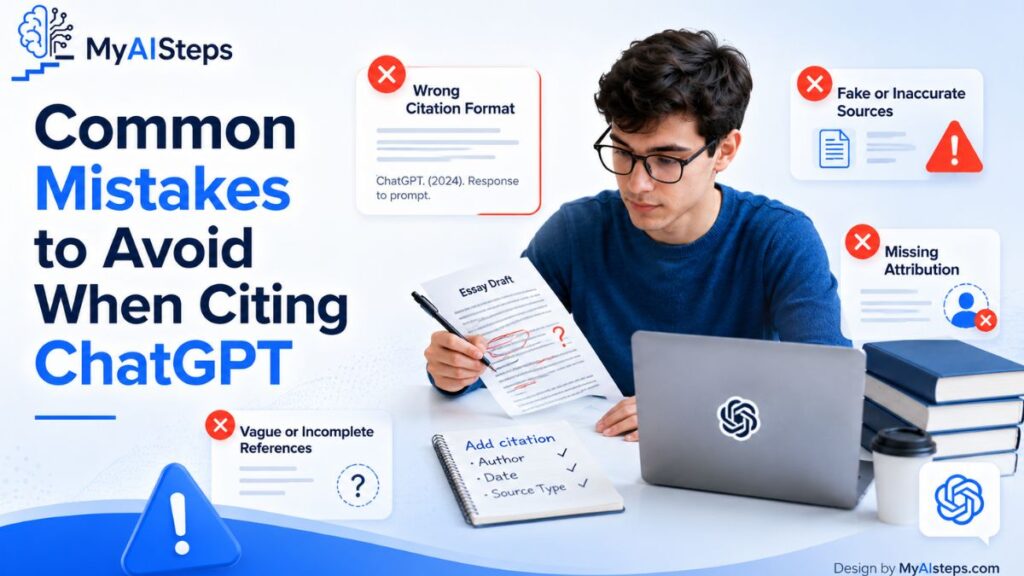
- Listing “ChatGPT” as the author in APA. The author is OpenAI, not the tool itself.
- Adding an author name in MLA. MLA deliberately skips the author field for AI tools.
- Forgetting the version or date. Since responses change over time, the date you generated the content matters.
- Treating ChatGPT as a factual source without verification. AI tools can generate confident-sounding but incorrect information, including fake citations — always double-check facts and sources independently.
- Citing it once but never mentioning how it was used. Many instructors expect a short description of your AI use, not just a citation.
- Assuming citation makes any use acceptable. If your instructor prohibits AI tools for an assignment, citing ChatGPT does not make that use permitted — it only documents what happened.
- Using a direct chat link when your style guide asks for the general URL. MLA and Chicago typically prefer the tool’s homepage URL unless your instructor says otherwise.
Do Universities Allow the Use of ChatGPT in Assignments?

This depends entirely on the institution, the department, and sometimes the individual instructor. Policies generally fall into three categories:
- Fully permitted with disclosure: Some courses allow AI tools for brainstorming, editing, or research support, as long as you cite and disclose their use.
- Permitted for specific tasks only: Many instructors allow grammar checking or idea generation but prohibit using AI-generated text directly in submitted work.
- Prohibited entirely: Some courses, especially those testing writing skill itself, ban AI tool use outright, regardless of citation.
Warning
Always check your syllabus or ask your instructor directly before using ChatGPT for an assignment. Citing an AI tool properly does not override a professor’s policy — if AI use is banned for an assignment, using it (even with a citation) can still be treated as an academic integrity violation.
A Practical Habit
Before starting any assignment, it’s worth spending two minutes checking the course’s AI policy. Requirements can differ even between two classes in the same department, and policies are being updated frequently as universities adjust to how students actually use these tools.
Best Practices for Using ChatGPT Responsibly in Academic Work

Do:
- Use ChatGPT to brainstorm, outline, or clarify concepts you’re struggling with.
- Verify any facts, statistics, or sources it provides before including them.
- Keep a record of your prompts, in case your instructor asks for them.
- Disclose your AI use clearly, even when a formal citation isn’t strictly required.
- Treat ChatGPT’s output as a starting point, not a finished product.
Avoid:
- Submitting AI-generated text as your own original writing without disclosure.
- Relying on ChatGPT for specialized statistics, legal information, or medical claims without independent verification.
- Assuming AI-generated citations are accurate — always check that referenced books, studies, or articles actually exist.
- Using ChatGPT as your only source for a research-heavy assignment; it works best as a supplement to your own reading and analysis.
Expert Tip
If your paper leans heavily on original research or a specific methodology, consider explaining your AI use in a short methods note, even if your citation style doesn’t strictly require one. This builds trust with your reader and shows exactly where your independent thinking begins.
How Citation Rules for AI Tools May Change in the Future
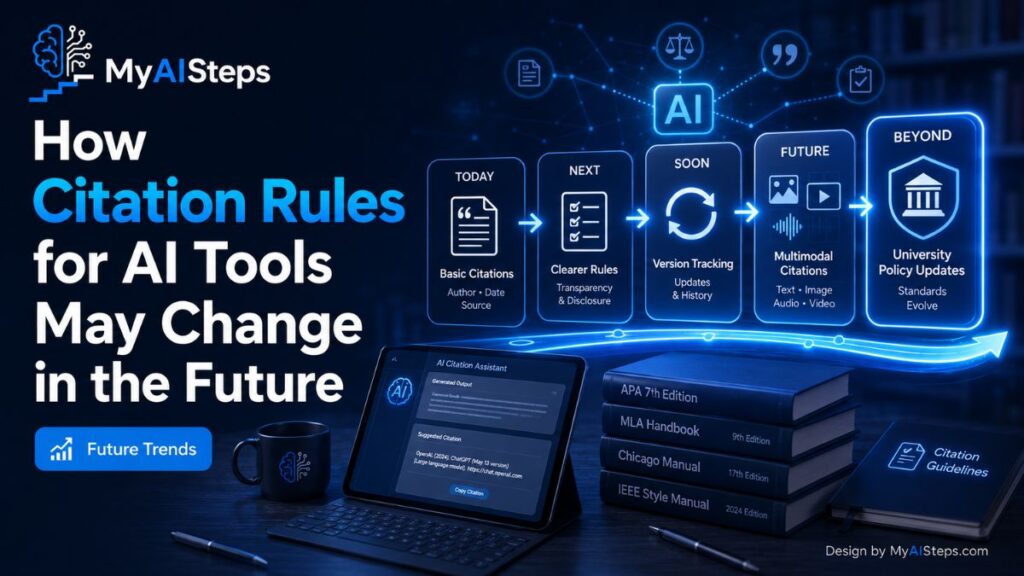
- More standardized formats. As AI use becomes routine in classrooms, expect APA, MLA, and Chicago to converge on clearer, more specific rules — including for newer models beyond ChatGPT.
- Version-specific citation expectations. As models update more frequently, style guides may require more precise version tracking than just a date.
- Clearer rules for multimodal content. Citing AI-generated images, audio, and video is still evolving, and dedicated formats are likely to mature further.
- Institutional policies catching up. Universities are actively updating academic integrity policies to address AI use directly, rather than relying on generic plagiarism rules written before these tools existed.
The safest long-term habit is simple: check your style guide’s official website (APA Style, MLA Style Center, or the Chicago Manual of Style Online) before submitting any paper that uses AI tools, since these organizations update their guidance more often than most printed handbooks do.
Conclusion
Citing ChatGPT doesn’t have to feel confusing once you understand the logic behind it. APA treats OpenAI as the author, MLA skips the author field entirely and leads with your prompt, and Chicago tucks the citation into a footnote. What matters most isn’t memorizing every format perfectly — it’s being transparent about how AI shaped your work. Cite it when its content appears in your paper, disclose it when you use it as an editing tool, and always check your instructor’s policy first. Citation rules for AI are still evolving, so it’s worth revisiting the official APA, MLA, or Chicago style pages before every major assignment. Used thoughtfully and cited properly, ChatGPT can be a genuinely useful part of your academic toolkit — not a shortcut, but a support for your own thinking and writing.
Frequently Asked Questions
Do I need to cite ChatGPT if I only used it for grammar checking?
Usually not a formal citation, but a short note in your paper acknowledging the edit is good practice and often expected.
Is ChatGPT considered a reliable academic source?
No. Always verify facts and citations it provides against real, credible sources before using them.
Can I cite a specific ChatGPT model like GPT-4 or GPT-5?
Yes, include the model name and version date in your citation whenever that information is available.
What if my professor doesn’t allow ChatGPT at all?
Don’t use it for that assignment. Citing it properly doesn’t make a prohibited use acceptable.
Does MLA list ChatGPT as the author?
No. MLA deliberately omits an author field and starts the entry with your prompt instead.
Should I include my full ChatGPT conversation in my paper?
Not usually, but you can add long responses as an appendix so readers can see exactly what was generated.
Will citation rules for ChatGPT stay the same in the future?
Probably not exactly. Guidelines have already changed since 2023, so always check the latest official style guide before submitting.