
Finding the right AI assistant in 2026 is no longer a simple decision. Artificial intelligence tools have evolved far beyond answering basic questions, and millions of people now use them for studying, writing emails, planning schedules, brainstorming ideas, and managing everyday tasks. As a result, the debate around ChatGPT vs Claude for personal use has become increasingly important for students, professionals, freelancers, and casual users alike. Choosing the wrong assistant can mean wasting time, while choosing the right one can significantly improve productivity and simplify daily life.
Both ChatGPT and Claude are among the most advanced AI chatbots available today, yet they serve users in different ways. While ChatGPT focuses on versatility, multimodal capabilities, and real-time assistance, Claude emphasizes thoughtful reasoning, long-document analysis, and natural writing. This comparison explores their differences in practical, real-world situations so you can determine which AI assistant deserves a place in your daily routine.
What Is the Difference Between ChatGPT and Claude for Personal Use?
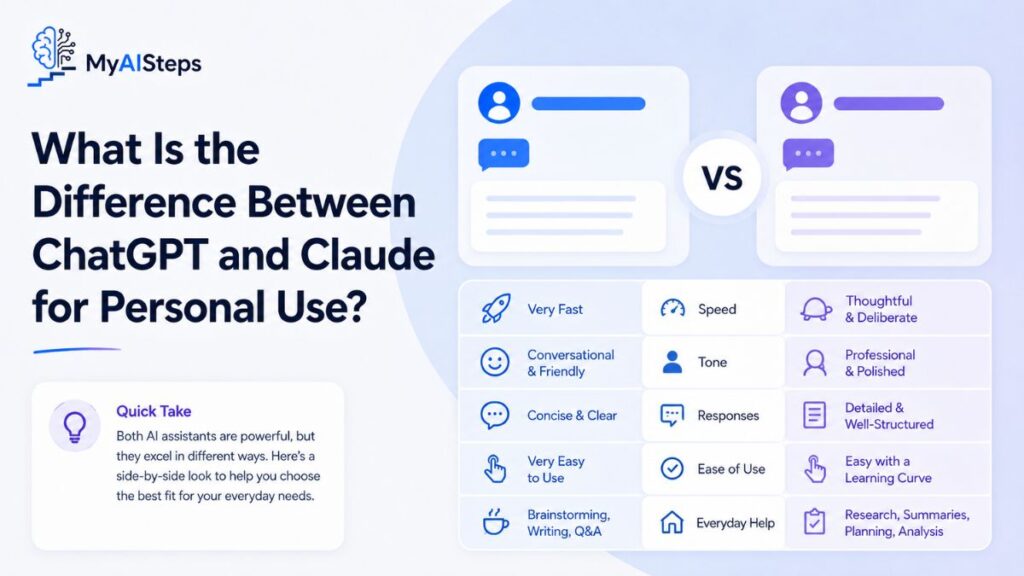
Short answer: ChatGPT is generally better for users who need a versatile AI assistant with voice, image generation, and real-time web access, while Claude excels at long-form writing, document analysis, and careful reasoning.
At first glance, ChatGPT and Claude appear remarkably similar. Both can answer questions, write content, summarize information, brainstorm ideas, and assist with everyday tasks. However, their design philosophies differ significantly.
ChatGPT, developed by OpenAI, aims to function as an all-purpose AI companion. It combines conversational AI with tools such as web browsing, image generation, voice interaction, and customizable assistants. This broad ecosystem makes ChatGPT attractive for users who frequently switch between different tasks throughout the day.
Claude, developed by Anthropic, takes a more focused approach. Instead of prioritizing numerous features, Claude concentrates on contextual understanding, detailed reasoning, and producing thoughtful responses. Many users appreciate Claude because its answers often feel deliberate, nuanced, and less rushed.
For example, imagine planning a family vacation. ChatGPT may instantly generate a complete itinerary, suggest attractions, provide restaurant recommendations, and even create travel-related images. Claude, on the other hand, is more likely to ask additional questions regarding budget, travel preferences, and timing before delivering a carefully structured plan.
This distinction extends into everyday use as well.
Key Philosophical Differences
| Aspect | ChatGPT | Claude |
| Primary focus | Versatility and multimodal experiences | Reasoning and contextual understanding |
| Developed by | OpenAI | Anthropic |
| Best for | Mixed daily tasks and multimedia workflows | Reading, writing, and deep analysis |
| Typical response style | Fast, conversational, feature-rich | Thoughtful, detailed, and measured |
Another major difference appears when users upload lengthy documents. Claude built much of its reputation on analyzing dense materials such as contracts, research papers, legal agreements, and lengthy reports. ChatGPT also performs well with long documents, but its broader feature set often means it prioritizes flexibility alongside comprehension.
Ultimately, neither approach is objectively superior. The better choice depends on how you intend to use an AI assistant in your personal life.
ChatGPT vs Claude: Key Features Compared for Everyday Users
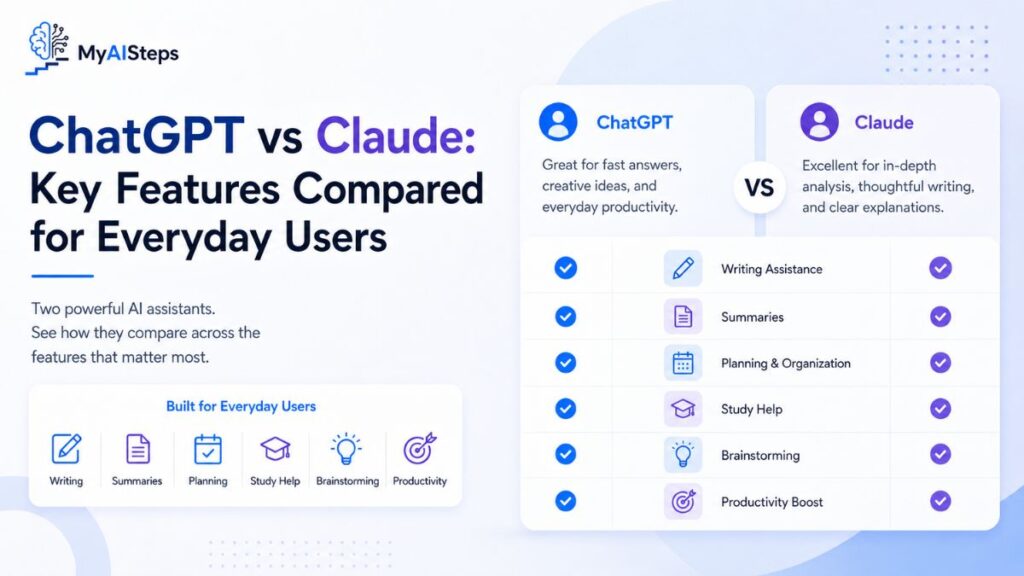
Short answer: ChatGPT offers broader functionality, while Claude prioritizes text quality, context retention, and long-document understanding.
When evaluating AI assistants for personal use, features matter because they directly affect your daily experience. The following comparison highlights the capabilities that most users care about.
| Feature | ChatGPT | Claude |
| Free Plan | Available with usage limits | Available with daily limits |
| Paid Plan | Plus plan and premium tiers | Pro plan and premium tiers |
| Real-Time Web Access | Yes | Limited |
| Image Generation | Built-in | Limited |
| Voice Conversations | Advanced voice mode | Basic voice features |
| Long Document Analysis | Very good | Excellent |
| Customization | Custom GPTs and memory | Projects and writing styles |
| Mobile Experience | Highly feature-rich | Clean and focused |
| Coding Assistance | Excellent | Very good |
| Third-Party Integrations | Extensive | More limited |
Several of these differences become increasingly noticeable during everyday use.
Free Plans and Accessibility
For occasional users, both free plans provide sufficient functionality. Someone asking a few questions per day, rewriting emails, or seeking quick explanations may never encounter meaningful limitations.
However, heavy users often notice differences quickly. ChatGPT’s free plan can reduce access to advanced models after certain usage thresholds are reached. Claude’s free plan operates differently, typically using daily limits that reset after a specified period.
Customization and Personalization
Customization represents another important distinction.
ChatGPT allows users to create and use custom GPTs designed for specific purposes. For example, someone could build dedicated assistants for meal planning, budgeting, language learning, or fitness coaching.
Claude approaches personalization through Projects and saved writing preferences. This system works especially well for users managing ongoing tasks that require consistent context, such as long-term research, personal journaling, or document-heavy projects.
Privacy Considerations
Privacy-conscious individuals should review settings carefully regardless of platform.
Both OpenAI and Anthropic provide privacy controls, but default settings and policies may change over time. Before regularly sharing personal information, users should examine available privacy options, data retention policies, and training preferences inside their account settings.
For sensitive information such as financial records, medical documents, or legal paperwork, exercising caution remains advisable regardless of which AI platform you choose.
Which AI Assistant Is Better for Writing, Studying, and Daily Tasks?
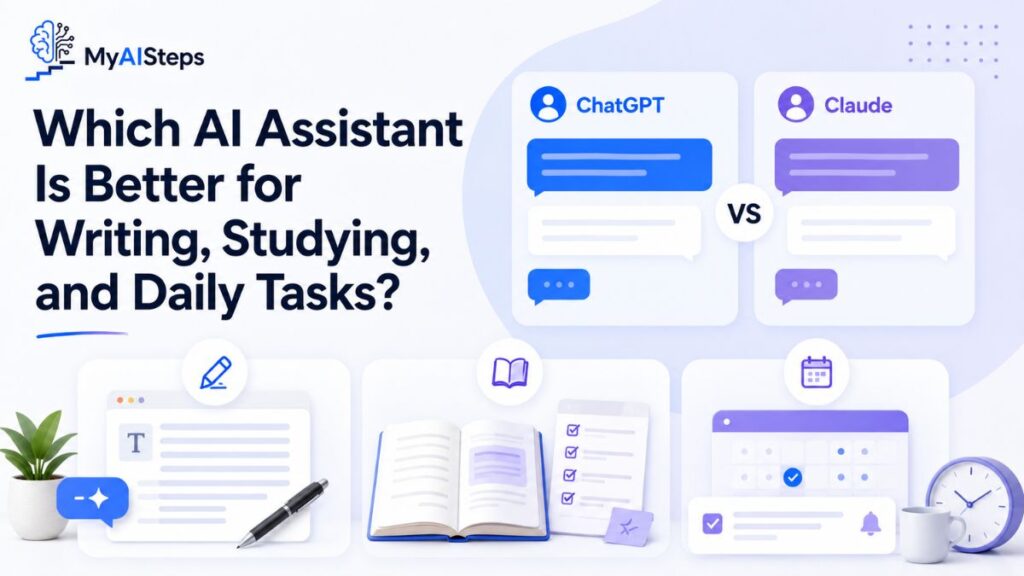
Short answer: Claude is generally stronger for long-form writing and document-based study, while ChatGPT performs better for multimedia learning, quick research, and diverse everyday tasks.
This is often the section that matters most because real-world usefulness outweighs technical specifications.
For Personal Writing
People frequently use AI assistants for writing emails, social media posts, cover letters, speeches, and personal messages.
Claude often produces writing that feels more natural and polished from the first draft. It tends to vary sentence structure effectively and provides straightforward editorial feedback when revising existing content. Users writing long articles, personal essays, newsletters, or thoughtful correspondence frequently appreciate Claude’s writing style.
ChatGPT performs exceptionally well when writing intersects with visual or multimedia content. For example, creating an Instagram caption alongside a generated image or producing promotional copy for a small side project becomes much easier within ChatGPT’s broader ecosystem.
For Studying and Learning
Students increasingly rely on AI assistants as study companions.
Claude excels when learning involves large volumes of text. Research papers, lecture notes, textbooks, and lengthy academic readings can be summarized and explained with impressive depth. Many students find Claude particularly useful for understanding complex concepts because its explanations tend to remain closely grounded in source material.
ChatGPT shines when studying requires multiple formats.
Examples include:
Explaining diagrams.
Generating quizzes.
Providing coding assistance.
Conducting voice-based revision sessions.
Finding up-to-date information online.
Students in technical fields such as computer science, engineering, and mathematics often benefit from ChatGPT’s broader capabilities.
For Everyday Productivity
Everyday tasks rarely involve only one activity.
A typical day may include:
Drafting messages.
Planning meals.
Creating shopping lists.
Comparing products.
Organizing schedules.
Brainstorming gift ideas.
For these situations, ChatGPT often feels like a digital Swiss Army knife because of its speed, voice functionality, image capabilities, and flexible toolset.
Claude remains highly capable for daily productivity, particularly when tasks involve thoughtful decision-making, detailed comparisons, or nuanced discussions that require deeper reasoning.
For many users, the answer to the ChatGPT vs Claude for personal use question ultimately depends on whether they prioritize versatility or depth.
ChatGPT vs Claude for Personal Productivity: A Detailed Comparison
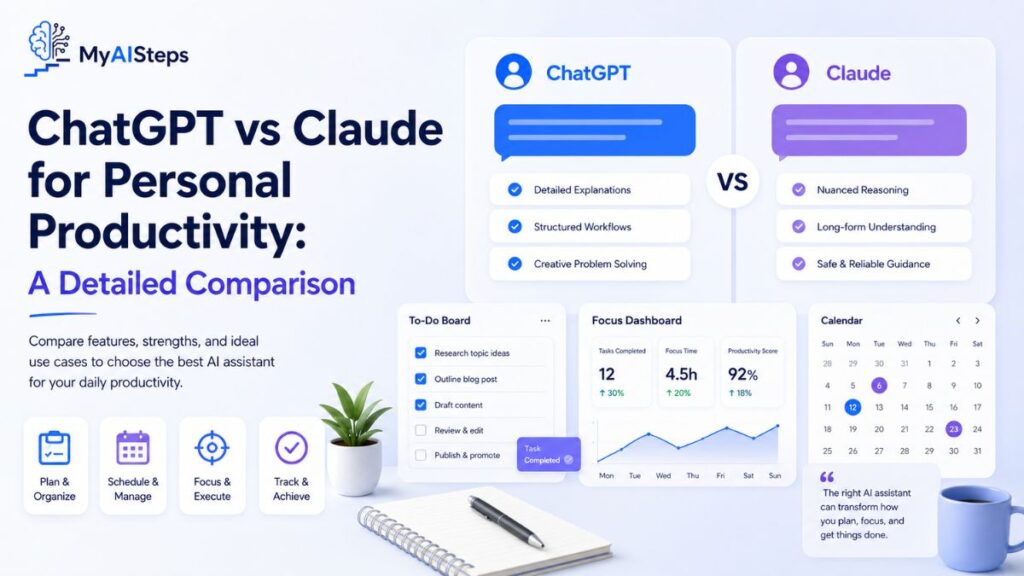
Short answer: ChatGPT is generally better for users who need flexibility across multiple daily tasks, while Claude is often the stronger option for long-term projects, detailed planning, and complex decision-making.
Personal productivity isn’t about getting one good answer. It’s about whether an AI assistant can help you manage multiple related tasks without constantly forcing you to repeat information.
Consider something as common as planning a home move.
With ChatGPT, you can create a moving checklist, build a packing schedule, estimate costs, and organize reminders within the same conversation. Thanks to memory features and customizable assistants, ChatGPT can streamline many recurring personal tasks.
Claude approaches productivity differently. Its Projects feature allows users to keep related documents, notes, and conversations in a single workspace. Someone managing a long-term goal—such as paying off debt, organizing a job search, or planning a major event—may appreciate Claude’s ability to maintain focus across extended discussions.
Productivity Scenarios: Which AI Performs Better?
| Productivity Task | ChatGPT | Claude |
| Daily planning | Excellent | Very Good |
| Goal tracking | Very Good | Excellent |
| Long-term projects | Very Good | Excellent |
| Budget planning | Good | Excellent |
| Brainstorming ideas | Excellent | Very Good |
| Managing documents | Very Good | Excellent |
| Quick task assistance | Excellent | Very Good |
Another important distinction involves transparency.
For example, if you ask both assistants to create a debt repayment strategy, Claude often explains exactly how it arrived at specific recommendations, including assumptions and calculations. ChatGPT usually presents the information in a more conversational and user-friendly format, which many people find easier to digest.
Neither platform can independently send reminders, schedule appointments, or manage your calendar without additional integrations. However, both can dramatically reduce the time spent organizing and planning everyday activities.
How Do ChatGPT and Claude Handle Conversations and Context?

Short answer: Both AI assistants maintain context well, but Claude often performs better during extremely long conversations, while ChatGPT offers stronger cross-conversation memory features.
One of the biggest frustrations users experience with AI assistants is repetition. Nobody wants to explain the same information repeatedly.
Fortunately, both ChatGPT and Claude perform well when maintaining conversational context.
Claude has earned a strong reputation for handling lengthy discussions without losing important details. If you spend hours discussing a research project, legal document, or personal planning scenario, Claude usually remembers earlier details accurately and incorporates them naturally into later responses.
Imagine planning a dinner party.
You mention early in the conversation that one guest has a severe peanut allergy. Twenty exchanges later, when discussing desserts, Claude will usually continue respecting that restriction without requiring another reminder.
ChatGPT also tracks conversational context effectively. Additionally, paid versions include persistent memory capabilities that can remember preferences across separate conversations over time.
For example, ChatGPT may remember:
Your preferred writing tone.
Favorite cuisines.
Frequently used formatting styles.
Recurring project preferences.
This long-term memory creates a more personalized experience for many users.
Context Comparison at a Glance
| Context Capability | ChatGPT | Claude |
| Single-session memory | Excellent | Excellent |
| Very long conversations | Very Good | Excellent |
| Cross-chat memory | Available | Limited |
| Persistent personalization | Strong | Moderate |
| Context accuracy in long documents | Very Good | Excellent |
Another noticeable difference involves clarification.
When presented with a vague request such as:
“Help me plan a vacation.”
Claude is more likely to ask follow-up questions about budget, destination, and travel dates before answering.
ChatGPT often makes reasonable assumptions first and then adjusts based on feedback.
Neither approach is inherently better. Some users appreciate Claude’s caution, while others prefer ChatGPT’s speed.
Comparing ChatGPT and Claude for Creativity, Brainstorming, and Content Writing

Short answer: ChatGPT typically generates a larger volume of creative ideas quickly, while Claude often produces more polished, natural, and nuanced long-form content.
Creativity is highly subjective, which makes this comparison especially interesting.
When brainstorming ideas, ChatGPT generally prioritizes variety and speed. Ask for business names, YouTube channel ideas, social media campaigns, or marketing concepts, and you’ll often receive a broad range of options almost instantly.
Claude tends to generate fewer suggestions, but the ideas frequently include additional reasoning and stronger contextual relevance.
For Content Creators
Content creators often need assistance with:
Blog posts
Newsletters
Video scripts
Social media captions
Email campaigns
Content calendars
Claude usually excels when producing long-form drafts because its writing often feels more natural and less formulaic. Many writers find that Claude requires fewer editing rounds before publication.
ChatGPT, however, offers significant advantages for multimedia creators. Someone managing a blog, YouTube channel, or social media brand can brainstorm ideas, draft content, generate supporting images, and conduct additional research without leaving the platform.
Creativity Comparison Table
| Creative Task | ChatGPT | Claude |
| Brainstorming volume | Excellent | Very Good |
| Long-form articles | Very Good | Excellent |
| Storytelling | Very Good | Excellent |
| Social media content | Excellent | Very Good |
| Script writing | Very Good | Excellent |
| Visual content creation | Excellent | Limited |
| Idea diversity | Excellent | Very Good |
Which AI Is Better for Writers?
For writers, journalists, bloggers, and researchers, the answer depends largely on workflow.
Choose Claude if you prioritize:
Natural writing quality.
Long-form content creation.
Detailed editing feedback.
Nuanced language.
Choose ChatGPT if you need:
Faster ideation.
Multimedia support.
Visual content generation.
Research assistance alongside writing.
Ultimately, many experienced content creators use both tools together—leveraging ChatGPT for brainstorming and multimedia tasks while relying on Claude for refining and polishing final drafts.
ChatGPT vs Claude Pricing: Which Option Offers Better Value for Personal Users?
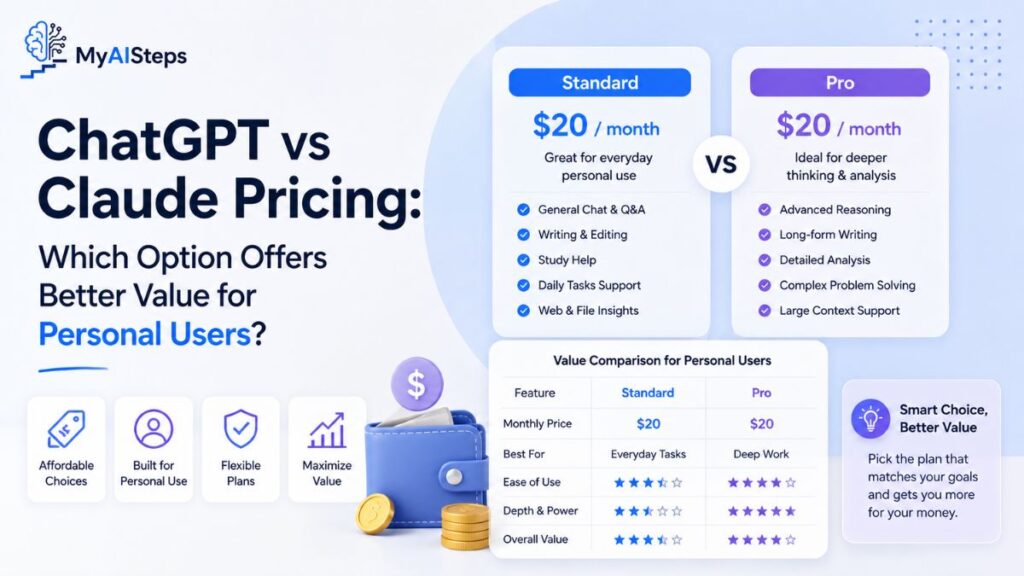
Short answer: Both ChatGPT and Claude offer excellent value at the entry-level paid tier, but the better option depends on how you use AI in your daily life.
Pricing matters because even the most powerful AI assistant isn’t useful if it doesn’t fit your budget or usage patterns.
For light users who only ask a few questions each week, both platforms offer free plans that are more than sufficient. If you primarily use AI for writing occasional emails, checking facts, or brainstorming ideas, upgrading immediately may not be necessary.
However, people who rely on AI daily for studying, writing, planning, or professional tasks often benefit significantly from paid subscriptions.
Pricing Comparison
| Pricing Factor | ChatGPT | Claude |
| Free Plan | Yes | Yes |
| Entry Paid Plan | Around $20/month | Around $20/month |
| Premium Plans | Higher usage tiers available | Higher usage tiers available |
| Best For | Multimedia and versatility | Writing and deep analysis |
For most personal users, the standard paid plan provides enough access without needing premium enterprise-level subscriptions.
If your daily workflow includes:
- Voice conversations
- Image generation
- Real-time web research
- Coding assistance
then ChatGPT often provides better overall value.
On the other hand, users who spend hours reading documents, writing reports, or analyzing information may find Claude’s subscription offers stronger value despite having fewer multimedia features.
The reality is simple: neither platform is universally cheaper or better. Value depends entirely on your personal workflow.
Is ChatGPT or Claude Better for Students, Freelancers, and Professionals?

Short answer: Claude is generally better for students and professionals working with long documents, while ChatGPT often suits technical users, freelancers, and individuals needing diverse tools.
Different users have different needs, which means the ideal AI assistant varies by profession and lifestyle.
For Students
Students frequently need help with:
Understanding difficult concepts.
Summarizing textbooks.
Preparing study notes.
Reviewing research papers.
Practicing for exams.
Claude performs exceptionally well in these situations because it handles lengthy academic material with remarkable consistency.
A university student preparing for exams can upload lecture notes, ask for simplified explanations, and generate revision summaries in one conversation.
ChatGPT, meanwhile, excels when students require:
Coding assistance.
Interactive learning.
Quiz generation.
Diagram explanations.
Real-time research.
Computer science, engineering, and technology students often prefer ChatGPT because of its broader technical capabilities.
For Freelancers
Freelancers need speed, flexibility, and reliability.
Writers, editors, and consultants often appreciate Claude because its long-form writing quality feels polished and natural.
Developers, marketers, and technical freelancers frequently lean toward ChatGPT due to:
Strong coding capabilities.
Integrations.
Real-time browsing.
Multimedia support.
For Professionals
Professionals dealing with contracts, reports, proposals, and research-heavy tasks often benefit from Claude’s contextual understanding.
However, professionals requiring quick answers, current information, collaboration tools, and productivity integrations usually find ChatGPT more practical.
User Type Comparison Table
| User Type | Recommended Choice |
| Students | Claude (general study) / ChatGPT (technical study) |
| Writers | Claude |
| Developers | ChatGPT |
| Researchers | Claude |
| Marketers | ChatGPT |
| Consultants | Claude |
| General Personal Users | ChatGPT |
| Multimedia Creators | ChatGPT |
What Are the Pros and Cons of Using ChatGPT and Claude Personally?
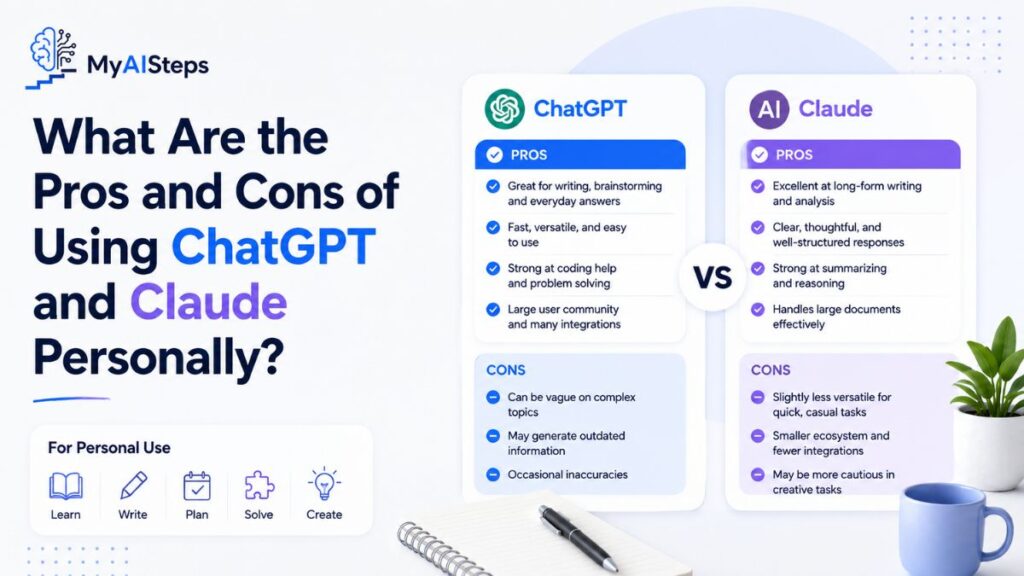
Short answer: ChatGPT excels in versatility and multimedia capabilities, while Claude shines in writing quality, reasoning, and long-document understanding.
No AI assistant is perfect. Understanding the strengths and limitations of both platforms helps set realistic expectations.
ChatGPT Pros
Excellent versatility.
Strong coding support.
Built-in image generation.
Real-time web browsing.
Voice conversations.
Extensive customization options.
Large ecosystem of integrations.
ChatGPT Cons
Can occasionally provide overly confident incorrect answers.
Advanced features often require paid plans.
Very long conversations may occasionally drift off-topic.
Claude Pros
Outstanding long-document analysis.
Highly natural writing quality.
Strong contextual understanding.
Excellent reasoning capabilities.
Consistent performance during lengthy discussions.
Claude Cons
Fewer multimedia capabilities.
Smaller integration ecosystem.
Limited real-time information compared to ChatGPT.
Pros and Cons Comparison
| Feature | ChatGPT | Claude |
| Long Document Handling | Very Good | Excellent |
| Real-Time Information | Excellent | Moderate |
| Writing Quality | Very Good | Excellent |
| Coding | Excellent | Very Good |
| Image Generation | Yes | Limited |
| Context Retention | Very Good | Excellent |
| Integrations | Extensive | Limited |
| Overall Versatility | Excellent | Very Good |
Final Verdict: Should You Choose ChatGPT or Claude for Personal Use in 2026?
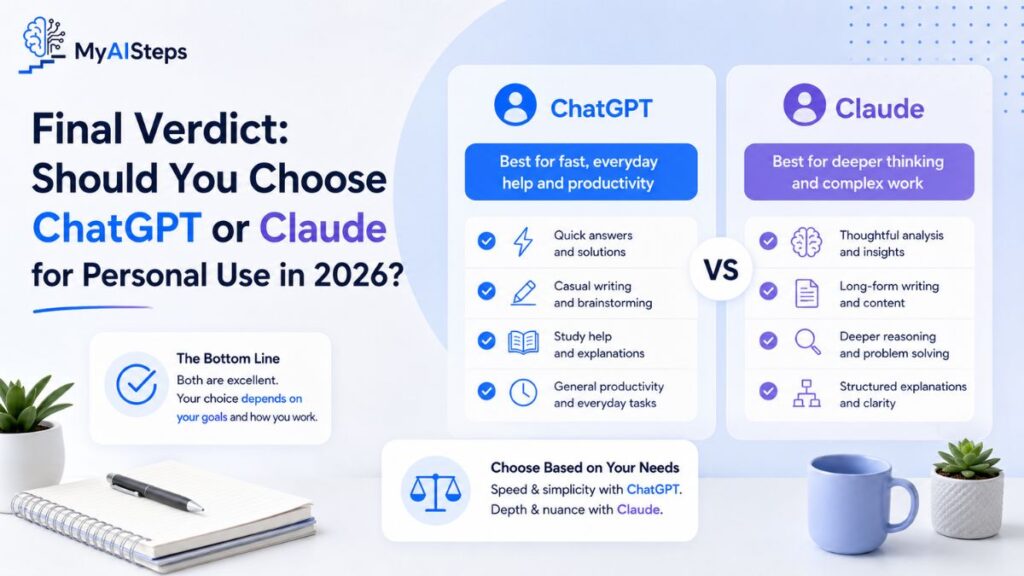
Short answer: Choose ChatGPT if you value versatility, multimedia features, and real-time assistance. Choose Claude if you prioritize deep thinking, writing quality, and document analysis.
After comparing both AI assistants across multiple categories, one conclusion becomes clear: there is no universal winner.
ChatGPT stands out as a highly versatile AI assistant capable of handling a broad range of daily tasks. Its voice mode, web access, image generation, and extensive ecosystem make it an excellent choice for users seeking an all-in-one digital companion.
Claude, meanwhile, excels when tasks involve careful reasoning, detailed analysis, and long-form writing. Users who spend significant time reading, researching, or producing content often appreciate Claude’s thoughtful and context-aware responses.
Choose ChatGPT if you:
Need real-time internet access.
Frequently work with code.
Want image generation.
Prefer voice interactions.
Need one AI tool for many different tasks.
Choose Claude if you:
Regularly analyze long documents.
Write detailed articles or reports.
Value nuanced, natural writing.
Need strong contextual understanding.
Prioritize depth over speed.
Many advanced users ultimately use both platforms together, selecting the right tool depending on the task at hand.
Conclusion
Both ChatGPT and Claude have matured into exceptionally capable AI assistants for personal use in 2026. While ChatGPT offers versatility, multimedia functionality, and broad everyday usefulness, Claude delivers deeper reasoning, stronger long-form writing, and excellent document comprehension. Neither platform is objectively superior in every situation.
The best choice depends entirely on your personal needs, workflow, and priorities. If possible, try both assistants using real tasks from your daily life. Your own experience will reveal which AI assistant feels more natural, productive, and valuable over time.
Frequently Asked Questions (FAQs)
Is Claude better than ChatGPT for long-form writing?
Yes. Claude generally produces more natural, polished, and contextually consistent long-form content, making it a strong choice for articles, reports, and detailed documents.
Can I use ChatGPT and Claude together?
Absolutely. Many users use both AI assistants side by side and switch between them depending on the task they need to complete.
Is ChatGPT free for personal use?
Yes. ChatGPT offers a free plan with basic functionality, although some advanced features require a paid subscription.
Which AI assistant is better for students?
Claude is typically better for reading and summarizing lengthy academic material, while ChatGPT excels at coding help, interactive learning, and quick research.
Does Claude have real-time internet access?
Claude offers limited web access compared to ChatGPT. Users who require current information frequently may prefer ChatGPT.
Which AI assistant is easier for beginners?
Both platforms are beginner-friendly. However, many first-time users find ChatGPT slightly easier because of its broader feature set and intuitive interface.