
Most people assume that getting better results from ChatGPT simply means asking better questions. In reality, the quality of an AI response depends far more on how the request is structured than on the topic itself. A ChatGPT Wrapped Prompt helps remove ambiguity by combining context, role, audience, tone, formatting, and clear instructions into a single, well-organized request. This structured approach produces responses that are more accurate, relevant, and useful while reducing the need for repeated revisions. Whether you’re creating content, studying, planning projects, or solving business problems, learning how to wrap a prompt can significantly improve your AI experience.
As AI tools continue to evolve in 2026, writing effective prompts has become an essential skill rather than an optional one. This guide explains what a ChatGPT Wrapped Prompt is, why it works, and how to create one using proven techniques and real-world examples. By the end, you’ll have a practical framework that helps you generate consistently high-quality AI responses for almost any task.
What Is a ChatGPT Wrapped Prompt?
Quick Answer
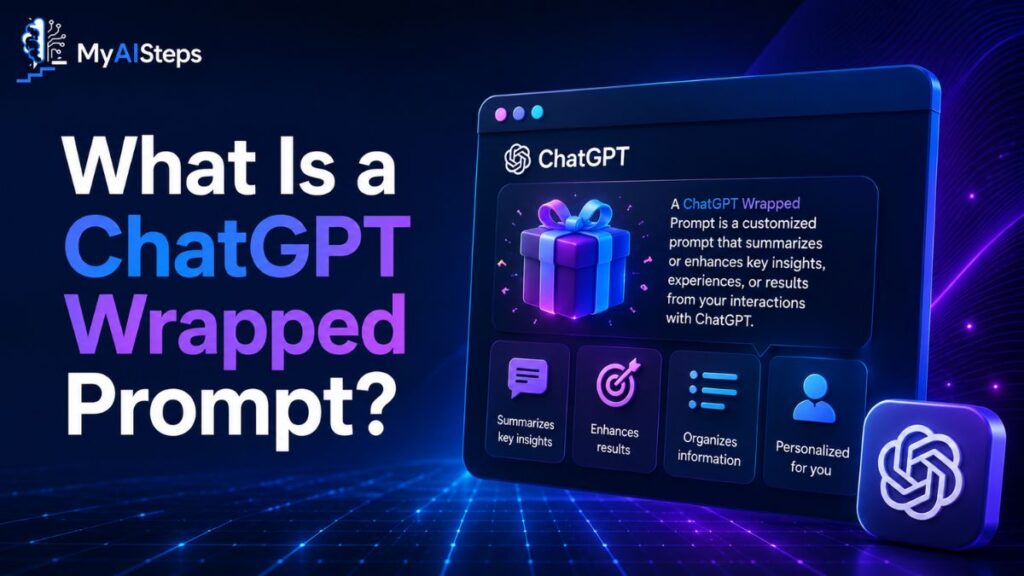
A ChatGPT Wrapped Prompt is a structured prompt that combines your main request with additional details such as role, context, audience, tone, format, and specific instructions. This reduces guesswork and helps ChatGPT generate more accurate, relevant, and consistent responses.
A ChatGPT Wrapped Prompt is a carefully structured way of communicating with AI instead of relying on a short, open-ended request. Rather than asking a simple question and hoping for the best, you provide enough context to guide the AI toward your intended outcome. This technique is widely used in prompt engineering because it improves response quality without making the prompt unnecessarily complicated.
For example, instead of writing:
“Write a product description.”
A wrapped prompt would be:
“Act as an experienced eCommerce copywriter. Write a 120-word product description for lightweight running shoes designed for beginner runners. Use a friendly tone, highlight comfort and breathability, avoid technical jargon, and end with a persuasive call to action.”
The second version gives the AI everything it needs to understand your expectations. By defining the role, audience, tone, structure, and limitations, you greatly reduce the chances of receiving generic or incomplete content.
A wrapped prompt doesn’t replace your original request—it enhances it with meaningful context. Think of it as giving clear instructions to a skilled professional instead of providing only a vague idea. The more relevant information you include, the more useful and focused the AI’s response becomes.
Key Components of a Wrapped Prompt
| Component | Purpose | Example |
| Role | Defines the AI’s perspective | Act as a marketing strategist |
| Context | Explains the background | Writing for a small business website |
| Audience | Identifies the target reader | Beginners learning digital marketing |
| Tone | Controls writing style | Friendly and professional |
| Format | Specifies the output | Bullet points, table, or article |
| Constraints | Sets limitations | Under 200 words, avoid jargon |
Key Takeaway
A ChatGPT Wrapped Prompt improves response quality by giving AI clear instructions instead of leaving it to guess your intent. The combination of role, context, audience, format, tone, and constraints leads to responses that are more useful, accurate, and consistent.
How Does a ChatGPT Wrapped Prompt Improve AI Responses?

Quick Answer
A wrapped prompt improves AI responses by reducing ambiguity. It tells ChatGPT exactly what you want, who the content is for, how it should be written, and what to avoid, resulting in more precise and reliable output.
AI models work by interpreting the information they receive. When a prompt lacks context, the model has to make assumptions about your intent, audience, and preferred format. These assumptions often lead to generic answers that require additional edits or follow-up prompts.
A wrapped prompt eliminates this uncertainty by providing detailed guidance from the beginning. Instead of asking the AI to “summarize a meeting,” you can specify the desired format, tone, audience, and important details. This helps the AI produce a response that is much closer to your expectations on the first attempt.
For example, compare these two prompts:
Regular Prompt
Summarize this meeting.
Wrapped Prompt
Summarize this meeting into three sections: key decisions, action items with responsible team members, and unresolved issues. Use concise bullet points and keep the language simple enough for the entire team to understand.
The second version produces a response that is easier to use immediately because every important requirement has already been defined.
Another major benefit is consistency. Once you’ve established a structured prompt template, you can reuse it for similar tasks while making only minor adjustments. This not only saves time but also helps maintain a consistent writing style across different projects.
Regular Prompt vs Wrapped Prompt
| Feature | Regular Prompt | Wrapped Prompt |
| Context | Minimal | Clearly defined |
| Accuracy | Moderate | High |
| Consistency | Varies | More consistent |
| Follow-up Editing | Often required | Usually minimal |
| Response Quality | Generic | Specific and actionable |
Key Takeaway
The better the prompt structure, the fewer assumptions the AI has to make. A wrapped prompt delivers clearer instructions, resulting in higher-quality responses that often need little or no additional editing.
Key Elements of an Effective ChatGPT Wrapped Prompt
Quick Answer
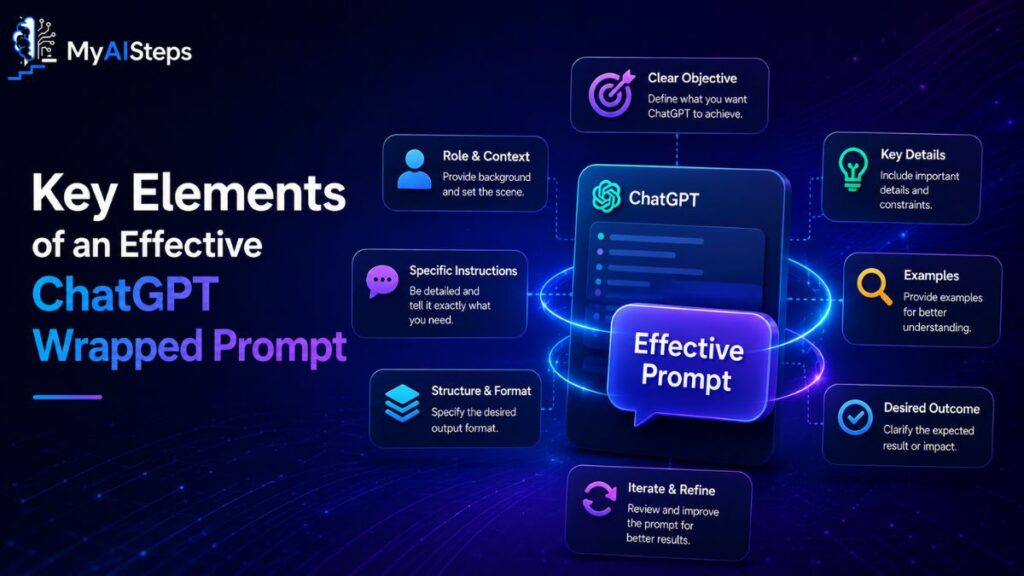
An effective ChatGPT Wrapped Prompt combines six essential elements: role, context, audience, tone, format, and constraints. Together, these components create clear instructions that consistently produce better AI-generated responses.
Although every task is different, most successful wrapped prompts are built using the same core framework. Understanding these elements allows you to adapt the structure for writing, research, education, marketing, business communication, and many other use cases.
Define the Role
Start by assigning ChatGPT a specific role, such as content writer, teacher, business consultant, software developer, or career coach. This immediately influences the style and expertise of the response.
Provide Context
Explain why you’re making the request and include any background information that helps the AI understand the situation.
Identify the Audience
Specify who the content is written for. Beginners, professionals, students, customers, and business owners all require different writing styles and levels of detail.
Specify Format and Length
Tell ChatGPT whether you want a blog post, checklist, email, comparison table, bullet list, or another format. Also mention the preferred length whenever necessary.
Define the Tone
Choose a tone that matches your goal, such as conversational, professional, persuasive, educational, or friendly.
Add Constraints
Clearly mention anything that should or should not appear in the response, including word limits, formatting rules, or phrases to avoid.
Essential Elements at a Glance
| Element | Why It Matters |
| Role | Sets expertise and perspective |
| Context | Improves relevance |
| Audience | Matches reader expectations |
| Format | Creates structured output |
| Tone | Controls writing style |
| Constraints | Prevents unwanted content |
When these six elements work together, the AI receives a complete picture of your expectations instead of trying to infer them from a short request. This simple framework can dramatically improve the quality, clarity, and consistency of nearly any AI-generated response.can dramatically improve the quality, clarity, and consistency of nearly any AI-generated response.
Key Takeaway
The most effective wrapped prompts aren’t necessarily the longest—they’re the clearest. By combining role, context, audience, tone, format, and constraints, you create a prompt that helps ChatGPT generate accurate, natural, and high-quality responses with minimal revision.
Step-by-Step Guide to Creating a High-Quality ChatGPT Wrapped Prompt
Quick Answer
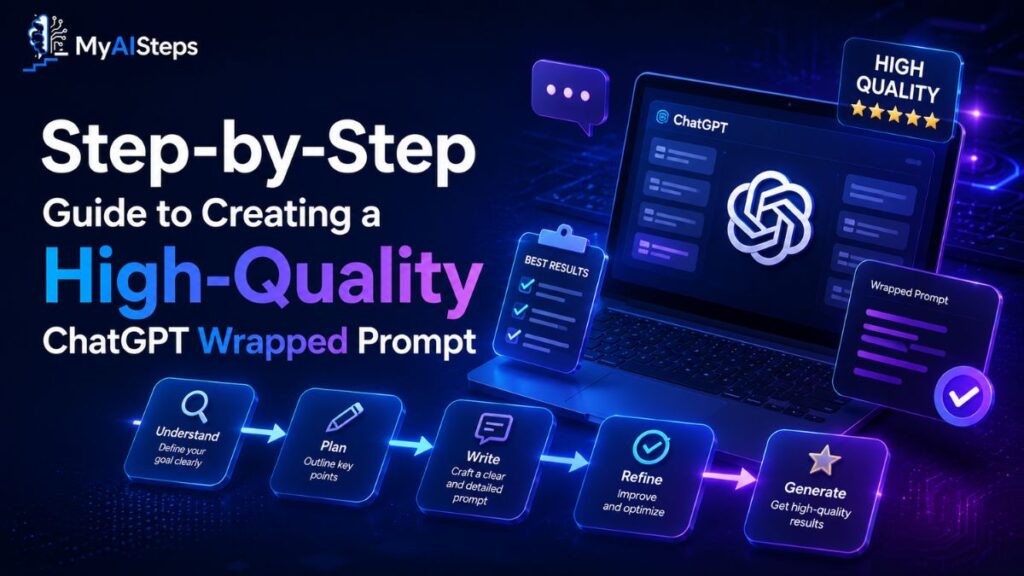
Creating a high-quality ChatGPT Wrapped Prompt is a simple process when you follow a structured framework. Start by defining your goal, assign a role, provide context, identify the audience, specify the format and tone, and add clear constraints. This approach consistently produces more accurate, relevant, and actionable AI responses.
A well-structured prompt isn’t about making your request longer—it’s about making it clearer. Whether you’re writing blog posts, generating marketing copy, studying complex topics, or planning a business project, following a repeatable framework helps ChatGPT understand exactly what you need. As a result, you’ll spend less time rewriting prompts and more time using high-quality outputs.
Step 1: Define Your Desired Outcome
Before writing your prompt, identify the exact result you want. Instead of focusing only on the topic, think about the final deliverable. For example, asking for “marketing advice” is too broad, while requesting “a 300-word marketing strategy for a local bakery targeting weekend customers” gives ChatGPT a clear objective.
Step 2: Assign an Appropriate Role
Giving ChatGPT a role helps shape both the quality and style of the response. The role should match your specific task.
Examples include:
- Content Writer
- SEO Specialist
- Career Coach
- Financial Advisor
- Software Engineer
- Business Consultant
- Teacher
- Social Media Manager
Choosing the right role improves relevance because the AI adapts its language and perspective accordingly.
Step 3: Provide Context
Context explains why you’re asking the question and what background information matters. Without context, AI has to make assumptions that may not match your expectations.
For example:
Instead of:
Write an email.
Use:
Act as a customer support representative and write a polite email apologizing for a delayed shipment to a first-time customer.
The additional information dramatically improves the quality of the output.
Step 4: Identify the Audience
Every audience requires a different writing style.
Examples include:
- Beginners
- Students
- Small business owners
- Developers
- Marketing professionals
- Teachers
- Healthcare professionals
When ChatGPT understands who will read the content, it adjusts vocabulary, explanations, and tone naturally.
Step 5: Specify the Format and Tone
Don’t assume ChatGPT knows your preferred structure.
Clearly define whether you want:
- Blog article
- Checklist
- Comparison table
- Social media caption
- Bullet points
- Step-by-step guide
Also specify the tone, such as:
- Friendly
- Professional
- Conversational
- Persuasive
- Educational
- Formal
Step 6: Add Constraints
Finally, mention anything the AI should include—or avoid.
Examples include:
- Keep under 300 words.
- Avoid technical jargon.
- Use simple English.
- Include practical examples.
- End with a call to action.
- Do not use bullet points.
These instructions reduce unnecessary revisions and improve response accuracy.
Complete Wrapped Prompt Framework
| Step | Purpose |
| Define the outcome | Clarifies the final objective |
| Assign a role | Sets expertise and perspective |
| Add context | Improves relevance |
| Identify the audience | Matches reader expectations |
| Specify format and tone | Controls structure and writing style |
| Add constraints | Eliminates unwanted content |
Key Takeaway
The strongest prompts follow a clear structure rather than relying on guesswork. By combining goal, role, context, audience, tone, format, and constraints, you can consistently generate higher-quality AI responses that require little or no editing.
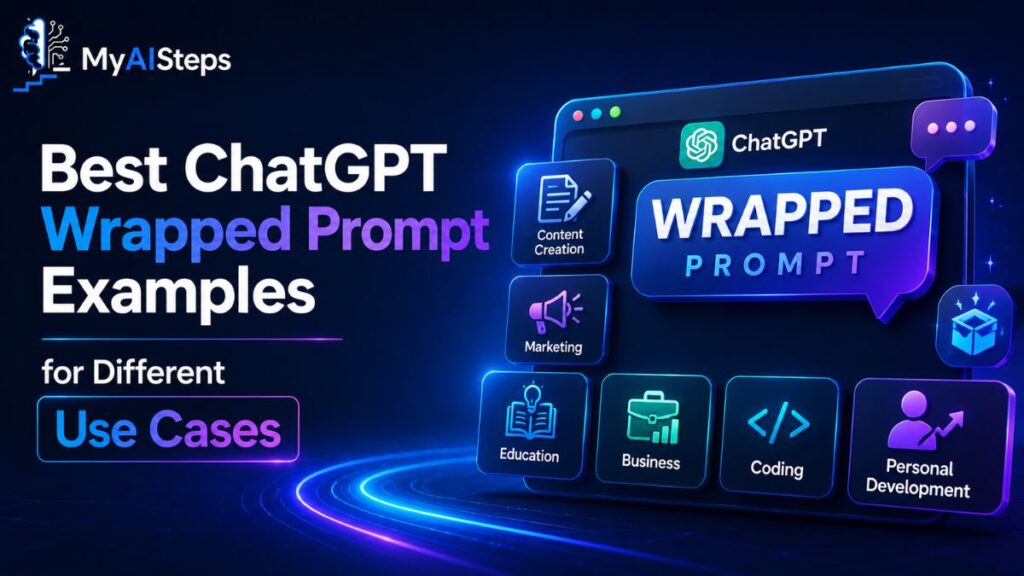
Best ChatGPT Wrapped Prompt Examples for Different Use Cases
Quick Answer
A ChatGPT Wrapped Prompt can be adapted for almost any task, including content writing, business communication, education, marketing, customer support, and social media. The same framework works across different industries by simply changing the role, audience, and objective.
One of the biggest advantages of wrapped prompts is their flexibility. Instead of memorizing dozens of different prompt formats, you can use one proven structure and customize it for different situations.
Content Writing Example
Act as an experienced SEO content writer. Write a 250-word introduction for an article about remote work productivity aimed at beginners. Use a friendly tone, include one practical example, and avoid unnecessary technical terms.
Business Email Example
Act as a customer support manager. Write a professional email apologizing for a delayed shipment. Keep it under 120 words, maintain a polite tone, and reassure the customer that the issue is being resolved.
Learning Example
Explain compound interest as if teaching a high school student. Use one real-life savings account example and avoid mathematical formulas.
Social Media Example
Act as a social media strategist. Write three Instagram captions promoting a new coffee blend. Keep each caption under 25 words, use an energetic tone, and include one relevant emoji.
Career Development Example
Act as a career coach. Write three LinkedIn summary bullet points for someone transitioning from teaching into corporate training. Highlight transferable skills using a confident but professional tone.
Business Planning Example
Act as a startup consultant. Create a simple business plan outline for a local bakery expanding into online delivery. Organize the response into clear headings and practical action steps.
Wrapped Prompt Examples by Purpose
| Use Case | Best Prompt Focus |
| Blog Writing | SEO, readability, audience, tone |
| Email Writing | Professional communication |
| Learning | Simple explanations with examples |
| Marketing | Persuasive messaging |
| Business Planning | Actionable strategies |
| Social Media | Short, engaging content |
The secret isn’t copying these examples word for word. Instead, use them as templates that can be customized for your own projects. Once you understand the structure, creating high-quality prompts becomes much faster and more consistent.
Key Takeaway
A single wrapped prompt framework can be adapted for countless tasks. Simply adjust the role, audience, objective, and formatting instructions to create highly targeted prompts for different situations.
Common Mistakes to Avoid When Writing Wrapped Prompts
Quick Answer
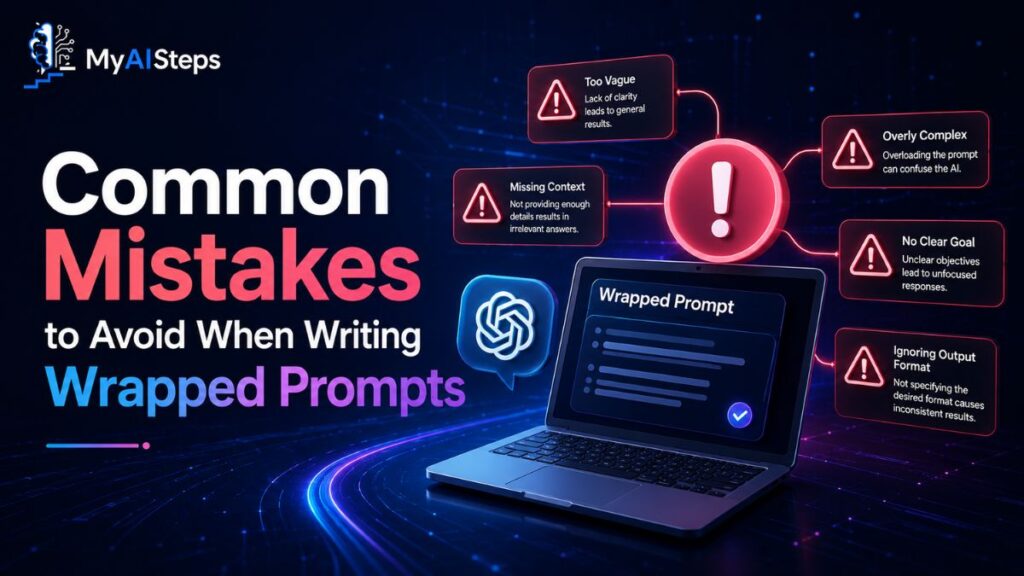
Most ineffective prompts fail because they are either too vague, overloaded with unrelated requests, or missing important context. Avoiding these common mistakes can dramatically improve the quality, accuracy, and consistency of ChatGPT’s responses.
Even experienced users occasionally write prompts that leave too much room for interpretation. Fortunately, these mistakes are easy to identify and fix once you understand how wrapped prompts work.
1. Being Too Vague
A prompt like:
Write about digital marketing.
doesn’t provide enough information.
Instead, explain the topic, audience, format, and objective.
2. Combining Too Many Requests
Trying to generate a blog post, social media captions, keywords, and an email in one prompt often produces lower-quality results.
Focus on one primary objective at a time.
3. Forgetting the Audience
Content written for beginners is very different from content written for professionals.
Always identify who the response is intended for.
4. Ignoring Tone
Without guidance, ChatGPT chooses its own writing style.
Specify whether you want conversational, formal, educational, or persuasive content.
5. Not Setting Constraints
If you don’t define limits, responses may become too long, overly technical, or include unnecessary information.
6. Skipping Context
Context allows ChatGPT to understand your situation instead of making assumptions.
A few additional sentences can significantly improve response quality.
Common Mistakes and Better Alternatives
| Common Mistake | Better Approach |
| Vague request | Clearly define the objective |
| Multiple unrelated tasks | Focus on one goal per prompt |
| Missing audience | Specify who the content is for |
| No tone instructions | Mention the desired writing style |
| No constraints | Define limits and exclusions |
| Lack of context | Explain the background clearly |
These small improvements can make a significant difference in the final output. A well-structured prompt minimizes confusion and helps ChatGPT deliver responses that are both accurate and immediately useful.
Key Takeaway
Great prompts are clear, focused, and specific. By avoiding vague requests, missing context, and unnecessary complexity, you’ll consistently receive higher-quality AI-generated responses.
ChatGPT Wrapped Prompt vs Regular Prompt
Quick Answer
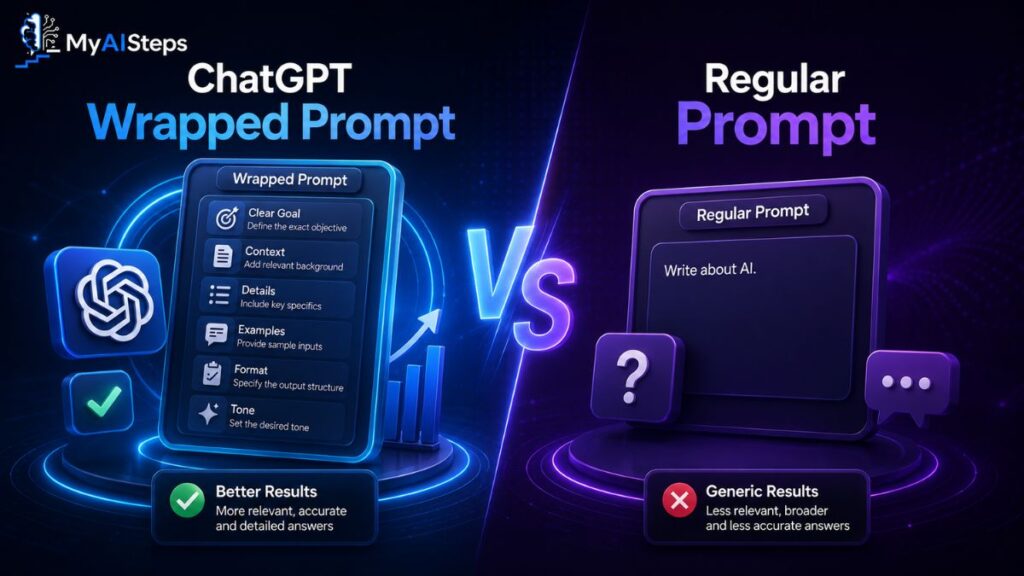
A regular prompt gives ChatGPT only a basic request, while a wrapped prompt provides additional context, audience, tone, formatting, and constraints. As a result, wrapped prompts usually generate more accurate, relevant, and consistent responses with fewer revisions.
Although both prompt types can produce useful answers, they serve different purposes. A regular prompt works well for quick, simple questions, whereas a wrapped prompt is ideal for professional, educational, or business-related tasks where precision matters.
Comparison Table
| Feature | Regular Prompt | ChatGPT Wrapped Prompt |
| Structure | Basic request | Structured framework |
| Context | Limited | Clearly explained |
| Audience | Usually unspecified | Clearly defined |
| Tone | AI decides | User specifies |
| Format | Flexible but unpredictable | Clearly instructed |
| Accuracy | Moderate | High |
| Consistency | Varies | More reliable |
| Editing Required | Often more | Usually less |
| Best For | Quick questions | Professional and detailed tasks |
For example, asking:
Write a birthday message.
may produce a perfectly acceptable response.
However, asking:
Act as a close friend. Write a heartfelt three-sentence birthday message for someone turning 30 who loves traveling. Keep the tone warm and humorous without using cliché birthday phrases.
produces a much more personalized and engaging result.
The difference lies in clarity. The more useful information you provide, the easier it becomes for ChatGPT to understand your expectations and generate content that closely matches your intended outcome.
Key Takeaway
Regular prompts are useful for simple requests, but wrapped prompts deliver better results whenever quality, consistency, and precision matter. For content creation, business communication, education, and professional tasks, a wrapped prompt is almost always the better choice.
Best Practices to Get More Accurate and Consistent AI Outputs
Quick Answer
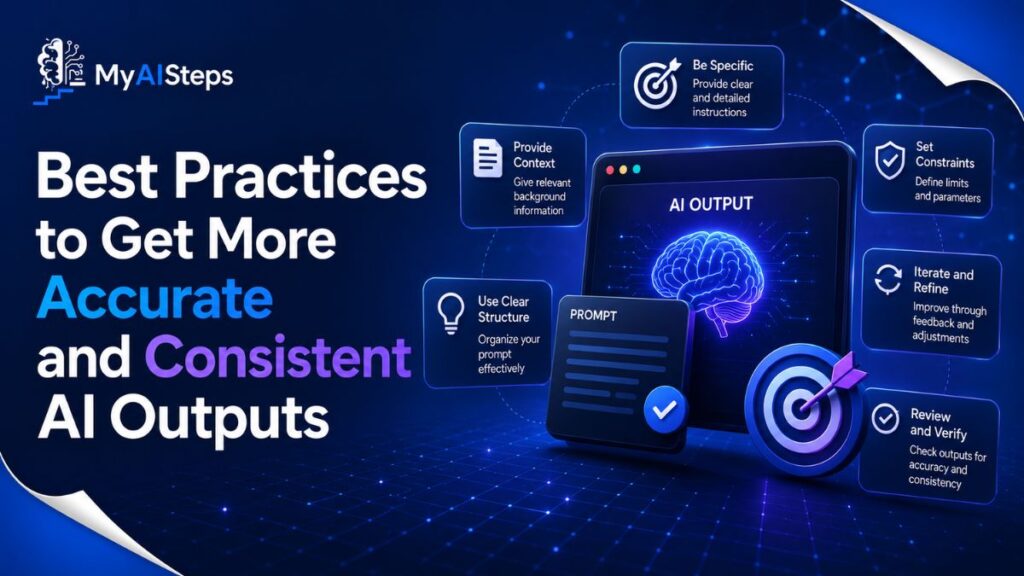
The best way to get accurate and consistent AI responses is to use clear, structured prompts, provide enough context, define your audience, specify the desired format, and refine successful prompts over time. Small improvements in prompt quality often produce significantly better AI-generated results.
Writing an effective wrapped prompt is only the beginning. Consistently producing high-quality AI outputs requires adopting a few practical habits that improve both accuracy and efficiency. Whether you use ChatGPT for content creation, research, education, marketing, or business communication, these best practices help reduce unnecessary revisions while improving response quality.
Save Your Best Prompts
Whenever a wrapped prompt produces excellent results, save it for future use. Building a personal prompt library allows you to reuse proven templates instead of starting from scratch every time.
Refine Instead of Rewriting
If the first response isn’t perfect, avoid creating an entirely new prompt. Instead, refine your existing request by adjusting the tone, format, length, or instructions. Small improvements usually produce better results than completely rewriting the prompt.
Match Prompt Detail to Task Complexity
Simple questions don’t require extensive instructions, but professional writing, SEO content, reports, and business communication benefit from additional context and structured guidance.
Be Specific Instead of Making Assumptions
Never assume the AI understands your preferences automatically. Clearly define the audience, writing style, objective, and desired outcome to minimize misunderstandings.
Test Different Prompt Variations
For recurring tasks such as blog writing, email drafting, or social media content, experiment with different prompt structures. Comparing multiple versions helps identify the format that consistently delivers the highest-quality responses.
Best Practices Summary
| Best Practice | Benefit |
| Save successful prompts | Saves time and improves consistency |
| Refine existing prompts | Reduces unnecessary rewriting |
| Match detail to task | Produces more relevant responses |
| Provide clear instructions | Improves accuracy |
| Test multiple versions | Identifies the best-performing prompt structure |
Key Takeaway
Consistent AI results come from consistent prompting habits. Clear instructions, reusable templates, and regular prompt refinement help generate more reliable, accurate, and high-quality responses over time.
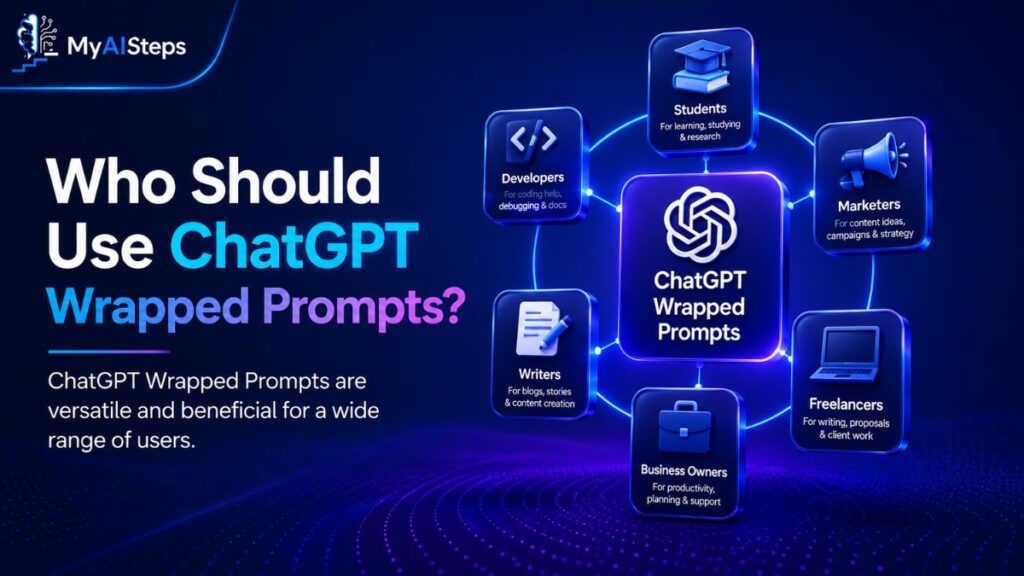
Who Should Use ChatGPT Wrapped Prompts?
Quick Answer
ChatGPT Wrapped Prompts are useful for anyone who wants more accurate AI responses, including writers, students, marketers, business owners, developers, educators, researchers, and professionals. The technique improves productivity regardless of experience level.
One of the biggest advantages of wrapped prompts is their versatility. They can be adapted for nearly any industry or workflow where clear communication and structured information are important.
Content Creators and Bloggers
Writers can create more engaging articles, improve SEO performance, maintain a consistent tone, and reduce editing time by providing detailed prompt instructions.
Students and Researchers
Students can simplify complex concepts, summarize study material, prepare assignments, and receive explanations tailored to their learning level.
Business Owners and Freelancers
Entrepreneurs often manage multiple responsibilities, from writing emails to creating marketing campaigns. Wrapped prompts help produce professional content quickly while maintaining a consistent brand voice.
Marketing Professionals
Digital marketers can generate blog outlines, advertising copy, email campaigns, product descriptions, and social media content that align with specific audiences and campaign goals.
Developers and Technical Professionals
Software developers can generate code explanations, documentation, debugging assistance, and technical summaries using clearly structured prompts.
Beginners Learning AI
You don’t need advanced prompt engineering knowledge to benefit from wrapped prompts. Even beginners can achieve significantly better AI responses simply by following a structured framework.
Popular Use Cases
| User | Common Tasks |
| Bloggers | Articles, outlines, SEO content |
| Students | Learning, summaries, assignments |
| Business Owners | Emails, proposals, planning |
| Marketers | Campaigns, ads, content creation |
| Developers | Documentation, explanations |
| Professionals | Reports, presentations, communication |
Key Takeaway
Wrapped prompts aren’t designed for one profession—they’re a universal communication framework that helps anyone produce more accurate, organized, and useful AI-generated content.
Is Using a ChatGPT Wrapped Prompt Worth It?
Quick Answer
Yes. For most professional, educational, and business tasks, using a ChatGPT Wrapped Prompt is worth the extra effort because it improves response quality, reduces revisions, saves time, and produces more consistent AI-generated content.
Although creating a wrapped prompt takes slightly longer than typing a simple request, the time invested usually pays for itself. Better prompts reduce misunderstandings, eliminate unnecessary follow-up questions, and generate outputs that are much closer to your intended goal.
As AI continues to become part of everyday workflows, prompt quality will play an increasingly important role in productivity. Learning how to communicate effectively with AI is becoming a valuable skill for professionals, students, creators, and businesses alike.
Instead of relying on trial and error, wrapped prompts provide a repeatable system that delivers consistent results across different tasks and industries. Once you become familiar with the framework, creating effective prompts becomes second nature.
When Should You Use a Wrapped Prompt?
| Situation | Recommended? |
| Quick factual question | ❌ Usually unnecessary |
| Writing blog articles | ✅ Highly recommended |
| Business emails | ✅ Yes |
| Research and learning | ✅ Yes |
| Marketing content | ✅ Yes |
| Professional documents | ✅ Strongly recommended |
| Content requiring a specific tone or format | ✅ Essential |
Key Takeaway
A wrapped prompt isn’t about writing longer requests—it’s about writing smarter ones. When accuracy, consistency, and professionalism matter, investing a few extra seconds in prompt structure can significantly improve the quality of AI-generated responses.
Conclusion
As AI tools become more capable, the ability to communicate with them effectively has become just as important as choosing the right tool itself. A ChatGPT Wrapped Prompt provides a practical framework for turning simple requests into well-structured instructions by combining context, audience, tone, format, and clear constraints. This approach not only improves response accuracy but also saves time by reducing unnecessary revisions and producing more consistent results across different tasks.
Whether you’re a student, writer, marketer, business owner, or simply someone who wants better AI-generated content, learning to create wrapped prompts is a valuable long-term skill. By applying the techniques, best practices, and examples covered in this guide, you’ll be able to generate clearer, more relevant, and more reliable responses while making the most of ChatGPT in 2026 and beyond.
Frequently Asked Questions (FAQs)
What is a ChatGPT Wrapped Prompt?
A ChatGPT Wrapped Prompt is a structured prompt that includes context, role, audience, tone, format, and constraints to generate more accurate AI responses.
How do I write a better ChatGPT Wrapped Prompt?
Start by defining your goal, assigning a role, adding context, identifying your audience, specifying the format and tone, and including any important constraints.
Why are wrapped prompts better than regular prompts?
Wrapped prompts reduce ambiguity by giving ChatGPT clearer instructions, resulting in more accurate, consistent, and useful responses.
Can beginners use ChatGPT Wrapped Prompts?
Yes. Beginners can easily improve AI responses by following a simple wrapped prompt framework without needing advanced prompt engineering skills.
Do wrapped prompts improve ChatGPT accuracy?
Yes. Providing detailed context and structured instructions helps ChatGPT understand your request more accurately and deliver better-quality responses.
Are ChatGPT Wrapped Prompts useful for SEO content writing?
Yes. SEO professionals and content creators use wrapped prompts to generate well-structured, audience-focused, and search-friendly content more efficiently.
When should I use a ChatGPT Wrapped Prompt instead of a regular prompt?
Use a wrapped prompt whenever your task requires a specific audience, tone, format, or high level of accuracy, such as blog writing, business communication, research, or marketing.
Can I reuse the same wrapped prompt for different tasks?
Yes. You can save successful wrapped prompts as templates and customize them for different projects by changing the topic, audience, or objective.