
If you’ve spent time on social media, you’ve probably seen people asking ChatGPT to “roast” them. These AI-generated jokes have become a popular form of entertainment, with witty one-liners and playful comebacks often going viral. A ChatGPT roast is simply a humorous response that pokes fun at you—or someone else—in a lighthearted way. Whether it’s your gaming skills, procrastination, coffee addiction, or another quirky habit, ChatGPT can create jokes based on the details you provide.
One of the best things about ChatGPT roasts is that you control the style of humor. You can ask for a friendly, sarcastic, or even savage roast while keeping it respectful. The more context you provide, the more personalized the jokes become. In this guide, you’ll learn what ChatGPT roasts are, why they’re so popular, how to write better prompts, and discover plenty of funny examples you can copy and try.
What Is a ChatGPT Roast?
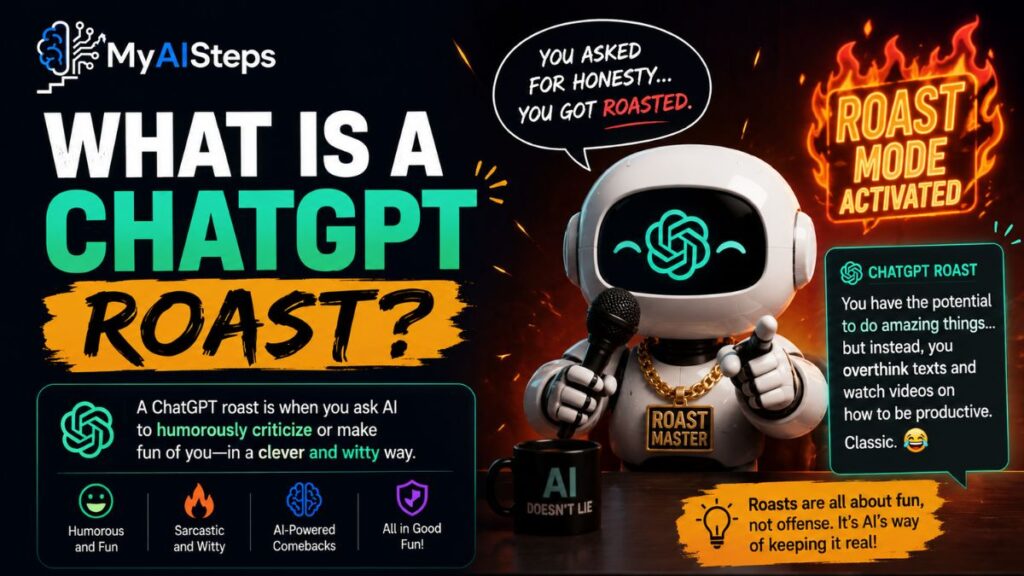
A ChatGPT roast is a humorous response designed to tease someone in a playful way. Instead of giving a serious answer, the AI creates jokes based on the information you provide. Think of it as friendly banter rather than an actual insult.
For example, if you tell ChatGPT that you own five unfinished notebooks because you always start new hobbies, it might joke:
“Your hobbies have a shorter lifespan than your phone battery.”
The goal isn’t to offend anyone. A good roast highlights harmless habits, funny situations, or relatable personality quirks that people can laugh about together.
Unlike traditional online insults, ChatGPT is designed to keep its responses within respectful boundaries. It avoids generating hateful or abusive content and generally steers clear of topics that could genuinely harm or target someone unfairly.
That’s one reason these AI-generated roasts have become so popular. They’re usually clever enough to make people laugh without crossing the line into personal attacks.
Why ChatGPT Roasts Have Become So Popular
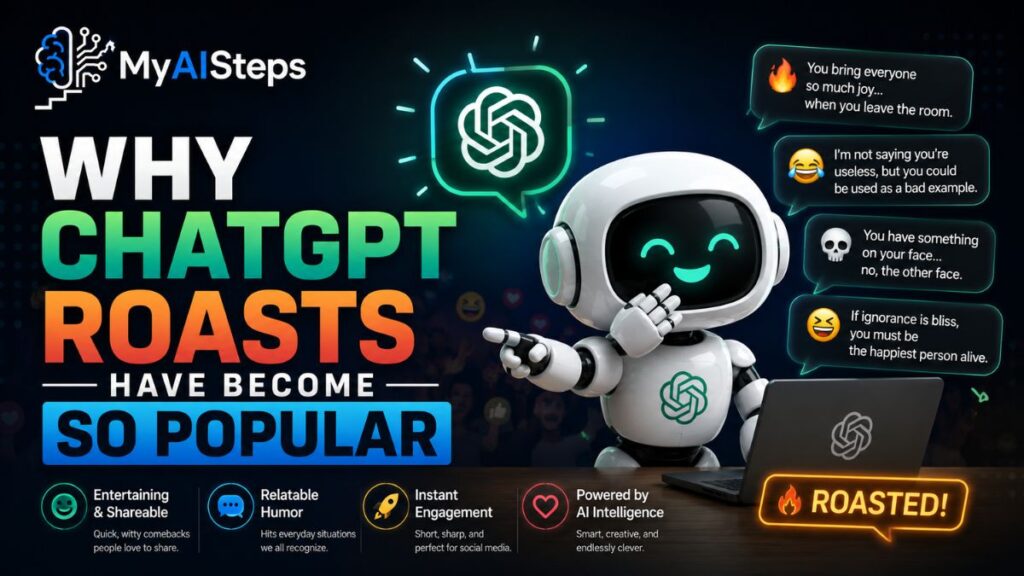
Not every ChatGPT conversation has to be about solving problems or answering questions. Sometimes people simply want to have fun, and roasting has become one of the easiest ways to do that.
Several factors have helped make ChatGPT roasts a trend.
They’re Easy to Personalize
Unlike random jokes found online, ChatGPT can tailor its humor to the person you’re talking about.
Tell it that you’re a college student who survives on instant noodles and leaves assignments until midnight, and the jokes become much more specific.
The extra context often makes the roast feel surprisingly personal—in a funny way.
They’re Perfect for Social Media
Many people share ChatGPT roasts on platforms like TikTok, Instagram, Reddit, and X because they’re quick to read and easy to relate to.
Some users even turn them into reaction videos or challenge friends to see who gets the funniest roast.
They’re Safe for Friendly Fun
Roasting has always been part of friendly conversations, but people don’t always know where to draw the line.
ChatGPT usually keeps the humor playful rather than cruel, making it easier to joke around without accidentally offending someone.
Anyone Can Try It
You don’t need to be naturally funny to get a good roast.
Even a simple prompt like:
“Roast me based on the fact that I drink coffee six times a day.”
can produce surprisingly creative results.
The better your prompt, the funnier the output tends to be.
Different Types of ChatGPT Roasts
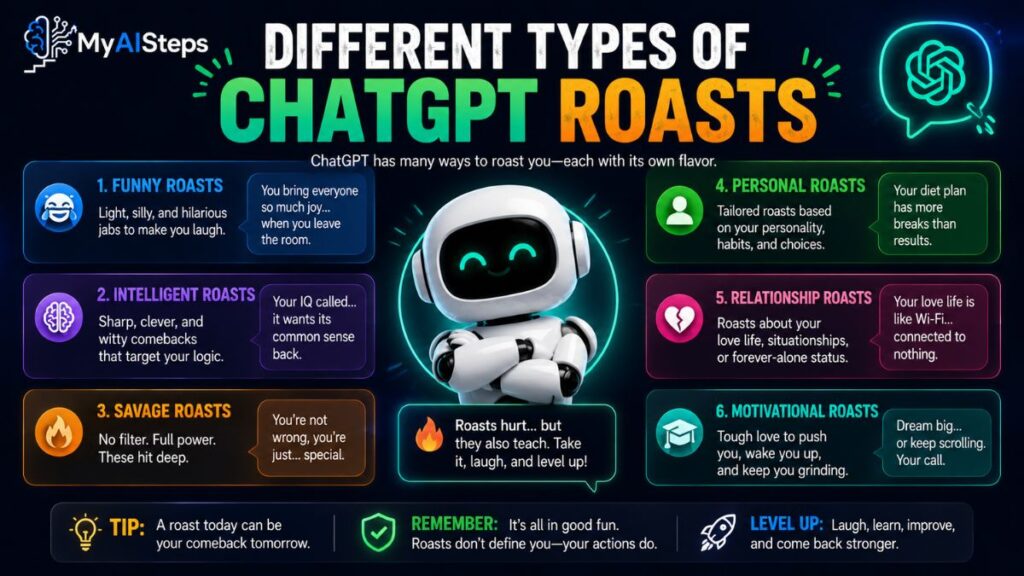
One of the reasons ChatGPT roasts stay entertaining is that they can be customized for almost any situation. Instead of using the same jokes repeatedly, you can choose a style that matches the person or topic.
Here are some of the most popular types.
Self Roasts
Many people enjoy asking ChatGPT to roast them.
It might sound strange at first, but self-roasts are often the funniest because they’re based on habits you’re already willing to laugh about.
Examples include:
- Procrastination
- Spending too much money online
- Sleeping late
- Being addicted to video games
- Never finishing projects
Since you’re inviting the jokes yourself, the humor usually feels harmless.
Friend Roasts
Roasting friends has become one of the biggest trends online.
You can describe your friend’s personality, hobbies, or funny habits and ask ChatGPT to create playful jokes.
For example:
- Always arrives late
- Never replies to messages
- Can’t cook
- Constantly loses things
- Takes hundreds of selfies
The more details you provide, the more creative the roast becomes.
Gamer Roasts
Gamers love challenging ChatGPT to make fun of their skills.
Whether someone always blames lag, never wins ranked matches, or spends more time customizing their character than actually playing, there are plenty of opportunities for funny jokes.
Gaming roasts are especially popular because they focus on relatable experiences rather than personal characteristics.
Student Roasts
School and college life offer endless material for comedy.
Students often ask ChatGPT to joke about things like:
- Last-minute studying
- Forgetting deadlines
- Living on caffeine
- Pulling all-nighters
- Pretending to understand lectures
These jokes resonate because almost every student has experienced at least one of them.
Programmer Roasts
Developers have embraced AI humor as well.
Typical programming roasts revolve around:
- Writing messy code
- Forgetting semicolons
- Spending hours fixing one typo
- Copying code from Stack Overflow
- Naming variables “test123”
Even experienced programmers usually find these jokes relatable.
Office Roasts
Workplace humor is another popular category.
Instead of making fun of people personally, ChatGPT can joke about everyday office situations like endless meetings, overflowing inboxes, coffee dependence, or coworkers who always say, “This meeting could have been an email.”
These jokes are generally lighthearted enough to share with colleagues.
Celebrity Roasts
People also enjoy asking ChatGPT to roast actors, singers, athletes, influencers, and other public figures.
Rather than making personal attacks, the AI usually focuses on public personas, famous moments, or widely known traits that audiences already recognize.
This keeps the humor entertaining while avoiding inappropriate or harmful content.
Popular ChatGPT Roast Types
| Roast Type | Best For | Typical Tone |
| Self Roast | Laughing at your own habits | Playful |
| Friend Roast | Friendly banter | Funny |
| Gamer Roast | Gaming jokes | Sarcastic |
| Student Roast | School or college humor | Witty |
| Programmer Roast | Coding mistakes | Nerdy |
| Office Roast | Workplace jokes | Professional |
| Celebrity Roast | Public figures | Respectful |
How to Ask ChatGPT for Better Roasts
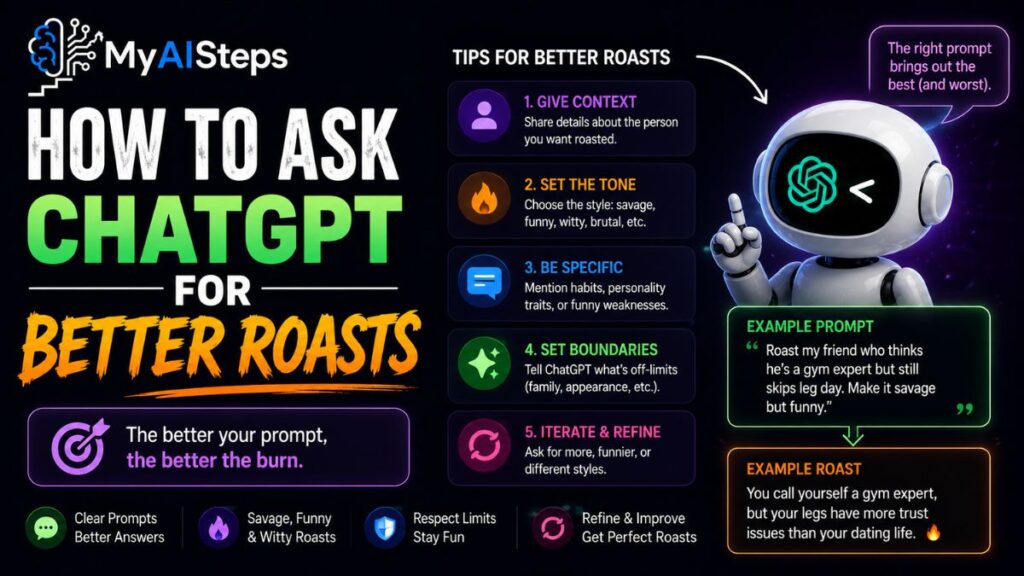
Not all roast prompts produce equally funny results.
If your prompt simply says, “Roast me,” ChatGPT has very little information to work with. The response may still be amusing, but it’ll probably feel generic because the AI doesn’t know anything about you.
A better prompt gives ChatGPT something specific to build jokes around.
Add Some Background
Think about what makes the person unique.
Maybe you always hit the snooze button five times before getting out of bed. Maybe your friend buys expensive gym memberships but never actually goes. Small details like these often lead to much stronger jokes than broad descriptions.
Instead of saying:
“Roast me.”
Try something like:
“Roast me. I spend three hours watching productivity videos every day instead of actually being productive.”
That single detail gives the AI much more material to work with.
Choose the Humor Style
Not everyone enjoys the same type of comedy.
Some people prefer gentle teasing that everyone can laugh at, while others want jokes that are a little sharper.
You can guide ChatGPT by adding instructions such as:
- Keep it wholesome.
- Make it sarcastic.
- Be witty instead of mean.
- Roast me like we’re lifelong friends.
- Keep it suitable for the workplace.
- Make it dramatic.
- Write short one-liners only.
These instructions help shape the overall tone of the response.
Mention What Should Be Off Limits
If there are topics you’d rather avoid, tell ChatGPT upfront.
For example, you might ask it to skip jokes about appearance, family, or anything too personal.
Setting boundaries usually results in humor that’s more enjoyable for everyone involved.
Ask for Multiple Versions
One roast might be funny, but asking for several gives you more options.
For example:
“Give me ten different roasts about my terrible cooking.”
Instead of repeating the same joke, ChatGPT will usually approach the topic from different angles, making it easier to find your favorite.
In the next section, we’ll look at some of the best ChatGPT roast prompts you can copy and use, along with examples that show just how creative AI-generated humor can be.
Best ChatGPT Roast Prompts
The quality of a ChatGPT roast often depends on the prompt you use. A vague request usually leads to a generic joke, while a detailed prompt gives the AI plenty of material to create something clever and memorable.
The prompts below are designed to produce different styles of humor. Feel free to copy them as they are or customize them with your own details.
Funny Roast Prompts
- Roast me like we’re best friends who have known each other for years.
- Roast me without mentioning my appearance.
- Roast me based on my hobbies.
- Roast my terrible cooking skills.
- Roast me for spending too much time online.
- Roast me because I never finish what I start.
- Roast me using only one-liners.
- Roast me like a stand-up comedian.
- Roast me as if I’m the main character in a sitcom.
- Roast me, but end every joke with a compliment.
Savage Roast Prompts
- Give me your most savage roast while keeping it funny.
- Roast me like I just lost the easiest game ever.
- Roast my excuses for not going to the gym.
- Roast my shopping habits.
- Roast my sleeping schedule.
- Roast my playlist like a music critic.
- Roast my social media addiction.
- Roast my productivity habits.
- Roast me as if I’m your most dramatic coworker.
- Roast my life choices—but keep it playful.
Creative Roast Prompts
- Roast me in Shakespearean English.
- Roast me like a pirate.
- Roast me as a movie narrator.
- Roast me using only food comparisons.
- Roast me using sports commentary.
- Roast me like a detective solving a mystery.
- Roast me in Gen Z slang.
- Roast me as if you’re a medieval king.
- Roast me like an angry customer service representative.
- Roast me in exactly five sentences.
You can also combine prompts. For example, asking ChatGPT to “Roast me like a stand-up comedian using only office jokes” usually produces more unique results than using either prompt on its own.
Funny ChatGPT Roast Examples
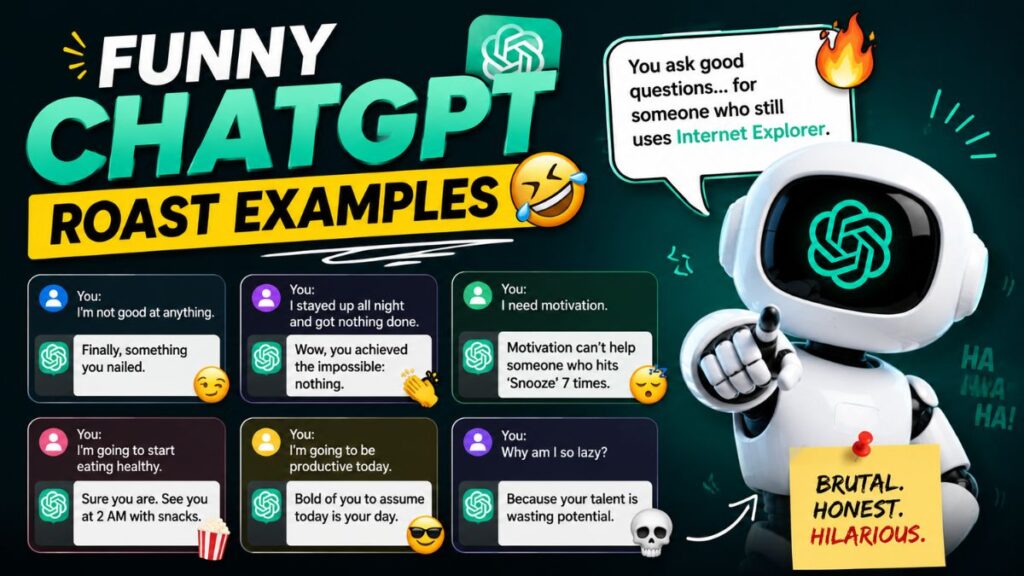
Seeing examples is often the easiest way to understand how different roast styles work. Here are a few original examples across different categories.
Self Roast Examples
“You make so many to-do lists that your productivity is basically a stationery collection.”
“Your phone battery has a better work ethic than you.”
“You watch motivational videos like they’re a substitute for motivation.”
“You’ve restarted your ‘new life’ so many Mondays that the calendar is getting suspicious.”
“Your biggest workout is carrying emotional baggage.”
Friend Roast Examples
“Your GPS probably asks someone else for directions.”
“You say you’re five minutes away even when you’re still deciding what to wear.”
“You have the confidence of someone who’s never checked their own facts.”
“Your cooking is so experimental that smoke alarms recognize your address.”
“You reply to messages so late they qualify as historical documents.”
Gamer Roast Examples
“You don’t lose because the game’s hard—you lose because even the tutorial gave up.”
“Your teammates don’t need enemies with you on the squad.”
“You blame lag so often your Wi-Fi deserves an apology.”
“Your character has better reflexes than you.”
“You’ve spent more time changing skins than actually winning.”
Student Roast Examples
“You treat deadlines like optional side quests.”
“Your notebook has more doodles than lecture notes.”
“You study best under pressure because you only start when the pressure arrives.”
“Your calculator deserves an honorary degree for doing all the work.”
“You’ve mastered the art of looking busy without actually being busy.”
Programmer Roast Examples
“Your code works purely out of sympathy.”
“You’ve fixed one bug and accidentally created seven more.”
“Your variable names tell a better mystery story than most novels.”
“Even your comments are confused.”
“Your keyboard deserves overtime pay.”
Office Roast Examples
“You attend meetings just to ask questions that could’ve been emails.”
“Your coffee works harder than you do.”
“You’ve perfected the art of looking productive while moving spreadsheets around.”
“If procrastination paid overtime, you’d be Employee of the Year.”
“You celebrate Friday like you personally invented weekends.”
Can ChatGPT Roast Based on Photos?
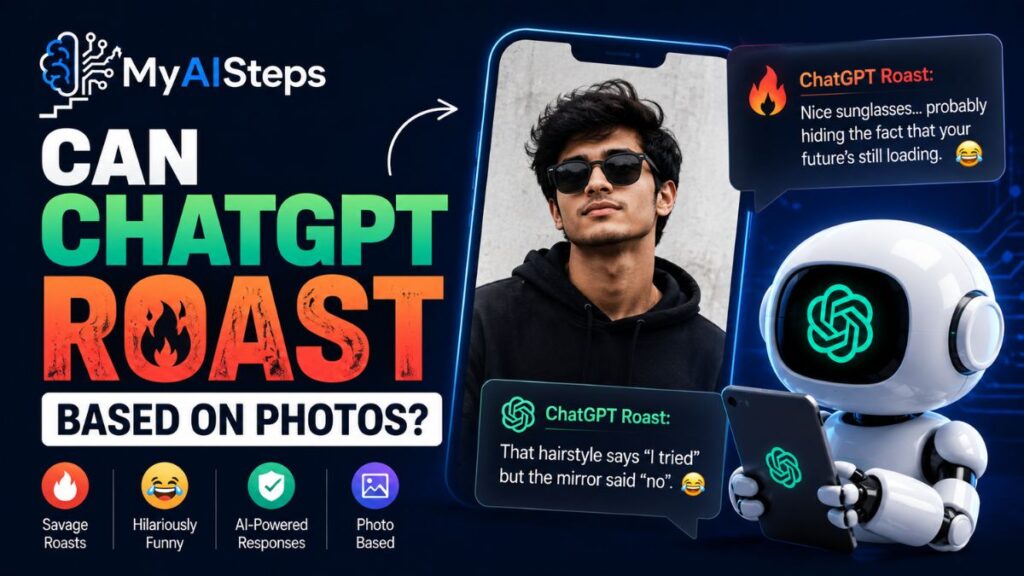
Yes, but there are a few important limitations.
If you upload a photo and ask ChatGPT for a roast, it can create jokes based on things it can actually see. That might include clothing choices, facial expressions, poses, the background, or funny situations captured in the image.
For example, if someone is wearing mismatched socks while posing confidently, ChatGPT might joke about their fashion choices in a lighthearted way.
However, it won’t generate harmful or abusive comments about protected characteristics or encourage bullying. The goal is playful humor, not personal attacks.
If you want the funniest results, adding a little context alongside the image usually helps. A simple explanation of what’s happening in the photo gives the AI more material to work with.
Can ChatGPT Roast Your Friends?
Absolutely. In fact, this is one of the most common ways people use roast prompts.
Instead of simply writing “Roast my friend,” describe what makes them unique.
For example:
- They always arrive late.
- They own hundreds of unread books.
- They start hobbies but never finish them.
- They’re obsessed with coffee.
- They think they’re amazing at karaoke.
Specific details almost always lead to better jokes.
That said, it’s worth remembering that the funniest roasts are the ones everyone can laugh at. Keeping the humor focused on harmless habits rather than sensitive topics helps ensure the jokes stay entertaining instead of becoming uncomfortable.
Can ChatGPT Roast Celebrities?
Yes, ChatGPT can create jokes about public figures, provided the humor stays respectful.
Instead of making harmful claims or personal attacks, it generally focuses on widely known public personas, memorable performances, career moments, or playful stereotypes that people already associate with that celebrity.
For example, someone might ask ChatGPT to roast a famous actor’s habit of appearing in action movies or joke about an athlete’s dramatic goal celebrations. The humor stays centered on public-facing aspects rather than targeting private or sensitive matters.
Why Some ChatGPT Roasts Feel Generic
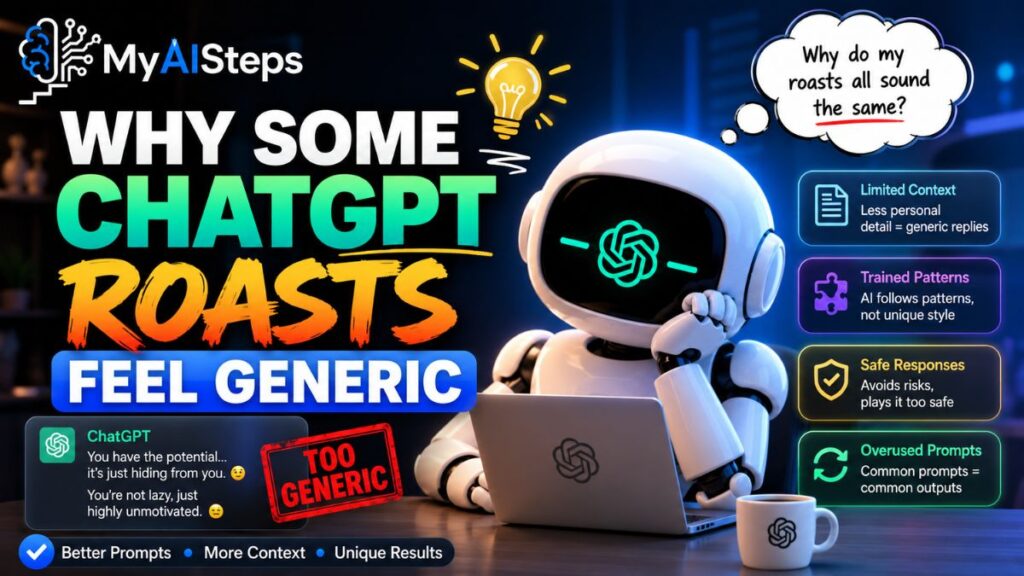
If you’ve ever asked ChatGPT for a roast and thought, “I’ve heard that joke before,” you’re not alone.
Most of the time, the issue isn’t the AI—it’s the prompt.
A request like “Roast me” doesn’t provide much information, so ChatGPT has to rely on common jokes that could apply to almost anyone.
Adding even a few personal details makes a huge difference.
Weak Prompt vs. Better Prompt
| Basic Prompt | Better Prompt |
| Roast me. | Roast me like we’re college roommates. I survive on instant noodles and always start assignments the night before they’re due. |
| Roast my code. | Roast my messy Python code like a senior developer reviewing it. |
| Roast my friend. | Roast my friend who’s always late but somehow still says, “I was waiting on you.” |
| Roast my gaming skills. | Roast my gaming skills like an esports commentator after I lost an easy match. |
Notice how the improved prompts provide a clear scenario. That extra context gives ChatGPT more opportunities to create original jokes instead of relying on generic humor.
Tips for Getting the Funniest ChatGPT Roasts
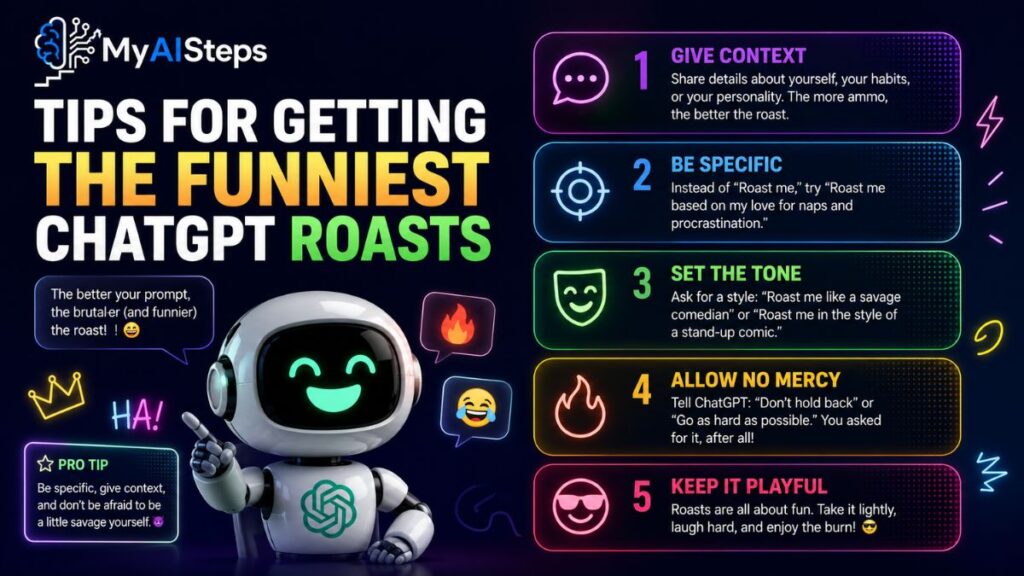
If you’re looking for better results, keep these simple tips in mind:
- Give ChatGPT a few interesting details about the person.
- Mention the type of humor you prefer, such as sarcastic, wholesome, witty, or savage.
- Tell it which topics to avoid.
- Ask for multiple versions instead of just one.
- Include hobbies, habits, or funny stories.
- Experiment with different writing styles, such as movie narrators, sports commentators, or historical characters.
- If a roast isn’t funny enough, ask ChatGPT to rewrite it with more creativity or exaggeration.
A little experimentation usually goes a long way.
ChatGPT Roast Limitations
While ChatGPT is capable of generating funny jokes, it also follows safety guidelines designed to keep conversations respectful.
That means it won’t help create content that encourages bullying, harassment, hate speech, or targeted abuse. It also avoids jokes that attack protected characteristics or promote harmful behavior.
Most users actually find this balance helpful. Instead of crossing the line, ChatGPT focuses on clever observations, relatable habits, and playful exaggeration—the kind of humor people are more likely to enjoy and share.
Conclusion
ChatGPT roasts have become a fun way to add humor to everyday conversations. Whether you’re poking fun at your own habits, teasing a friend, joking about your gaming skills, or looking for creative content to share online, the right prompt can lead to surprisingly clever results.
The biggest secret to getting better roasts isn’t asking ChatGPT to be funnier—it’s giving it better material to work with. Adding context, choosing a specific humor style, and setting clear boundaries can turn an average joke into one that’s genuinely memorable.
At the end of the day, the best roasts are the ones that leave everyone laughing. Keep the humor light, avoid sensitive topics, and don’t be afraid to experiment with different prompts until you find the style that suits you best.
FAQs
Is ChatGPT good at writing roasts?
Yes. ChatGPT can generate witty, sarcastic, and lighthearted roasts based on the details you provide. The more context you include, the more personalized the jokes are likely to be.
Can ChatGPT roast me without being offensive?
Absolutely. You can specifically ask for a friendly or family-friendly roast, and ChatGPT will aim to keep the humor playful instead of hurtful.
Can I ask ChatGPT to roast my friends?
Yes, as long as the request is intended for fun. Providing harmless details about your friend’s habits or hobbies usually leads to more entertaining results.
Can ChatGPT create savage roasts?
Yes, you can request a more savage style, but ChatGPT still avoids generating content that promotes harassment, hate speech, or personal abuse.
Can ChatGPT roast celebrities?
Yes. It can make jokes about public figures based on their public personas or well-known career moments while staying within respectful boundaries.
Why do some ChatGPT roasts feel repetitive?
Generic prompts often produce generic jokes. Giving ChatGPT more background information, choosing a specific style, and asking for multiple versions usually results in fresher, more creative humor.
Can ChatGPT roast photos?
Yes. If you upload an image, ChatGPT can create playful jokes about visible details such as clothing, poses, expressions, or the overall scene while avoiding harmful or inappropriate comments.