
Generative engine optimization (GEO) is the practice of preparing your website so that AI systems like ChatGPT, Perplexity, Claude, Gemini and Google AI Overviews will pull from it and name it when they answer a user’s question. Traditional SEO tries to win a position in a list of links. GEO tries to win a mention inside the answer itself.
The term came out of Princeton research published in 2023. It has since become a normal part of how businesses plan their content, because a growing share of buyers now ask an AI assistant before they ever open a search results page.
This guide explains what GEO actually involves, how it differs from SEO, which tactics work, and what results you can realistically expect.
How is GEO different from traditional SEO?
SEO earns you a link in a list. GEO earns you a sentence inside a generated answer. SEO measures rankings, clicks and impressions. GEO measures how often an AI names your brand, cites your page, or recommends you when someone asks a question in your category.
The two overlap, but less than most people assume. Research from the GEO platform Brandlight found that the overlap between the pages Google ranks at the top and the pages AI systems actually cite has fallen from roughly 70% to under 20%. Ranking well no longer guarantees you get quoted.
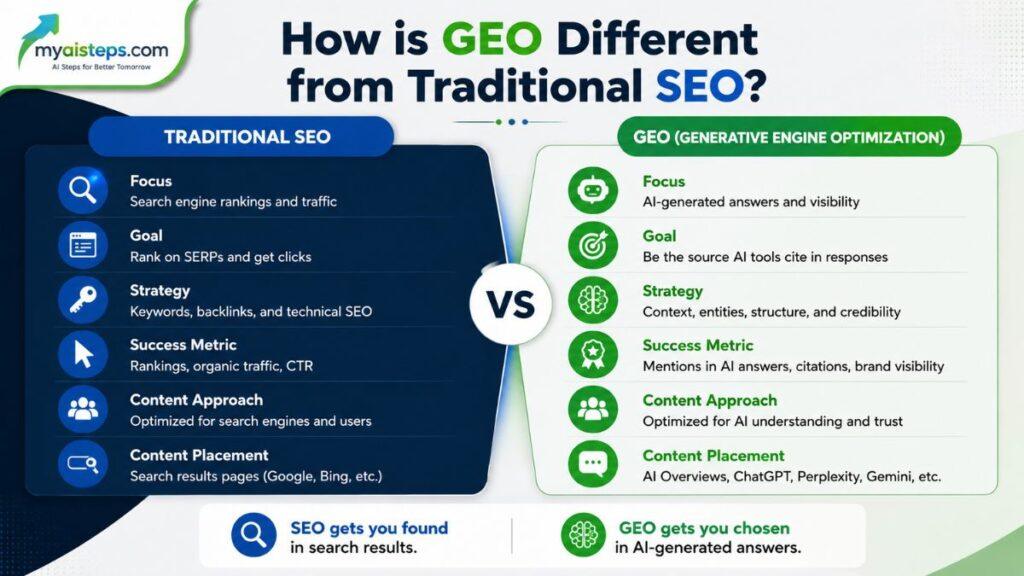
Here is the practical difference:
| Traditional SEO | Generative Engine Optimization | |
|---|---|---|
| Goal | Rank in the list of blue links | Be cited inside the AI’s answer |
| Main signal | Backlinks, keywords, page experience | Clarity, structure, citations, brand mentions |
| Where you appear | Position 1 to 10 | Named in a 2 to 7 source answer |
| Click behaviour | User clicks through to read | User often reads the answer and stops |
| How you measure | Search Console rankings and clicks | Share of answers that mention your brand |
| Best content type | Long guides, service pages | Comparisons, direct answers, third-party coverage |
Why does GEO matter now?
Because a large share of answers now happen before the click. When an AI summary sits above the results, far fewer people scroll down to the links underneath. That shifts the goal from being listed to being quoted.
There is a second half to this story that most agencies leave out, and you should know it before you spend money: AI referral traffic is still a small slice of total search traffic. Google continues to send the overwhelming majority. GEO is not replacing SEO as a traffic source.
What it does deliver is quality. Visitors arriving from AI assistants have consistently converted at higher rates than most other channels, because the assistant has already done the filtering before sending them.
So the honest framing is this: GEO is a small stream of unusually good visitors, growing quickly, and cheap to influence right now because most competitors are ignoring it. It is an early-mover advantage, not an emergency.
The numbers behind this (data as of mid-2026)
- Google’s AI Overviews appeared in roughly one in four searches.
- Pew Research recorded an 8% click-through rate when an AI summary was shown, against 15% when it was not.
- A field experiment by researchers at ISB and Carnegie Mellon measured a 38% drop in organic clicks where AI summaries appeared.
- OpenAI reported ChatGPT reaching roughly 900 million weekly active users.
- Cloudflare Radar placed ChatGPT at under 1% of all search referrals.
- Adobe Digital Insights found AI referrals converted about 31% better than non-AI traffic over a holiday shopping season.
- SimilarWeb measured ChatGPT referral traffic converting at around 7.1%, second only to paid search.
How do AI engines decide which sources to cite?
They do not simply take your query and search it. Most AI search systems break the question into several smaller sub-queries, run each one separately, gather passages from many pages, and then assemble an answer from the pieces they trust most. This is often called query fan-out.
That changes what wins. The system is not looking for the best-ranking page. It is looking for the clearest, most extractable passage that answers one narrow sub-question.
Three things influence selection more than anything else:
- Can the crawler read the page at all? Many sites accidentally block AI crawlers in robots.txt, or hide key content behind JavaScript that AI crawlers do not execute.
- Is the answer stated plainly and early? Buried answers get skipped.
- Does anyone else vouch for you? Analysis by Muck Rack found that around 84% of AI citations came from earned media rather than a brand’s own pages.
That third point is the one most businesses underestimate. Publishing more of your own content is not the strongest lever. Being written about elsewhere is.
What GEO tactics actually work?
The Princeton study that introduced the term tested specific content changes and found that citing sources, adding statistics and including quotations improved AI visibility by roughly 30 to 40% compared with unoptimised content. Those findings have held up well in practice.
Here is what that looks like in real work:
Answer first, explain second. Put a direct 40 to 60 word answer at the top of every page and under every heading. Write headings as the questions people actually ask.
Make your content machine-readable. Serve important text and numbers as plain HTML, not as JavaScript-generated content. Add Organization, Service, Article and FAQ schema. Our technical SEO work usually starts here, because a page an AI crawler cannot parse cannot be cited.
Use tables and lists. Structured comparisons are far easier for a model to extract than the same information written as flowing paragraphs.
Publish something only you have. Original data, a small survey, a breakdown of results across your own client work. Models preferentially cite sources that contain information they cannot get elsewhere.
Build brand mentions, not just backlinks. A mention of your company name in a relevant article carries weight even without a link. This is where content writing and digital PR start to matter more than classic link volume.
Get listed where the models look. For commercial questions like “best SEO agency”, AI systems frequently pull from review platforms and industry directories. Being absent from those is being absent from the answer.
Check your robots.txt. Some hosting and CDN providers now block AI crawlers by default, which means sites shut off AI access without ever choosing to.
Does GEO replace SEO?
No. GEO sits on top of SEO and depends on it. Crawlability, site speed, clean structure, internal linking and genuine authority are prerequisites for both. A site that Google cannot index properly will not be cited by an AI system either.
The right way to think about it: SEO makes your page findable, on-page SEO makes it understandable, and GEO makes it quotable.
How do you measure GEO?
There is no Search Console for AI answers, so measurement is less precise than SEO reporting. Three approaches are in common use.
Manual prompt testing. Write out 20 to 30 questions a customer might ask, run them monthly across the major AI assistants, and record how often your brand appears. This is free and surprisingly informative.
Referral tracking. Filter your analytics for traffic from AI domains. Expect the true number to be understated, because links copied from an AI chat into a new tab lose their referrer and land in “direct”.
Paid visibility tools. A category of GEO tracking platforms measures citation share across engines automatically. Useful at scale, not necessary when you are starting out.
How long does GEO take to work?
Plan for three to six months of consistent effort before you see meaningful movement, which is roughly the same horizon as SEO. Some pages get picked up faster because AI systems refresh from live web results, but brand-level recognition builds slowly.
Be sceptical of anyone promising AI visibility in weeks. The mechanics do not support it.
Frequently asked questions
Is GEO the same as AEO or LLMO?
Largely yes. Generative engine optimization, answer engine optimization (AEO) and large language model optimization (LLMO) are competing names for the same goal: getting cited by AI systems. The industry has not settled on one term.
Do I need an llms.txt file?
It is cheap to add and does no harm, but no major AI provider has confirmed using it as a ranking input. Treat it as optional housekeeping, not a priority.
Can I pay to appear in ChatGPT answers?
Not through the organic answer itself. Advertising products are appearing around AI assistants, but the cited sources inside an answer are earned, not bought.
Does GEO work for small businesses?
Often better than for large ones. Niche and local questions have far fewer competing sources, so a small site with clear, well-structured answers can be cited quickly.
What is the single fastest GEO win?
Check that AI crawlers are not blocked in your robots.txt, then rewrite your top five pages so each one opens with a direct, quotable answer.